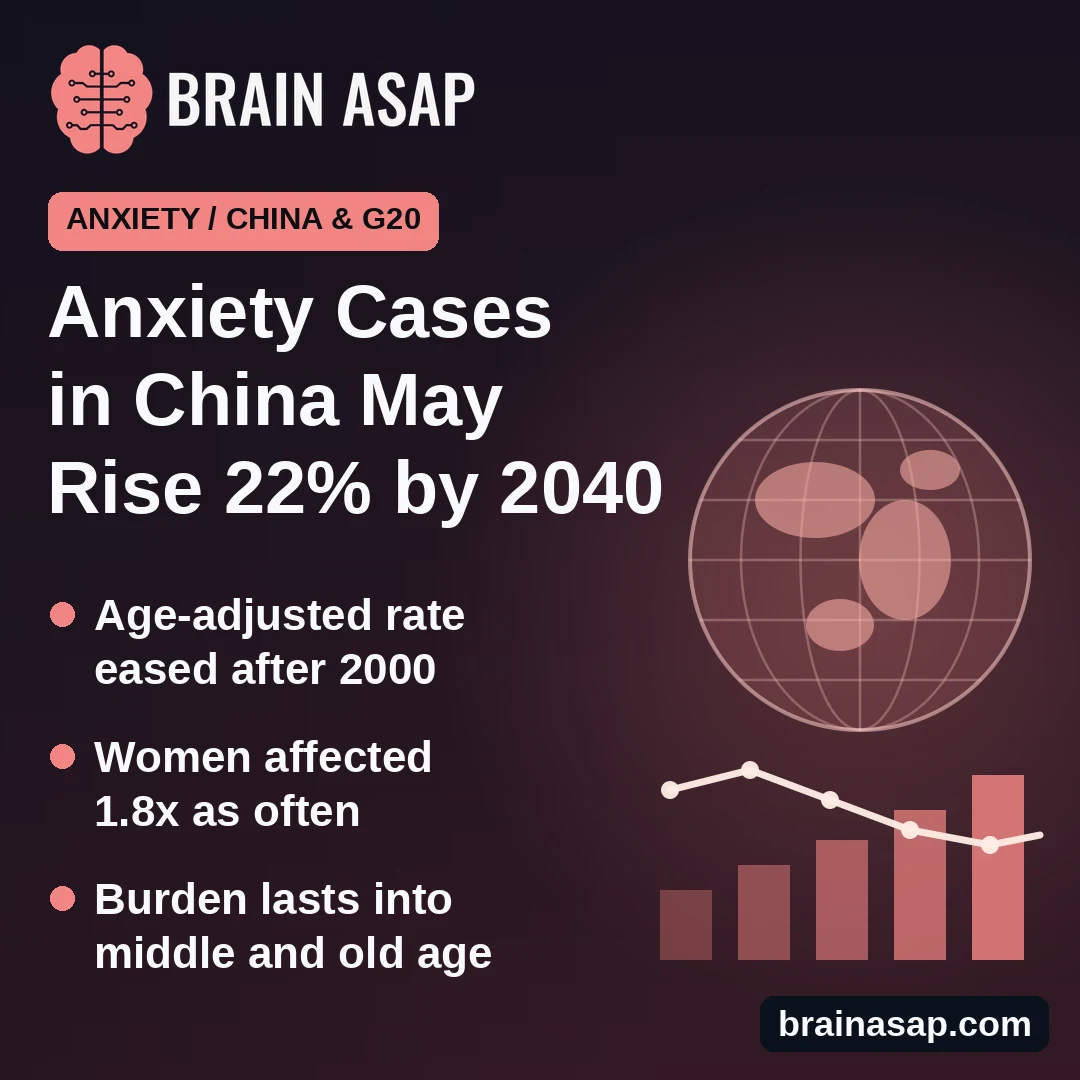
TL;DR: A 2026 study used worldwide health estimates to compare anxiety disorders in China with G20 countries from 1990 to 2021. In China, the share of people with anxiety, adjusted for age, slowly fell after 2000, but models projected about 22% more total cases by 2040 as the population changes.
Key Findings
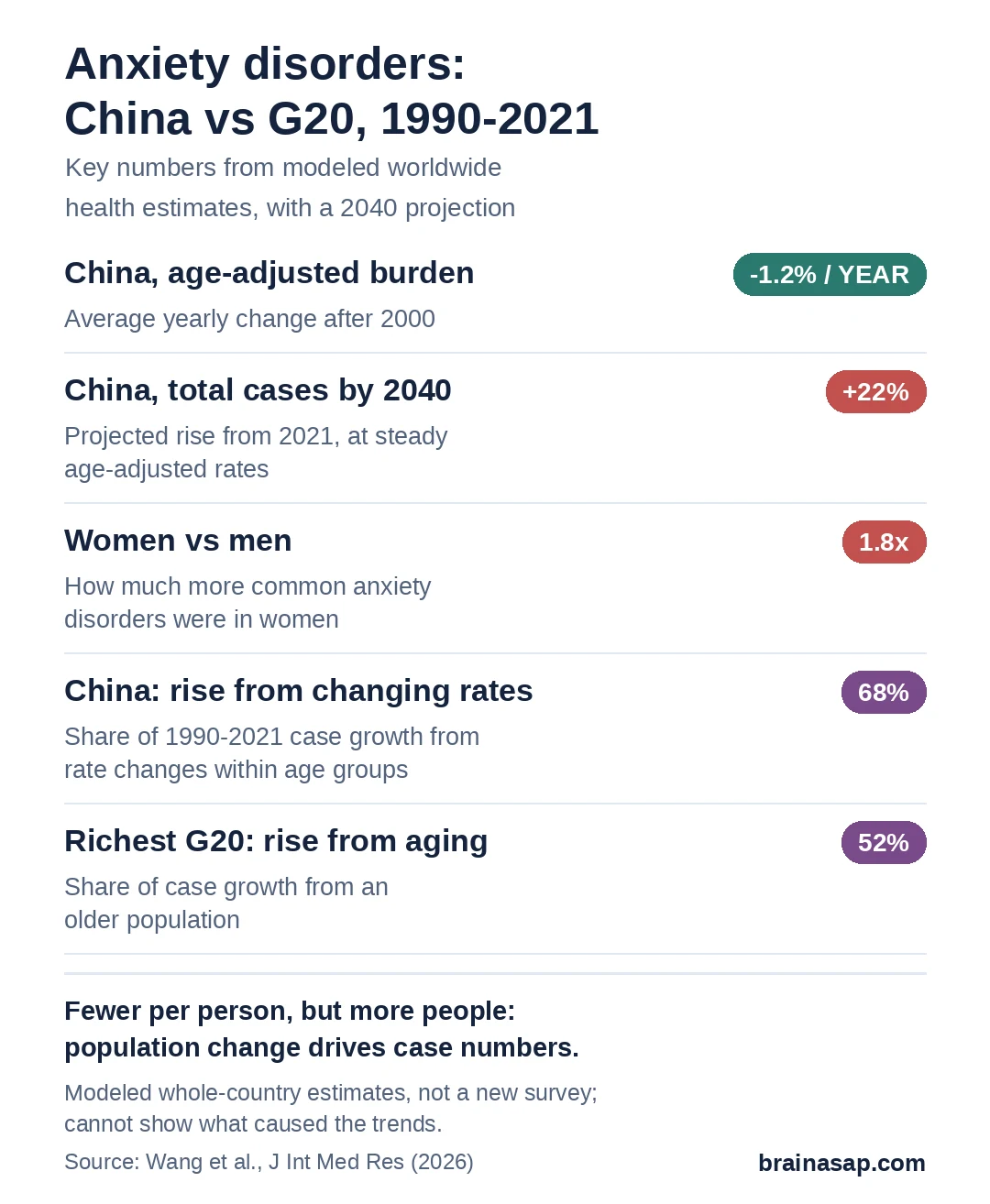
- Age-adjusted anxiety burden in China fell after 2000: by an average of about 1.2% a year, with a recent bump back up.
- More total cases ahead: forecasting models projected about 22% more people with anxiety disorders in China by 2040 than in 2021, even with steady age-adjusted rates.
- Women affected more often: anxiety disorders were about 1.8 times as common in women as in men.
- Different age pattern: in most G20 countries, anxiety peaked in people in their 20s; in China, a larger share stayed with middle-aged and older adults.
- Different drivers of growth: in China, changing rates within each age group explained 68% of the rise in cases; in the richest G20 countries, an aging population explained 52%.
Source: Journal of International Medical Research (2026) | Wang et al.
Anxiety disorders are among the most common mental health conditions in the world. The World Health Organization estimates that about 470 million people had anxiety disorders in 2023.
But a country's anxiety numbers can go up for very different reasons: more people, an older population, or a real change in how often people develop anxiety.
A 2026 study in the Journal of International Medical Research tried to separate those reasons for China and compare them with the Group of Twenty (G20).
Where Did the Anxiety Numbers Come From?
Researchers at Chuzhou City Vocational College and a Chuzhou hospital in China did not survey anyone new. They used the Global Burden of Disease Study 2021, a large project that combines surveys, records and statistical models into estimates for 204 countries.
From that database, they pulled yearly figures for 1990 to 2021 on:
- Prevalence: how many people were living with an anxiety disorder
- Incidence: how many new cases started each year
- Disability-adjusted life years: a combined measure of healthy years lost to the condition
Many of these numbers were age-standardized. That adjusts for how old a population is, so a country with many older people can be compared fairly with a younger one.
Did Anxiety in China Go Down or Up?
Both, depending on what you count.
China's age-adjusted anxiety burden dropped after 2000, by about 1.2% a year on average, with a recent rebound. Among G20 countries and regions, China showed the slowest yearly change in this measure over the full period.
Across the G20 as a whole, age-adjusted rates stayed roughly flat while the total number of cases kept climbing.
Looking forward, 2 forecasting models projected about 22% more total anxiety cases in China by 2040 than in 2021, even though age-adjusted rates were expected to stay stable. A lower rate in a large, changing population can still mean more people affected.
Who Carried More of the Anxiety Burden?
Women did, both in China and across the G20. Anxiety disorders were about 1.8 times as common in women as in men.
Age told a different story in China than elsewhere:
- Most G20 countries: anxiety rose sharply in the teen years, peaked between ages 20 and 30, then declined with age.
- China: a relatively larger share of the burden stayed with middle-aged and older adults.
One more surprise: among middle-aged and older people in China, new cases appeared more often in men than in women. Wang and colleagues suggested stresses specific to that generation, such as job competition and caregiving duties, but the data could not test this.
Across G20 regions, prevalence was highest in Tropical Latin America and lowest in Central Asia, and wealthier regions tended to have higher prevalence than poorer ones.
Why Were Case Numbers Growing in Each Place?
Researchers split the change in case numbers from 1990 to 2021 into 3 parts: population growth, population aging, and changes in how often each age group had anxiety.
- China: changing rates within age groups explained about 68% of the rise, followed by population growth. Aging played only a small part.
- Highest-income G20 countries: population aging was the biggest driver, at about 52% of the rise.
- Lowest-income G20 countries: population growth was the main driver.
That "changing rates" part is a catch-all. It can reflect real changes in risk, but also changes in diagnosis, survey methods or how cases are coded.
What These Estimates Can't Show
- Modeled, not measured: Global Burden of Disease figures are statistical estimates for whole countries, not a new count of patients.
- Cause can't be assigned: the authors stressed that China's decline after 2000 should not be credited to any specific policy, economic growth or health education.
- Likely undercounting: stigma and limited diagnosis, especially in rural China, may hide many cases.
- All anxiety types lumped together: generalized anxiety, phobias and others may follow different trends.
- Forecasts assume no shocks: pandemics, recessions or major health reforms could change the 2040 picture.
- Some figures shown only in charts: many comparisons were reported as graphs without exact numbers or uncertainty ranges in the text.
Planning for More People With Anxiety, Even at Steady Rates
For readers, the clearest point is simple: a falling or flat anxiety rate does not mean fewer people need help. In China, population changes alone could push the number of people with anxiety disorders up by about a fifth over the next 2 decades.
A key open question is why China's pattern differs, especially the heavier burden in middle-aged and older adults. Studies that follow real individuals, and separate anxiety types, would be needed to answer it.
Citation: DOI: 10.1177/03000605261485098. Wang Y, Wang W, Liu X, Zhou M, Gu R, Lv F. Anxiety disorders in China and G20 countries: A comparative burden study. Journal of International Medical Research. 2026;54(9):03000605261485098.
Study Design: Ecological secondary analysis of Global Burden of Disease Study 2021 estimates (1990–2021) for China and G20 countries; average annual percentage change, demographic decomposition, ARIMA and Bayesian age–period–cohort projections.
Sample Size: Aggregated modeled estimates for China and G20 member countries; no individual participants.
Key Statistic: China age-standardized burden AAPC −1.2% after 2000; female-to-male prevalence ratio 1.8; epidemiological change 68% of China's case increase; aging 52% of increase in high-SDI G20; China total cases projected +22% by 2040.
Caveat: Modeled aggregate data; ecological design cannot attribute trends to policies; possible underdiagnosis; anxiety subtypes combined; projections assume past trends continue.