TL;DR: In a 2026 study, researchers interviewed 24 Chinese parents of children with autism about watching short autism videos on apps like Douyin, China's version of TikTok. Parents said the videos taught them practical skills and gave them hope, but endless recommendations, polished success stories and paid-course pitches also left them anxious and doubting themselves.
Key Findings
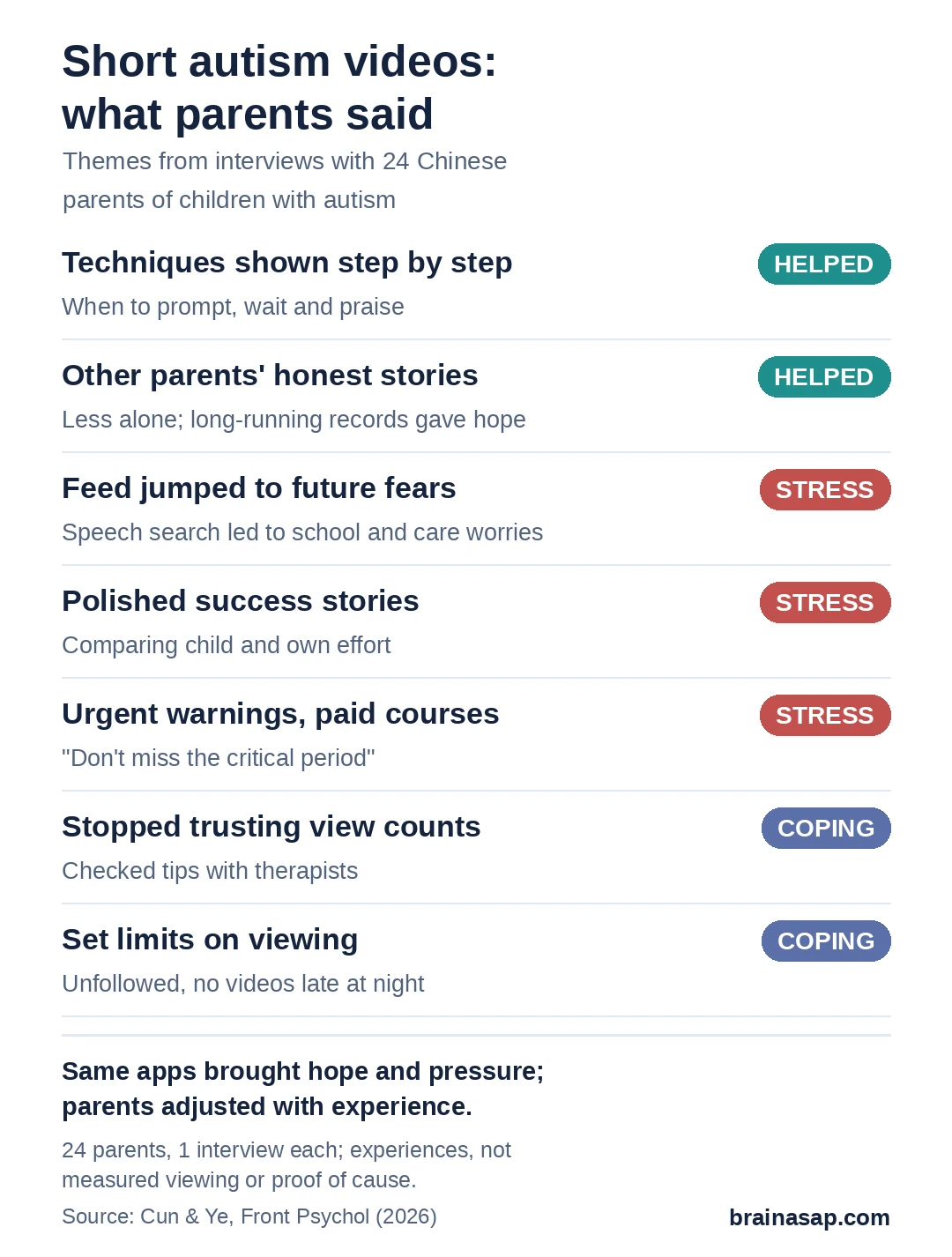
- Seeing it beat reading it: parents said demonstration videos showed them exactly when to prompt, wait and praise their child, which written advice hadn't.
- Honest stories gave the most hope: parents trusted videos that followed one family for years, setbacks included, more than dramatic before-and-after clips.
- Recommendations fed future fears: a search about a toddler's speech could lead to an app feed full of videos about school rejection and lifelong care.
- Success stories invited comparison: seeing a same-age child chatting made some parents feel their own child, and their own effort, fell short.
- Parents learned to set limits: over time, many stopped trusting view counts, avoided autism videos at night and compared their child mainly with their own past progress.
Source: Frontiers in Psychology (2026) | Cun & Ye
After a child's autism diagnosis, many parents turn to their phones. Short video apps promise quick answers, real families and expert tips, all a thumb-swipe away.
But the same feed that shows a helpful technique can also show a frightening future or a miracle cure for sale.
A 2026 study in Frontiers in Psychology, by researchers at Yunnan University of Finance and Economics in China and Assumption University in Thailand, asked parents what that mix actually feels like.
Who Were the Parents in the Interviews?
Cun and Ye recruited parents through autism therapy and family support groups in 4 Chinese provinces, plus ads on social media. Each parent:
- had a child with a clinician's autism diagnosis
- was mainly responsible for the child's daily care and therapy decisions
- had watched autism-related short videos in the past year
In all, 24 parents from 24 families took part: 13 mothers and 11 fathers, aged 29 to 48. Their children were 4 to 15 years old, and 22 of 24 were boys. Most used Douyin, WeChat Channels, Xiaohongshu or Kuaishou.
Each parent did one interview lasting about an hour. Researchers then looked for shared themes across the conversations.
How Did Short Videos Help Parents?
Parents described 4 kinds of help:
- Seeing techniques done: one mother said she understood terms like "prompt, wait and reinforce" but not how to do them, until videos showed when to speak, when to stop and how long to wait.
- Understanding behavior: another mother said a video simulating sensory overload helped her see her child's ear-covering as real discomfort, not disobedience.
- Finding resources: app suggestions pointed some parents to subsidies, school information and parent training they hadn't known to look for.
- Feeling less alone: a mother said hearing another parent admit to losing her temper made her realize "one breakdown did not mean I was a bad mother."
Parents placed the most trust in long-running accounts that followed one child for years, slow progress and setbacks included. That kind of honest record gave them a more believable reason for hope than a dramatic success clip.
Where Did the Anxiety Come From?
Those same features could also hurt:
- Advice without context: short clips rarely said which children or ages a technique was meant for. Conflicting tips left one mother feeling "either choice could be wrong."
- A feed that runs ahead: one parent searched how to teach her child to respond to his name. Her feed then filled with videos about older children who couldn't attend school. "Those issues are still far away from us," she said, "but watching them repeatedly made me afraid in advance."
- Comparison: seeing a same-age child having conversations made one mother feel "we had fallen too far behind." Some parents also judged their own effort against videos of endlessly patient caregivers.
- Urgent warnings: phrases like "Do not miss the critical period," often set to tense music, pushed parents to keep doing more.
- Sales pitches: some parent creators built trust, then sold courses or products. One father bought a course from someone who had "walked the same path"; when it didn't work, he first blamed himself.
Autoplay and endless scrolling made it hard to stop, and some parents kept watching late at night despite feeling worse.
How Did Parents Learn to Cope?
With experience, many parents changed how they watched:
- Doubting popularity: one father realized a topic kept showing up "simply because I had spent more time watching that type of video," not because it was correct.
- Setting limits: parents unfollowed accounts that raised their anxiety, and one father stopped watching autism videos after 10 p.m.
- Changing the yardstick: one mother said she now compares her child with how he was doing a few months ago, not with children in videos.
- Checking with professionals: parents increasingly weighed online tips against their therapists' advice and their own child's needs.
What These Interviews Can't Tell Us
- Small, self-selected group: 24 parents, mostly found through therapy organizations and social media, in one country.
- Memories, not measurements: no one's actual viewing time or app feed was recorded.
- One conversation each: changes over time were described looking back, not followed as they happened.
- No cause shown: the study can't say the apps made parents more anxious, only how parents experienced them.
- Parents only: children, therapists and video creators weren't interviewed, and apps weren't compared with each other.
Helping Parents Use Autism Videos Without the Extra Worry
For parents scrolling through autism content, these interviews point to a few reasonable habits: favor accounts that show the whole journey, be wary of urgent warnings and paid fixes, and check new techniques with your child's care team.
Cun and Ye also called on apps to show creators' qualifications and paid partnerships more clearly. Whether those changes would ease parents' stress is a question for future studies that track real viewing over time.
Citation: DOI: 10.3389/fpsyg.2026.1952061. Cun Z, Ye Y. Scrolling into hope and anxiety: a qualitative study of how short-video platforms shape psychological adjustment among Chinese parents of children with autism. Frontiers in Psychology. 2026;17:1952061.
Study Design: Exploratory qualitative study; purposive and snowball sampling; single semi-structured interviews (45–75 min, mean ~58 min); Braun and Clarke thematic analysis informed by social support and social comparison theories.
Sample Size: 24 parents (13 mothers, 11 fathers) from 24 families; children aged 4–15 (22 boys, 2 girls).
Key Statistic: 3 themes and 12 subthemes: support shaped by content form, source and credibility; psychological pressure from decontextualized advice, recommendation loops, selective success stories, urgency framing and commercial promotion; recalibration of credibility, emotional and comparison boundaries.
Caveat: Small purposive sample; retrospective self-report; no objective platform-use data; no cross-platform comparison; parents' perspectives only; cannot establish that platforms cause anxiety.