TL;DR: In 4 American elementary schools, 30 autistic students wore a finger-ring sensor that tracked heart rhythm, skin sweat and movement during the school day for 4 weeks. In a test using the recordings, a computer model correctly classified about 85% of 30-second windows as occurring within five minutes before an observed episode or outside that period. The researchers did not test live alerts.
Key Findings
- Body signs shifted before outbursts: In the 5 minutes before an observed episode, heart rhythms were less variable, skin conductance rose more, and movement varied more than in the comparison windows.
- Best model about 85% accurate: A type of computer model that reads patterns over time sorted short recording slices into "before an episode" or "calmer time" correctly 85% of the time, compared with 81% and 79% for 2 simpler models.
- New students too: When trained on all students but one and tested on the student left out, the best model was still right about 83% of the time.
- Heart and sweat mattered most: Heart rhythm and skin sweat were the strongest clues, and adding movement helped further.
- Not a live test: All results came from analyzing recordings afterward, so it's unknown whether real-time alerts would help teachers or students.
Source: Frontiers in Psychiatry (2026) | Lamb, Owens and colleagues
In a busy classroom, the first signs that a student needs support can be difficult to recognize.
For some autistic children, the stress building up beforehand is hard to spot from the outside, especially for kids who can't easily say how they feel. A body sensor might pick up that stress earlier.
What Did Students Wear?
A 2026 study in Frontiers in Psychiatry, led by researchers at the University of Georgia with colleagues at East Carolina University and Emory University, followed 30 autistic students aged 6 to 14 in four rural public elementary schools in the northeastern United States. Participants had a history of escalating distress and were able to wear the sensor.
Each student wore a small research ring on one finger from 9:00 AM to 3:30 PM every school day for 4 weeks. This ring recorded 4 kinds of signals:
- Heart rhythm variability: how much the time between heartbeats changes, which tends to drop under stress
- Skin sweat: tiny changes in how well skin carries electricity, which rise with stress or excitement
- Skin temperature: fingers can cool slightly under stress as blood vessels narrow
- Movement: how much and how unevenly the hand moved
All 30 students wore the ring through the study. Four needed some breaks or adjustments, which left gaps in their data.
What Counted as an Outburst?
Trained observers in the classroom logged every episode of rising distress, which researchers called "behavioral escalation," with the exact time. Episodes ranged from mild to severe:
- Mild: fidgeting, rocking or hand-flapping, louder vocal sounds, avoiding a task
- Moderate: shouting, pacing, refusing a task with strong emotion
- Severe: hitting or kicking, self-injury, breaking things, running away
Observers logged 200 episodes in all. Mild agitation (24%) and repetitive movements (18%) were most common; aggression (9%), self-injury (8%) and running away (5%) were less common.
Researchers divided the recordings into 30-second slices that overlapped by half. They labeled slices within five minutes before a logged episode as "before an episode" and used slices outside that period for comparison.
Did Body Signals Change Before Episodes?
On average, they did. Compared with calmer times, the 5 minutes before an episode showed:
- Heart rhythm: less variable, about 25 vs. 37 milliseconds on a standard measure
- Skin sweat: spikes about twice as large
- Movement: about 60% more variable
- Skin temperature: slightly lower, 30.8°C vs. 31.3°C
One student's recording, shown in the paper, had heart rhythm beginning to fall and sweat beginning to rise about 5 minutes before an episode.
How Well Did the Computer Models Do?
Next, 3 kinds of computer models were trained on 70% of the recording slices and tested them on the other 30%. Best of the 3 was a model designed to follow how signals change over time, known as an LSTM network.
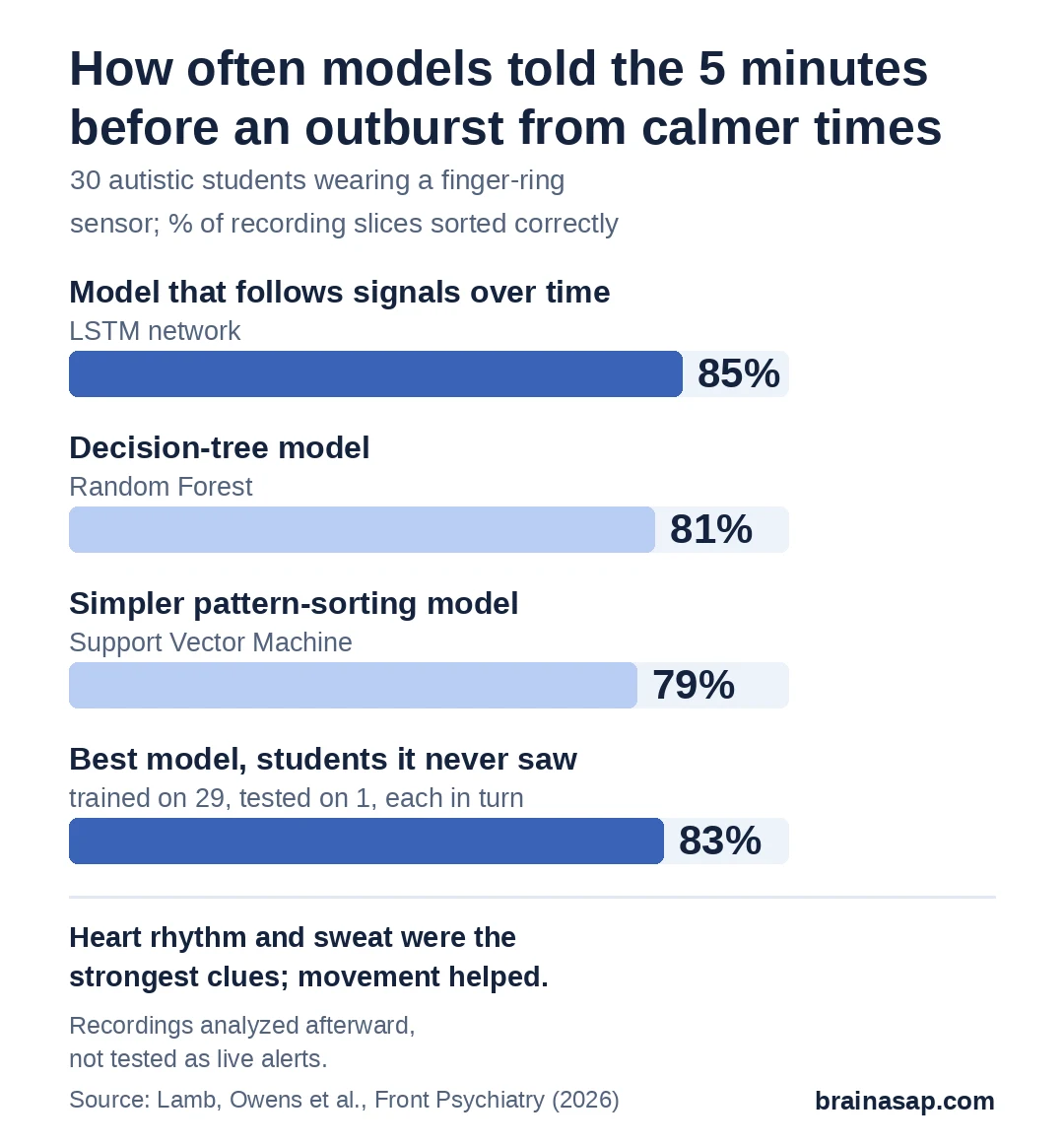
On the held-back slices, the best model was right 85% of the time and caught about 87% of the slices that came before an episode. When it flagged a slice as "before an episode," it was right about 84% of the time.
Could it work for a student it had never seen? In a second check, the model was trained on 29 students and tested it on the 30th, repeating this for every student. It averaged about 83% accuracy, only a little lower.
Removing signals showed what mattered most. Using heart rhythm and sweat alone, the best model scored 81% on a measure that balances catching episodes against false alarms. Adding movement raised that score to 85%, and adding skin temperature barely changed it.
Why Is This Still Early?
- No live alerts yet: models were tested on recordings afterward, so nobody knows if teachers would get warnings in time or act on them
- Built-in time window: "before an episode" was defined as the 5 minutes before a logged event, so the 2- to 5-minute warning partly reflects that choice
- Same students in training and testing: the main test used the same students as training. Because adjacent slices overlapped, training and test sets could share some of the same recordings, making the accuracy look better
- Small and local: 30 students in 4 rural schools in one region, with only 1 non-speaking student
- Missing detail: the paper doesn't report how many slices were analyzed or how often false alarms would come up across a full school day
Could a Ring Help Teachers Step In Sooner?
One hope is that a quiet alert could prompt a teacher to offer a sensory break or a calm space a few minutes before a student reaches crisis. Lamb and colleagues said such alerts should support, not replace, a teacher's judgment, and should never be used to label or punish students.
An open question is whether real-time alerts in a busy classroom would actually prevent episodes, without so many false alarms that teachers start ignoring them.
Citation: DOI: 10.3389/fpsyt.2026.1850879. Lamb R, Owens T, Choi I, Kundu S, Nookkarapu S, Ray P, Kavner A. Predicting behavioral escalation in students with autism using physiological and movement data. Frontiers in Psychiatry. 2026;17:1850879. PMID: 43005425. Full text: PMC13746157.
Study Design: Observational study with wearable ring sensors over 4 school weeks; retrospective machine-learning classification (Random Forest, SVM, LSTM) of 30-second windows as pre-escalation (within 5 minutes before an observed event) vs. non-escalation; 70/30 split and leave-one-subject-out validation.
Sample Size: 30 autistic students aged 6 to 14; 200 observed escalation events.
Key Statistic: LSTM accuracy 85.2%, recall 86.5%, precision 83.7%, AUC 0.90; leave-one-subject-out accuracy about 82.6%.
Caveat: Retrospective only, not tested as a live system; prediction window partly set by the labeling rule; random split of overlapping windows and a small regional sample. The indexed abstract and original journal methods and results were reviewed.