TL;DR: Scanning 8 people during hours of real conversation, Japanese researchers found that speaking and listening share some brain patterns for words and sentences. But when speaking, brain activity best matched the last few seconds of talk, while listening matched much longer stretches.
Key Findings
- 8 people, about 3 hours each: Free conversation inside an MRI scanner.
- Shared codes: Speaking and listening used overlapping patterns for words and single sentences.
- Speaking favored short context: About 1 to 4 seconds.
- Listening favored long context: About 16 to 32 seconds.
- AI as a measuring tool: A GPT language model turned the talk into numbers.
Source: Nature Human Behaviour (2025) | Yamashita et al.
Most brain studies of language have people listen to stories or read sentences alone in a scanner. Real conversation is different: we switch between talking and listening every few seconds, and meaning builds up across the exchange.
This study from Osaka, Japan, looked at the brain during actual back-and-forth talk, and asked which lengths of preceding context best matched brain activity.
Real Conversations Inside a Scanner
Eight native Japanese speakers chatted with an experimenter about 27 everyday topics while lying in an MRI scanner. Each conversation lasted about 7 minutes, adding up to roughly 3 hours of data per person.
The researchers transcribed every word and fed it through a GPT language model. The model turned each moment of talk into a set of numbers describing its meaning, using different amounts of preceding context: 1, 2, 4, 8, 16 or 32 seconds. They then tested which version best predicted each person's brain activity on conversations the model had not seen.
Speaking and Listening Share Word-Level Codes
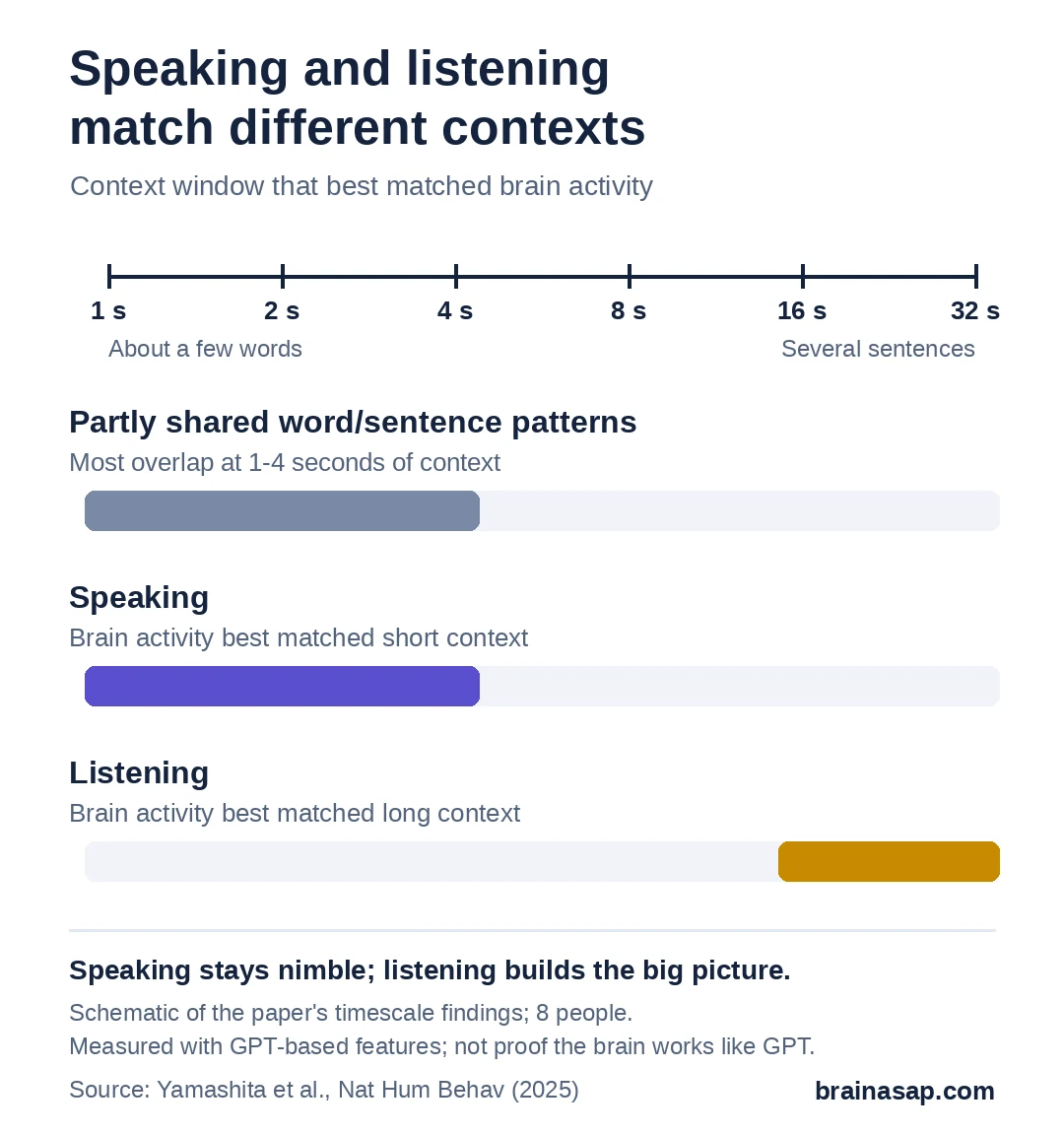
When the researchers trained a model on speaking and tested it on listening, or the reverse, it still predicted brain activity in many areas. That overlap was strongest for short context, the length of a few words or one sentence, and mainly in known language regions.
In other words, the brain seems to use a common vocabulary of meaning whether it is producing words or taking them in.
Listening Takes a Longer View
Beyond the shared codes, speaking and listening diverged:
- Speaking: Brain activity best matched short context, about 1 to 4 seconds.
- Listening: Brain activity best matched long context, about 16 to 32 seconds.
The authors' explanation fits everyday experience. When you talk, you are busy planning the next words and reacting to your partner in the moment. When you listen, you are piecing together what they mean from everything said so far, like following a friend's story to its point.
Eight People and an AI Yardstick
- Small sample: 8 people, though each gave hours of data.
- One language: All spoke Japanese with an experimenter, not friends.
- AI as a tool: Matching GPT features does not mean the brain works like GPT.
- No region-mapping tasks: Areas could not be precisely assigned to known brain networks.
- Published 2025: Online in June 2025, in the October 2025 issue.
Conversation Runs on Two Clocks
This is basic science, not a therapy. But it suggests a useful picture of talk: a shared code for words, a fast clock for speaking and a slower one for listening.
The open question is whether these clocks run differently in people who struggle with conversation, such as after a stroke or in some developmental conditions, which future studies could test.
Citation: DOI: 10.1038/s41562-025-02231-4. Yamashita M, Kubo R, Nishimoto S. Conversational content is organized across multiple timescales in the brain. Nat Hum Behav. 2025;9:2066-2078.
Study Design: fMRI during spontaneous conversation with voxel-wise encoding models using GPT contextual embeddings (1-32 s context).
Sample Size: 8 participants; ~3 hours each (27 runs).
Key Statistic: Production explained more variance at 1-4 s context; comprehension at 16-32 s.
Caveat: Small sample; one language; no functional localizers; model-based features.