TL;DR: In 8 healthy beagles, kratom capsules raised pain thresholds only modestly, and less consistently than the opioid buprenorphine. Kratom caused far less sedation, but the study was small and did not test pain relief in sick animals or people.
Key Findings
- Opioid worked best: 7 of 8 dogs on buprenorphine showed meaningful threshold rises on pressure, heat and electrical tests.
- Kratom was weaker on pressure and heat: 3 of 8 dogs had meaningful rises on each.
- Electrical test was unclear: Kratom matched the opioid, but most dogs on placebo also responded.
- Far less sedation: Average sedation score 0.75 on kratom vs 4.00 on buprenorphine, out of 12.
- Few side effects on kratom: Vocalizing in 2 dogs, soft stool in 1; blood tests stayed normal.
Source: Frontiers in Pharmacology (2026) | Maxwell et al.
Kratom, a leaf from a Southeast Asian tree, is used by an estimated 10 million or more people in the United States, often for pain. Yet there is little controlled evidence that it actually dulls pain.
A University of Florida team turned to dogs, whose pain pathways and opioid receptors resemble ours, to get a first measured look.
Three Treatments, Same Eight Dogs
The study used 8 healthy, spayed female beagles aged 5 to 6. Each dog received all three treatments in random order, with at least a week between them:
- Kratom: Capsules of a standardized kratom extract by mouth, about 1 mg of mitragynine (kratom's main active compound) per kg, given 3 times, 8 hours apart.
- Buprenorphine: A standard opioid pain injection used in dogs.
- Placebo: Dummy capsules.
Before dosing and for 8 hours after, researchers measured how much pressure on a leg, heat on the back, or mild electrical current on a paw it took before each dog pulled away or turned to look. A higher threshold suggests less pain sensitivity. The testers did not know which treatment each dog had received.
The Opioid Raised Pain Thresholds Most
To count as a real change, a rise had to beat the normal test-to-test wobble. By that measure, buprenorphine raised thresholds in 7 of 8 dogs on every test.
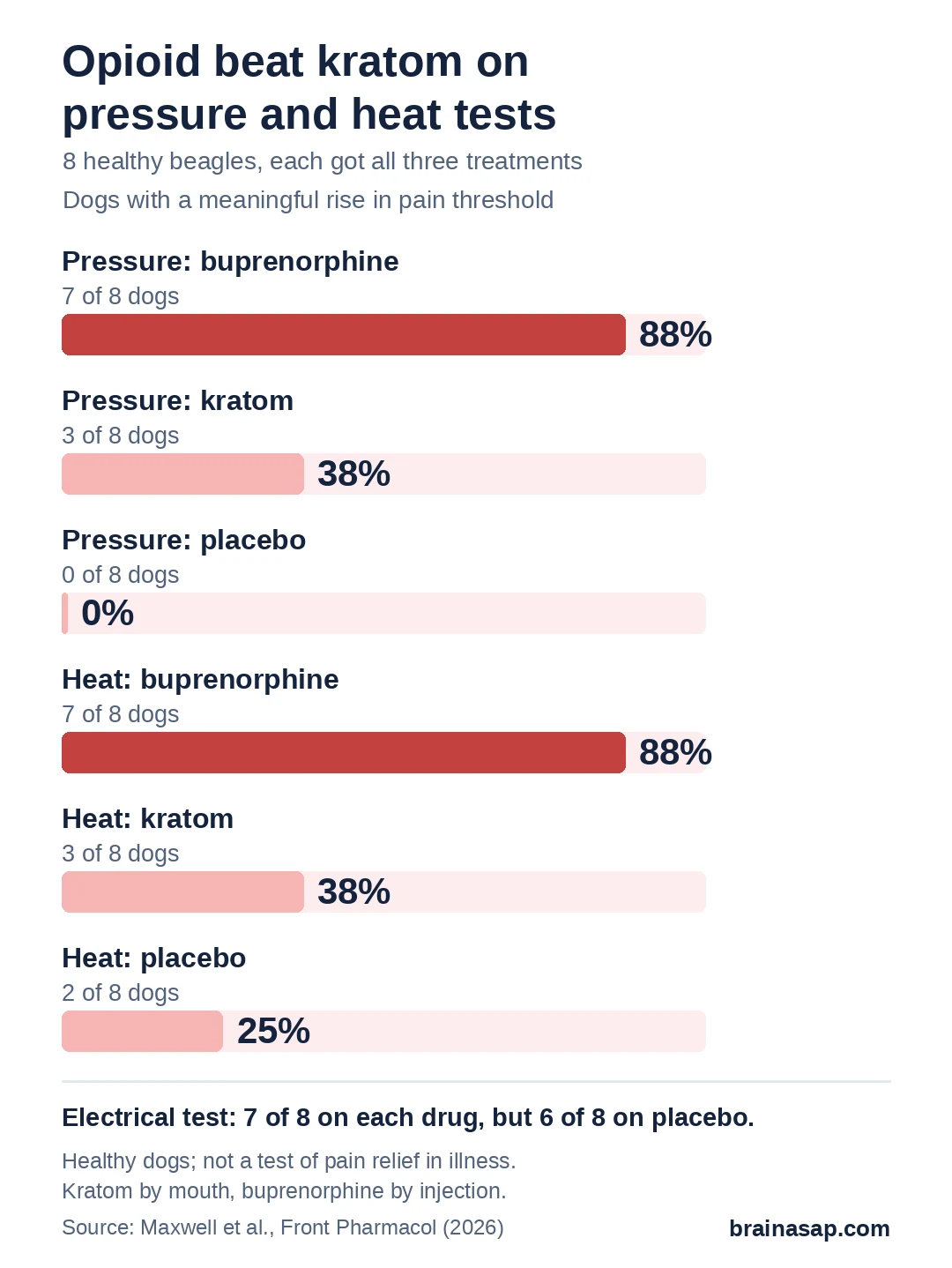
Kratom's effects were smaller. On the pressure test, kratom's average peak rise was 2.3 newtons, compared with 7.2 for buprenorphine and 0.8 for placebo. That kratom-placebo difference held up statistically. On the heat test, kratom did not differ significantly from placebo.
A Tie on the Electrical Test Comes With a Catch
On the electrical test, kratom and buprenorphine looked similar, with 7 of 8 dogs responding to each. But 6 of 8 dogs on placebo crossed the same line, and kratom's within-dog difference from placebo was not statistically significant.
The authors suggest kratom may act more on how the nervous system processes signals than on pain-sensing nerve endings. They call this idea hypothesis-generating.
Calm Dogs, Not Sleepy Ones
Buprenorphine made dogs noticeably drowsy. All 8 had at least one side effect, including drooling (8 of 8), vocalizing (6), sleepiness (5) and trembling (4). Some of its threshold rise faded once the researchers accounted for sedation.
Kratom's effects were milder. Two dogs vocalized, one had brief soft stool, and a few seemed calmer or more sociable. Blood counts and chemistry stayed normal for all treatments. Mitragynine peaked in the blood about 2.4 hours after the third dose and had a half-life of about 18.7 hours.
Eight Healthy Dogs Can Only Say So Much
- Tiny sample: 8 dogs; too few to detect small effects, especially for heat.
- No real pain: Healthy dogs, short tests; not dogs or people with chronic pain.
- One sex, one breed: Spayed female beagles only.
- Blinding may have slipped: Buprenorphine's obvious sedation could have tipped off observers.
- Different routes: Kratom by mouth, buprenorphine by injection.
- One product, one dose: A standardized extract, not the varied kratom products sold in stores.
The work was partly funded by the U.S. National Institute on Drug Abuse.
Kratom Needs Testing in Real Pain
These results do not support kratom as a reliable painkiller for dogs or people, and owners should not give it to pets. They do show a measurable but modest effect with little sedation, which makes a case for careful studies in dogs with naturally occurring pain.
The key open question is whether higher or longer dosing produces clear pain relief without the side effects that come with opioids.
Citation: DOI: 10.3389/fphar.2026.1895945. Maxwell EA, Hardison A, Moura RA, et al. Exploratory evaluation of encapsulated kratom using multimodal quantitative sensory testing in dogs. Front Pharmacol. 2026;17:1895945.
Study Design: Blinded, randomized, three-phase crossover study with quantitative sensory testing (pressure, heat, electrical).
Sample Size: 8 healthy spayed female beagles.
Key Statistic: Meaningful threshold rise in 3 of 8 dogs on kratom vs 7 of 8 on buprenorphine for pressure and heat.
Caveat: Exploratory; healthy animals; tiny sample; kratom oral vs buprenorphine injected.