TL;DR: Researchers gave mice with diabetes-related nerve pain a signaling molecule that nerve cells make naturally, then tested how they reacted to touch, heat and cold. Treated mice were less sensitive to pain and walked better, even though their blood sugar stayed high.
Key Findings
- Lower in patients with nerve pain: people with diabetic nerve pain had lower blood levels of PACAP than people with diabetes but no nerve pain.
- Less pain in treated mice: diabetic mice given PACAP flinched less from light touch, heat and cold than untreated diabetic mice, and their walking improved.
- Blood sugar barely moved: PACAP did not clearly lower fasting blood sugar or repair insulin-making cells, even though the mice showed less hypersensitivity.
- Cell power plants protected: PACAP helped keep mitochondria, the energy units inside pain-sensing nerve cells, in better shape, and blocking one signaling step weakened both that protection and the pain relief.
Source: Neurotherapeutics (2026) | Di Cao, Wuping Sun and colleagues, Shenzhen Nanshan People's Hospital and Jinan University
Burning, tingling or stabbing pain in the feet is one of the most common and stubborn complications of diabetes. Managing blood sugar remains important, and nerve pain can persist.
A 2026 study in Neurotherapeutics looked at a molecule the body already makes, to see whether it could reduce signs of nerve pain in a mouse model.
What Is PACAP?
PACAP (pituitary adenylate cyclase-activating polypeptide) is a small protein that nerve cells and other tissues release as a signal. Earlier research linked it to protecting nerve cells and to regulating metabolism, but its role in diabetic nerve pain was unclear.
Work began with people. Patients with diabetic nerve pain had lower blood levels of PACAP and higher levels of inflammatory signals than patients with diabetes who did not have nerve pain.
That is a link, not proof that low PACAP causes the pain. It gave the team a reason to test PACAP in animals.
How the Mouse Experiments Worked
Mice were given streptozotocin, a drug that destroys insulin-making cells, to cause diabetes. Over time these mice develop nerve damage and become oversensitive to touch and temperature, similar to diabetic nerve pain in people.
Diabetic mice treated with PACAP were compared with untreated diabetic mice on:
- Pain sensitivity: reactions to light touch, heat and cold on the paws
- Walking: gait analysis of how the mice moved
- Nerve fibers: counts of fine nerve endings in the skin, which are lost as diabetic nerve damage progresses
- Diabetes measures: weight, fasting blood sugar, glucose tolerance and damage to insulin-making cells
Pain Eased While Blood Sugar Stayed High
PACAP-treated mice were less sensitive to touch, heat and cold, walked better and kept more nerve fibers in their skin than untreated diabetic mice.
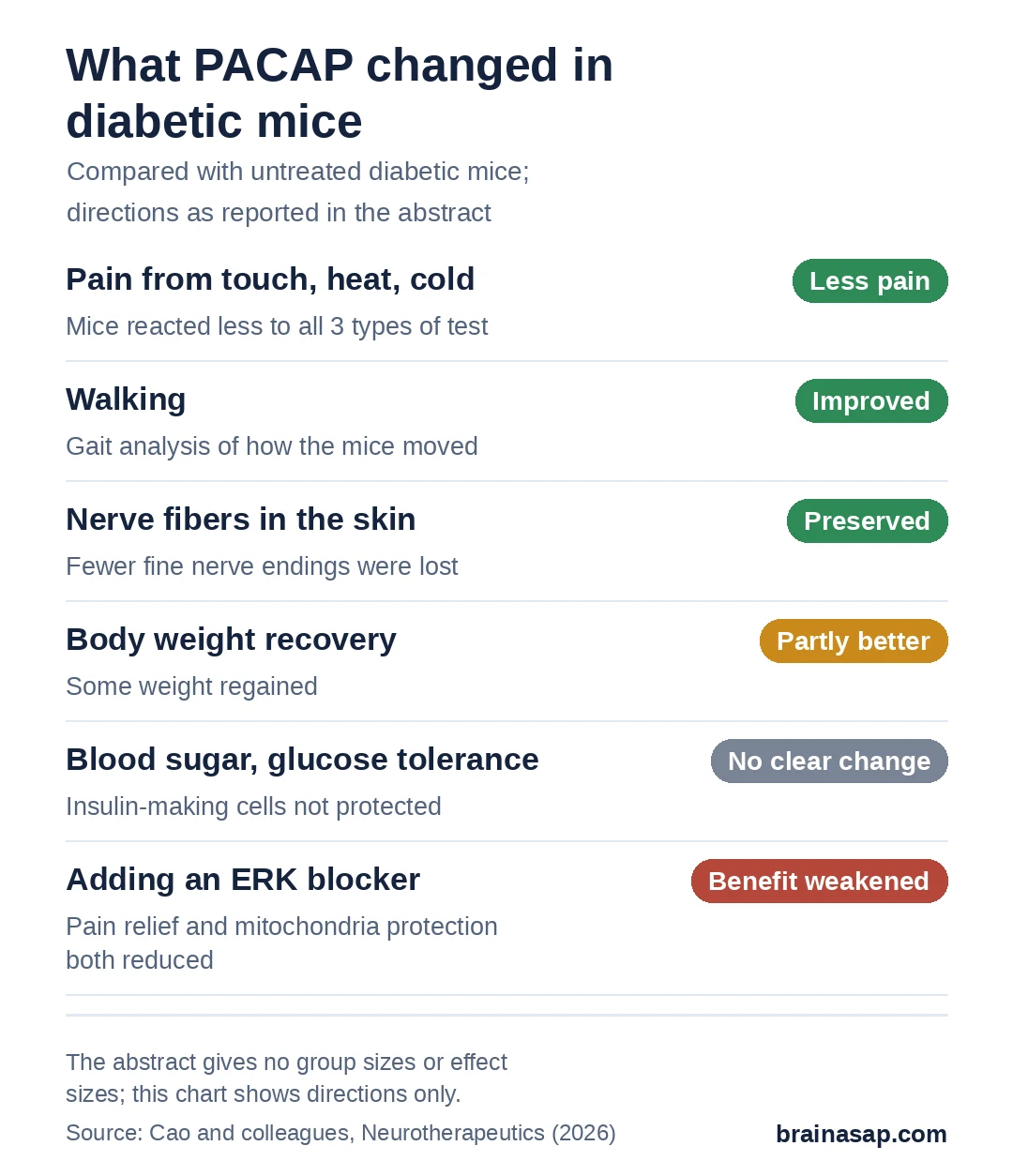
Diabetes itself changed little. PACAP partly helped the mice regain weight, but it did not markedly lower fasting blood sugar, improve glucose tolerance or protect insulin-making cells.
That combination matters: the mice showed less hypersensitivity even though their fasting blood sugar did not markedly improve.
What PACAP Did Inside Nerve Cells
Researchers next looked at the dorsal root ganglia, clusters of pain-sensing nerve cells next to the spinal cord. In diabetic mice, the researchers reported changes associated with blood vessel dysfunction, low-oxygen signaling, and stressed mitochondria (the cell's energy producers).
PACAP partly shifted those patterns. It increased a marker of ERK signaling and raised PGC1α, a protein that tells cells to build new mitochondria. Treated nerve cells had healthier-looking mitochondria and better electrical charge across their mitochondrial membranes.
To test whether ERK mattered, the team gave mice a drug that blocks it (U0126). With ERK blocked, PACAP lost much of its protective effect on mitochondria and much of its pain relief.
Why This Is Still Early
- Mice only: the treatment was tested in a drug-induced model of type 1-like diabetes, not in people or in type 2 diabetes
- Abstract only: this article is based on the published abstract, which gives no group sizes, effect sizes, PACAP dose or how it was given
- Patient data unclear: the abstract does not say how many patients had PACAP measured
- Partial pathway: blocking ERK weakened the benefit, but other routes may also be involved
Could a PACAP-Based Drug Help People?
This work points to protecting nerve cells' energy supply as a way to ease diabetic nerve pain without relying on blood sugar control alone.
Still unanswered is whether PACAP, or a more targeted drug that triggers the same ERK and mitochondria response can ease diabetic nerve pain in people without side effects. Testing that would need careful dose studies and, eventually, a placebo-controlled trial.
Citation: DOI: 10.1016/j.neurot.2026.e01112. Cao D, Zhang Q, Shi S, Jiang L, Gong B, Yang S, Luo Z, Guo S, Xiao L, Zhai M, Sun W. PACAP attenuates diabetic neuropathic pain by modulating ERK-PGC1α-associated mitochondrial homeostasis. Neurotherapeutics. 2026. PMID 42998387.
Study Design: Human serum comparison (diabetic neuropathic pain vs diabetes without pain) plus preclinical study in streptozotocin-induced diabetic mice; behavioral pain and gait testing, intraepidermal nerve fiber counts, dorsal root ganglion transcriptomics, mitochondrial measures, and ERK inhibition with U0126.
Sample Size: Not reported in the abstract.
Key Statistic: Abstract reports directions only: lower serum PACAP-38 and higher pro-inflammatory cytokines in diabetic neuropathic pain patients; PACAP attenuated mechanical, thermal and cold hypersensitivity, improved gait and preserved intraepidermal nerve fibers without markedly reducing fasting hyperglycemia; ERK inhibition attenuated mitochondrial protection and analgesia.
Caveat: Article based on the PubMed abstract alone (full text not accessible this run); no numbers, group sizes or dosing available; mouse model of drug-induced diabetes; human data are correlational.