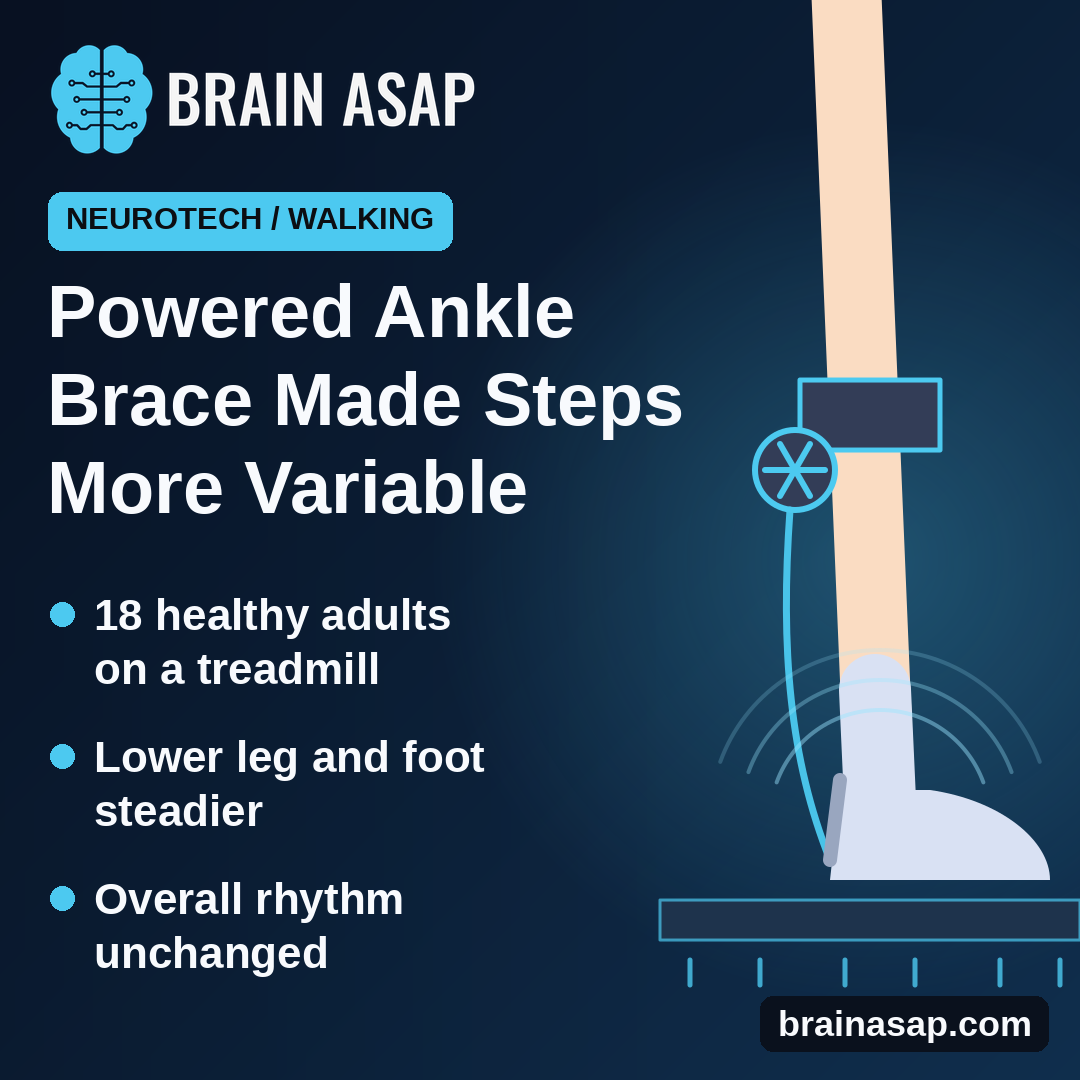
TL;DR: When 18 healthy adults walked on a treadmill wearing a powered ankle exoskeleton, their stride lengths varied more from step to step, but their lower legs and feet moved more steadily. Their overall walking rhythm did not change.
Key Findings
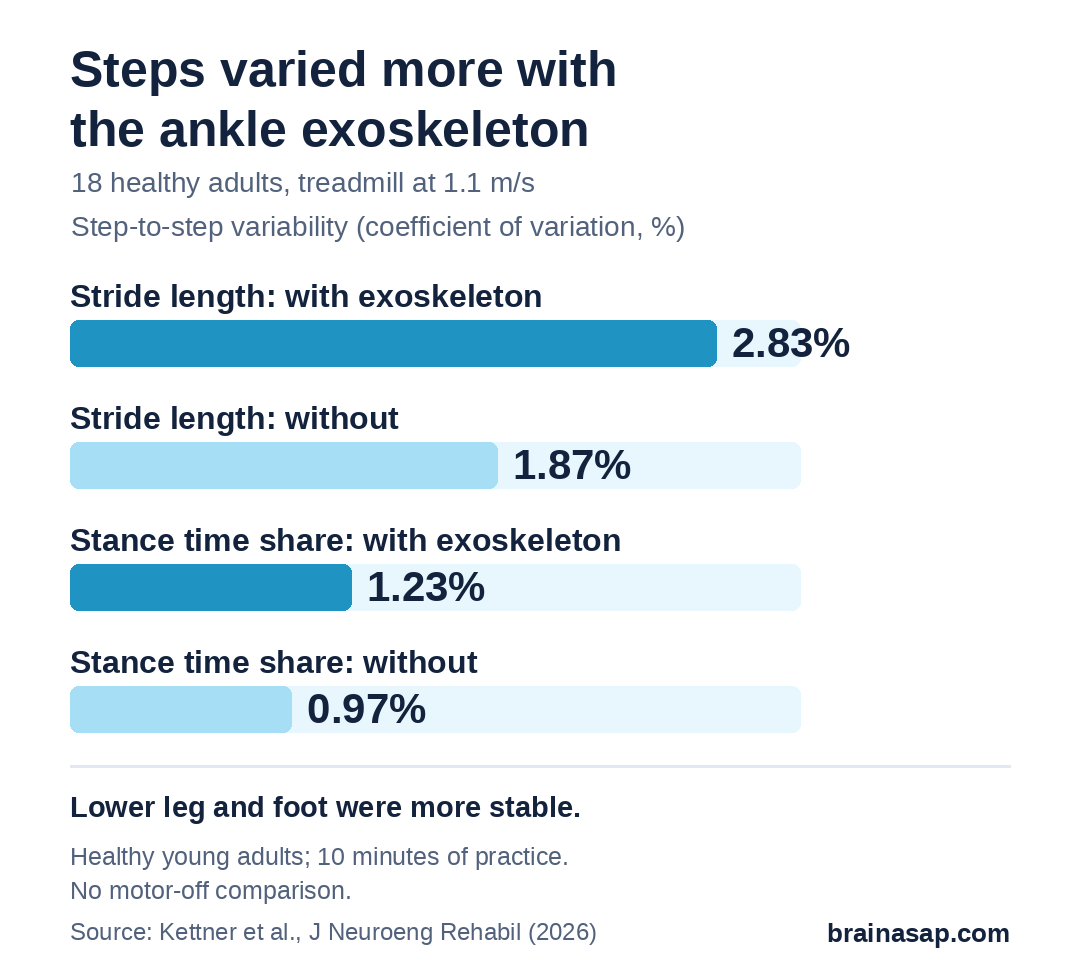
- More step-to-step variation: Stride-length variability rose from 1.9% to 2.8%.
- Steadier near the device: Lower leg and foot were more stable.
- Rhythm unchanged: Long-range walking pattern stayed the same.
- Same stride length and width on average.
Source: Journal of NeuroEngineering and Rehabilitation (2026) | Kettner et al.
Powered ankle exoskeletons, motorized braces that help push off with each step, can make walking take less energy. They are being developed for older adults, people after stroke and workers. But making walking easier is only useful if it does not make walking wobblier.
A team at the Karlsruhe Institute of Technology in Germany measured stability from several angles.
Treadmill Walking With and Without the Device
Eighteen healthy adults (6 women, average age about 25) walked on a treadmill at a steady 1.1 m/s in two conditions, in random order:
- With exoskeleton: Wearing a motorized device on both ankles that actively assisted push-off.
- Without exoskeleton: Normal walking.
Motion capture tracked the trunk, hips, legs and feet. The team looked at three kinds of stability: how much each stride varied, whether the long-range rhythm of strides held its pattern, and how quickly tiny wobbles grew in each body segment (local stability).
Strides Varied More
Average stride length and step width did not change, but stride-to-stride consistency did. People also spent a slightly smaller share of each stride with the foot on the ground (66.1% vs 67.3%).
But the Lower Leg and Foot Were Steadier
Local stability improved right where the device worked. A measure of how fast small wobbles grow (lower is steadier) fell at the lower leg (0.27 vs 0.33) and the foot (0.72 vs 0.76). The trunk, hips and thighs showed no significant change.
The long-range rhythm of stride timing was also the same with and without the device (0.66 vs 0.65 on a standard measure), suggesting overall walking control stayed intact.
What the Study Could Not Separate
- Wearing vs assisting: No “device on, motor off” condition, so the effect of the device’s weight and fit can’t be separated from the push-off help.
- Short adaptation: Only 10 minutes of practice before testing.
- Healthy young adults on a treadmill: Not older adults, patients or real-world walking.
- Unclear meaning of more variation: It could signal instability or active exploration of a new walking pattern.
Designing Exoskeletons That Keep People Steady
The results suggest this ankle device changed walking at the local level without upsetting overall gait. The next test is whether the same holds for the people who would use these devices most, such as older adults or stroke survivors, and after longer practice.
Citation: DOI: 10.1186/s12984-026-02151-y. Kettner C, Beyerlein M, Marquardt C, Dežman M, Asfour T, Stein T. Effects of an actuated ankle exoskeleton on walking stability in healthy adults: a controlled laboratory study. J Neuroeng Rehabil. 2026;23:261.
Study Design: Randomized crossover laboratory study, treadmill walking with and without a bilateral actuated ankle exoskeleton.
Sample Size: 18 healthy adults (6 women).
Key Statistic: Stride-length CoV 2.83% vs 1.87% (p < 0.001); lower-leg local divergence exponent 0.27 vs 0.33 (p < 0.001).
Caveat: No zero-torque condition; brief familiarization; healthy young participants.