TL;DR: In a lab study published in 2026, 119 U.S. college students filled out questionnaires about their relationships and about any pain they had, such as how strong it was and how much it got in their way.
Students who worried more about being rejected or abandoned by people close to them reported a somewhat heavier pain burden. Much of that link went along with seeing pain as a threat they couldn't handle, but a single round of questionnaires can't show cause.
Key Findings
- Rejection worry and pain: Students more worried about rejection by close others reported more pain burden, a modest but statistically clear link.
- Feeling threatened by pain: Seeing pain as something they couldn't cope with carried a statistically clear part of that link.
- Trouble naming feelings: Difficulty identifying and describing emotions also carried part of the link on its own, but not once both factors were tested together.
- No clear winner: The 2 factors' shares were not statistically different from each other.
- Student sample: Nobody was screened for chronic pain, and no pain was applied in the lab.
Source: Behavioral Sciences (2026) | Shannon et al.
Two people can stub the same toe and have very different days. How much pain weighs on someone depends partly on what goes on in their head, not only in their tissues.
One factor researchers keep returning to is attachment anxiety: an ongoing worry that partners, friends or family will reject or abandon you. People high in it tend to report more pain, and they're more likely to develop chronic pain.
A 2026 study in Behavioral Sciences, by Trevor Shannon, Lauren Cravens and Richard Pond at the University of North Carolina Wilmington, tested 2 possible reasons for that link in undergraduates who were not screened for pain conditions.
What Were the 2 Possible Explanations?
- Threat appraisal: believing pain is more than you can cope with, as in "I feel controlled by the pain".
- Alexithymia: difficulty identifying and putting words to your feelings, and telling emotions apart from body sensations.
Both are more common in people with high attachment anxiety, so either could help explain why they feel pain as heavier.
How Was It Tested?
Students came to a lab for a single session, sat in private cubicles and completed a set of questionnaires for course credit.
- Who: 119 undergraduates, average age about 19, 52% women, mostly white
- Pain burden: combined score for pain intensity, how much pain interfered with daily activities, and how tense or irritable they had felt
- Attachment anxiety: 6 statements such as "I need a lot of reassurance that I am loved by my partner"
- Other questionnaires: threat appraisal, alexithymia, self-esteem and several more
Researchers then checked how much of the link between attachment anxiety and pain burden ran through each possible explanation.
Which Explanation Held Up?
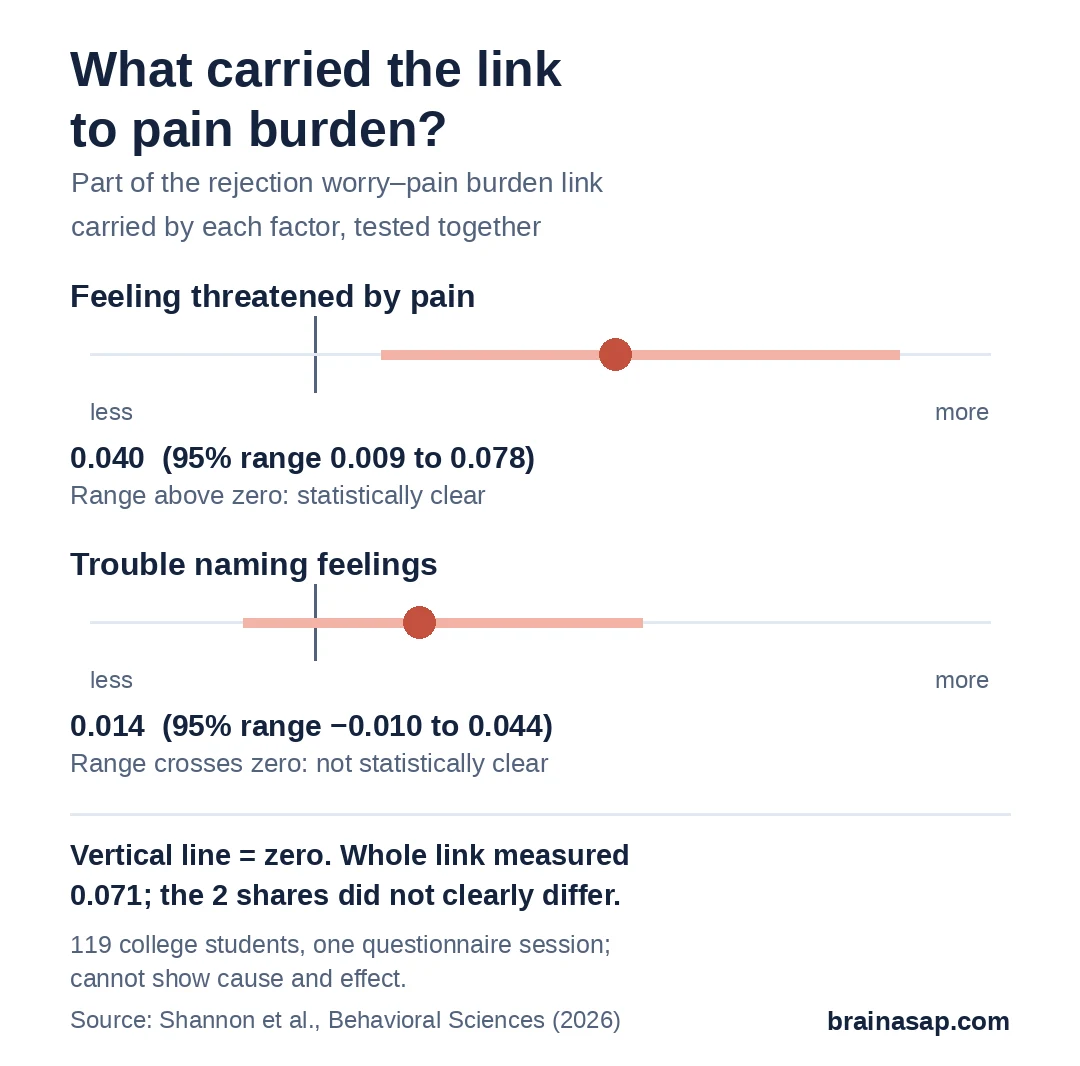
Tested one at a time, each factor had a statistically clear indirect link, while the remaining direct link was not clear. Once the 2 were tested together, only threat appraisal still carried a statistically clear indirect share.
Students who worried about rejection tended to see pain as more threatening, and that view went along with a heavier pain burden.
Still, the 2 shares were not statistically different from each other, so this doesn't rule out trouble naming feelings. In a further exploratory test with 7 factors, lower self-esteem also carried a small, statistically clear share.
What Are the Limits?
- One snapshot: Everything was measured once, so pain could just as well shape how people feel about relationships.
- Self-report only: Shared answering habits could make all the scores move together.
- Missing factors: Depression and general anxiety weren't measured and could explain the pattern.
- Small sample: 119 students may be too few to separate 2 overlapping factors, and results may not apply to older adults or people with chronic pain.
Could Easing Threat Help With Pain?
Shannon and colleagues suggested that people high in attachment anxiety who have a pain condition might benefit from help with how threatening pain feels, or from building self-esteem. That idea has not been tested yet.
A trial in people with chronic pain, following them over time, would show whether changing how threatening pain feels actually lightens its burden.
Citation: DOI: 10.3390/bs16091579 Shannon TCJ, Cravens LE, Pond RS Jr. Alert to Hurt: Threat Appraisal Mediates the Association Between Attachment Anxiety and Perceptions of Pain Burden Among Healthy Young Adults. Behavioral Sciences. 2026;16(9):1579.
Study Design: Cross-sectional, single laboratory questionnaire session; simple and parallel mediation models (PROCESS Model 4, 5,000 bootstrap resamples), attachment avoidance as covariate; post hoc 7-mediator model.
Sample Size: 119 undergraduates (mean age 19.5; 52.1% female), University of North Carolina Wilmington; not screened for pain conditions.
Key Statistic: Total effect of attachment anxiety on pain burden B = 0.071 (p = 0.028). Parallel model indirect effects: threat appraisal 0.040 (95% BCa CI 0.0089–0.0779); alexithymia 0.014 (−0.0095 to 0.0437); contrast B = −0.024 (−0.0769 to 0.0199). Post hoc model: self-esteem 0.022 (0.0006–0.0477), threat 0.031 (0.0062–0.0650).
Caveat: Cross-sectional self-report; nonclinical, mostly white student sample; possibly underpowered for parallel models; mood not measured; post hoc analysis exploratory.