TL;DR: In a small Spanish study of 84 adults with severe grief, scores fell most in the group given ayahuasca alongside grief therapy. People were not randomly assigned, so this is an early signal, not proof.
Key Findings
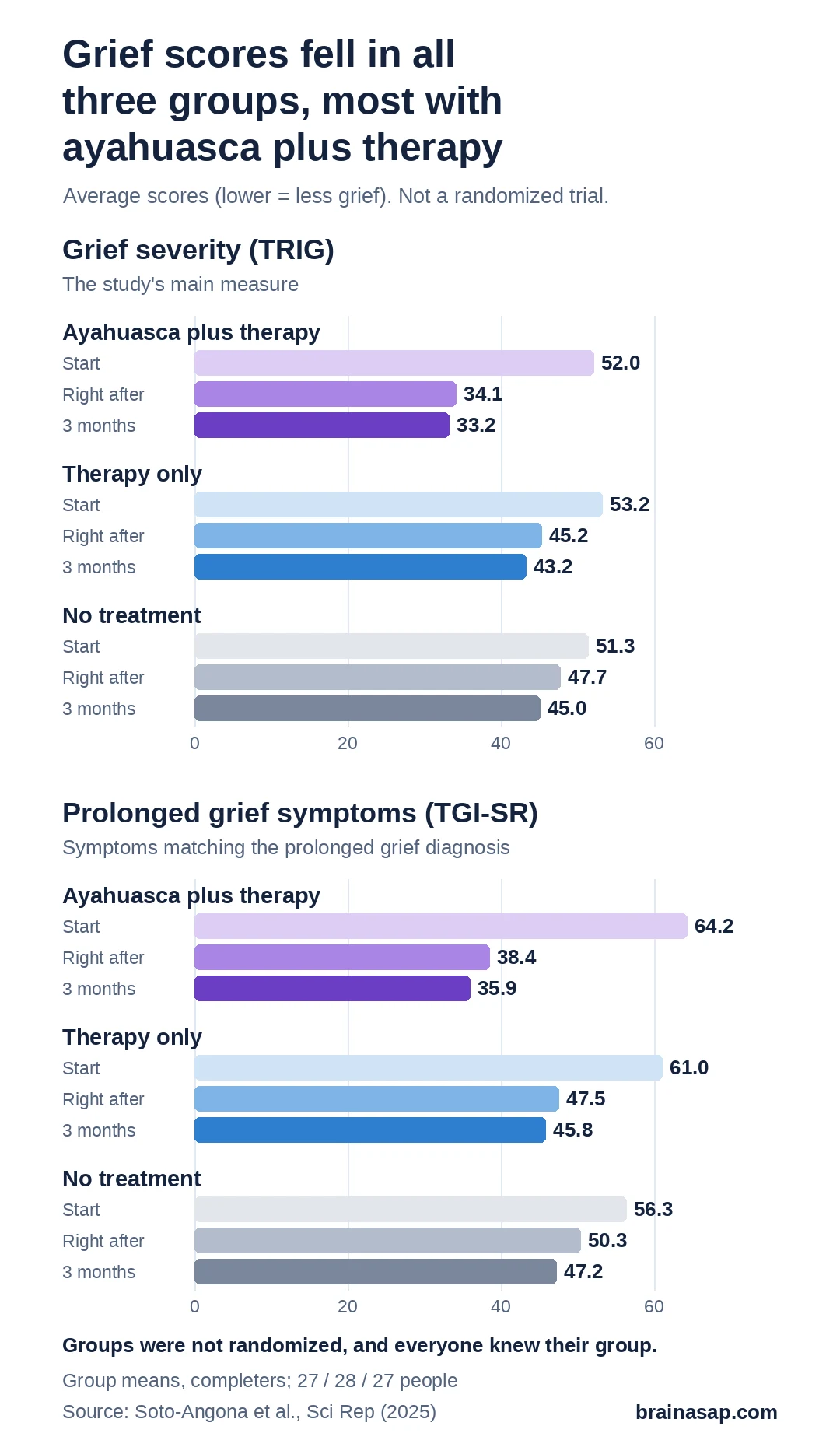
- Ayahuasca plus therapy: Grief severity fell from 52.0 to 34.1 right after the program, 33.2 at 3 months.
- Therapy only: Score went from 53.2 to 45.2, then 43.2 at 3 months. Ayahuasca group's drop was larger.
- No treatment: Score still slipped, from 51.3 to 45.0 by 3 months. Grief eases on its own for many people.
- Beyond grief severity: Ayahuasca group also did better on prolonged grief symptoms and personal growth after loss.
- Safety: No serious adverse events. Nausea, vomiting or diarrhea most common (16 people).
Source: Scientific Reports (2025) | Soto-Angona et al.
Can a psychedelic brew ease the worst of grief? In this Spanish study, people who took ayahuasca alongside grief therapy ended up with lower grief scores than people who had therapy alone or nothing at all.
But nobody was randomly assigned to a group, and grief scores drifted down everywhere. The question is how much of the gap belongs to ayahuasca.
Who was in the study
Losing a parent, partner, child, or sibling can flatten the months that follow. Most people slowly adapt, but some stay stuck in intense grief, and there is little proof that early support prevents that. Antidepressants have not shown much benefit for the kind of grief that lingers.
Ayahuasca is a plant brew from the Amazon that contains the psychedelic compound DMT. Earlier, smaller studies had hinted that it might ease grief. This one added comparison groups.
The 84 adults were 18 to 65 (average age 43), and 64% were women. All had lost a first-degree relative within the past 12 months, on average about 6 months earlier. All scored at least 40 on a grief inventory, which the study used as its cutoff for severe grief. Participants found the study through the social media accounts of psychedelic research groups, and about three-quarters had used psychedelics before.
There were three groups of 28, which this article calls:
- The therapy-only group: nine weekly online sessions of meaning reconstruction therapy.
- The no-treatment group: assessments only.
- The ayahuasca-plus-therapy group: the same nine therapy sessions, plus two ayahuasca sessions.
Meaning reconstruction therapy is a talking therapy built on the idea that grief is partly a struggle to make sense of a loss. Clients work through the story of the death, the story of the relationship, and then who they are now.
In the ayahuasca group, the sessions happened after the first phases of that therapy, at a center in Barcelona. Groups of up to 8 people lay on couches with music and at least 4 facilitators present. Participants stayed 24 hours under medical supervision, and each session was followed by an online integration talk the next week. Of the 28, 27 took part in the first ayahuasca session and 24 in the second.
The main measure, grief severity, came from the Texas Revised Inventory of Grief, a questionnaire people fill out about themselves. A second questionnaire counted symptoms that match the diagnosis of prolonged grief disorder, a lasting, disabling form of grief. On both, a lower score means less grief. People were assessed at the start, right after the program, and 3 months later.
Grief scores by group
Grief severity fell in all three groups. That includes the no-treatment group, which fits what researchers already know: for many people, the raw edge of early grief softens with time. The trial's own attention may also play a part.
The ayahuasca-plus-therapy group fell furthest. Their average score went from 52.0 to 34.1 right after the program and stayed there (33.2) at 3 months. The therapy-only group went from 53.2 to 45.2 to 43.2. The no-treatment group went from 51.3 to 47.7 to 45.0.
The ayahuasca group's drop was statistically larger than the other two groups' drops, both right after the program and at 3 months. Interestingly, the therapy-only group was not clearly better than the no-treatment group on either grief measure, even though its scores dropped more on paper.
Prolonged grief and personal growth
The second grief questionnaire told a similar story. Scores in the ayahuasca group fell from 64.2 to 38.4, then 35.9. The therapy-only group went from 61.0 to 47.5, then 45.8, and the no-treatment group from 56.3 to 50.3, then 47.2. Note that the ayahuasca group started with the highest score on this one, so it had the most room to drop.
The ayahuasca group also scored higher on post-traumatic growth, which captures positive changes people report after a hard event, such as a new appreciation of life or closer relationships. Their score rose from 23.1 to 35.1, compared with 25.2 to 28.0 in the therapy-only group and 27.1 to 28.2 with no treatment. Psychological quality of life improved in both therapy groups, and only the gap between the ayahuasca and therapy-only groups right after the program was clearly significant. Social relationships scores showed no clear differences between groups after treatment.
Side effects
No serious adverse events were reported. During the ayahuasca sessions, 16 people had nausea, vomiting, or diarrhea, 4 had headaches, 2 fainted, and 2 reported anguish. Only 3 people reported anything the following week, all minor. Two people needed ibuprofen for a headache. One person quit after the first session, saying it held no meaning for them. Four skipped the second session.
The authors note that standardized tools were not used to track side effects and that no independent rater judged whether a problem was caused by the treatment, so minor harms may be undercounted.
Limits of a non-randomized design
- Groups filled in order, not by chance: Therapy-only first, then no treatment, then ayahuasca. Authors say COVID-19 rules made in-person sessions hard. Different timing, staff experience, or who signed up when could all have shaped the results.
- Everyone knew their group: Grief and quality-of-life outcomes were self-reports. People who expected ayahuasca to help (many had used psychedelics before) may have reported bigger improvements.
- Ayahuasca not isolated: Nobody got it without therapy and preparation. Group setting, nature setting and support from other grieving people came along with it.
- Grief eases on its own: No-treatment group improved too, so some of every group's change is likely time.
- Self-selected group: Mostly white, well educated, drawn from psychedelic-interest communities. Results may not carry to others.
- Short follow-up: Three months says little about lasting effects or relapse. Analysis counted only completers (82 of 84).
A randomized trial is needed next
This does not show that ayahuasca treats grief. Early grief has few proven treatments, though, and adding two psychedelic sessions to a structured program looked safe here and came with large drops in grief scores. That is enough to justify a better test, not enough to change what anyone does.
The authors call for a randomized trial with a blinded comparison and a longer follow-up. The authors also stress that ayahuasca has deep roots in Indigenous and religious traditions, and that working with those communities matters if it is ever used more widely in Western settings.
Citation: DOI: 10.1038/s41598-025-13251-5. Soto-Angona O, Andión O, Sabucedo P, Neimeyer RA, Haro JM, Javkin J, Farré M, González D. Ayahuasca-assisted meaning reconstruction therapy as an early resource for bereavement: a non-randomized clinical trial. Scientific Reports. 2025;15:32158.
Study Design: Three-arm, sequentially allocated, open-label, non-randomized clinical trial (NCT06150859): meaning reconstruction therapy with two ayahuasca sessions, meaning reconstruction therapy alone, or no treatment; assessed at baseline, after the program, and at 3 months.
Sample Size: 84 adults with severe grief within 12 months of losing a first-degree relative (28 per group); 82 completed the assessments.
Key Statistic: Grief severity (TRIG) after the program: ayahuasca plus therapy versus therapy only, p = .0001, d = 1.20; versus no treatment, p < .0001, d = 1.50. Prolonged grief symptoms (TGI-SR): versus therapy only, p = .012, d = 0.86; versus no treatment, p = .0008, d = 1.07.
Caveat: Non-randomized, open-label, self-reported outcomes; ayahuasca not separated from therapy and group support; short follow-up; self-selected participants.