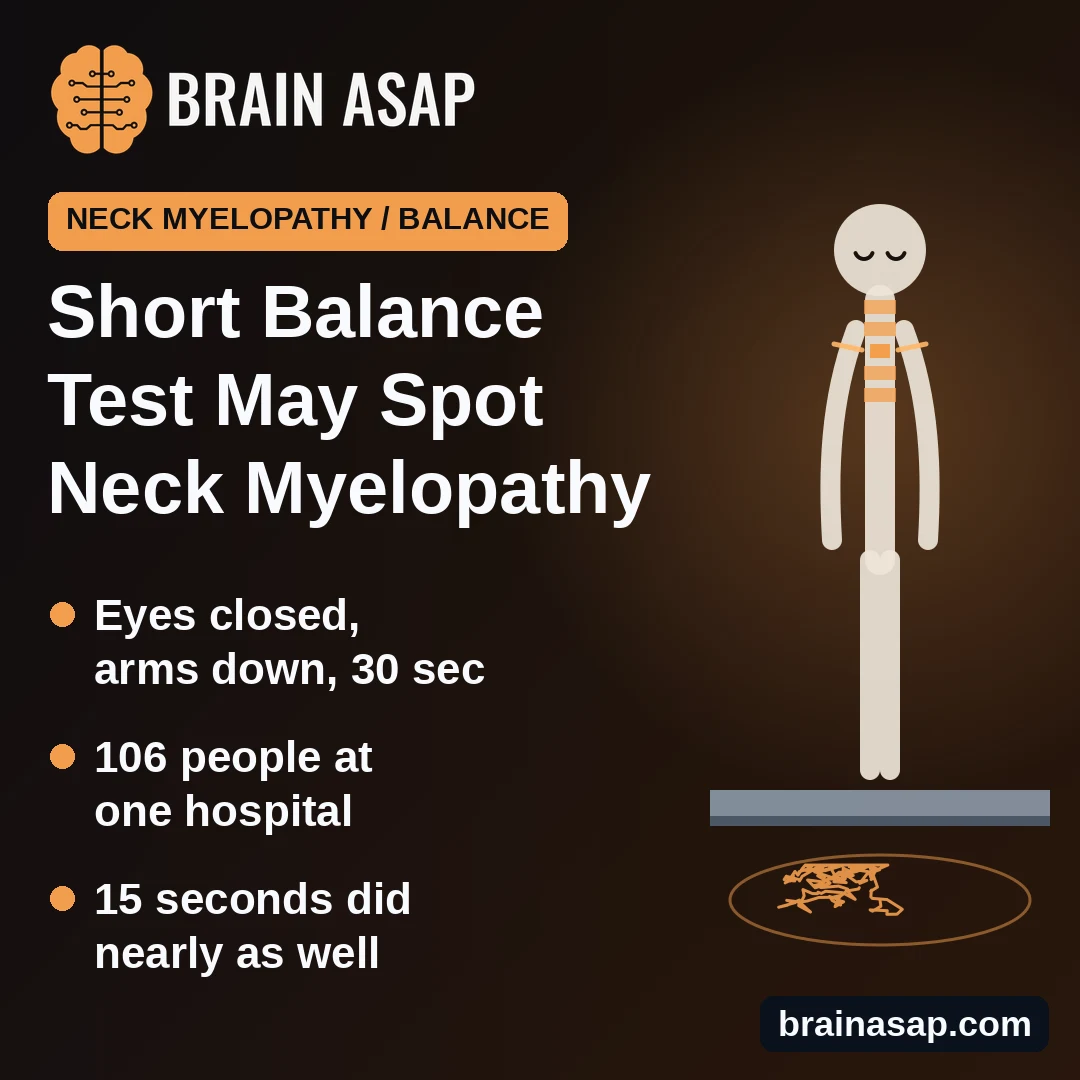
TL;DR: Standing still for 30 seconds on a pressure-sensing mat, eyes closed and arms at the sides, best separated people with spinal cord compression in the neck from people without it. The 15-second version did almost as well.
Key Findings
- 106 people tested: 56 with cervical myelopathy and 50 without symptoms.
- Patients swayed far more: Their sway path was roughly 1.7 to 1.9 times longer in every version of the test.
- Best version: 30 seconds with arms down (AUC 0.897), then 15 seconds with arms down (0.890).
- All six versions worked fairly well: Scores ranged from 0.840 to 0.897.
Source: Frontiers in Neuroscience (2026) | Tian et al.
Wear and tear in the neck can slowly squeeze the spinal cord. Early on, the main sign is often a slight loss of balance that people brush off and doctors can miss in a quick exam.
Pressure-sensing platforms can pick up that hidden wobble, but clinics test it in different ways. A team at a Beijing hospital asked a simple question: which way of standing, and for how long, works best?
A Slow Squeeze That Shows Up as Sway
The condition is cervical spondylotic myelopathy, or CSM. Bone spurs, disc bulges and thickened ligaments in the neck narrow the space around the spinal cord. That can disrupt the signals that tell the body where it is in space, so people become unsteady. Because long-term compression can cause lasting cord damage, catching it early matters.
Six Ways to Stand on a Pressure Mat
The researchers tested 56 people with CSM and 50 people without symptoms, aged about 52 to 55 on average. The two groups were similar in sex, age, weight, smoking, drinking, blood pressure and diabetes. People with other conditions that affect balance, such as stroke, Parkinson's or inner-ear problems, were excluded.
Everyone stood barefoot on a force platform with feet together and eyes closed in six combinations, in random order:
- Arms down: Arms resting at the sides.
- Arms forward: Arms held straight out at shoulder height.
- Each for 15, 30 or 60 seconds.
The mat tracked four measures of sway, including how far the body's center of pressure wandered and how fast it moved front to back and side to side.
Arms Down for 30 Seconds Came Out on Top
In every version, people with CSM swayed significantly more on all four measures. Over 30 seconds with arms down, for example, their center of pressure traveled about 136 cm on average, compared with about 72 cm in people without symptoms.
When the four measures were combined, every test version separated the groups reasonably well. The researchers used a score called AUC, where 0.5 is a coin flip and 1.0 is perfect sorting:
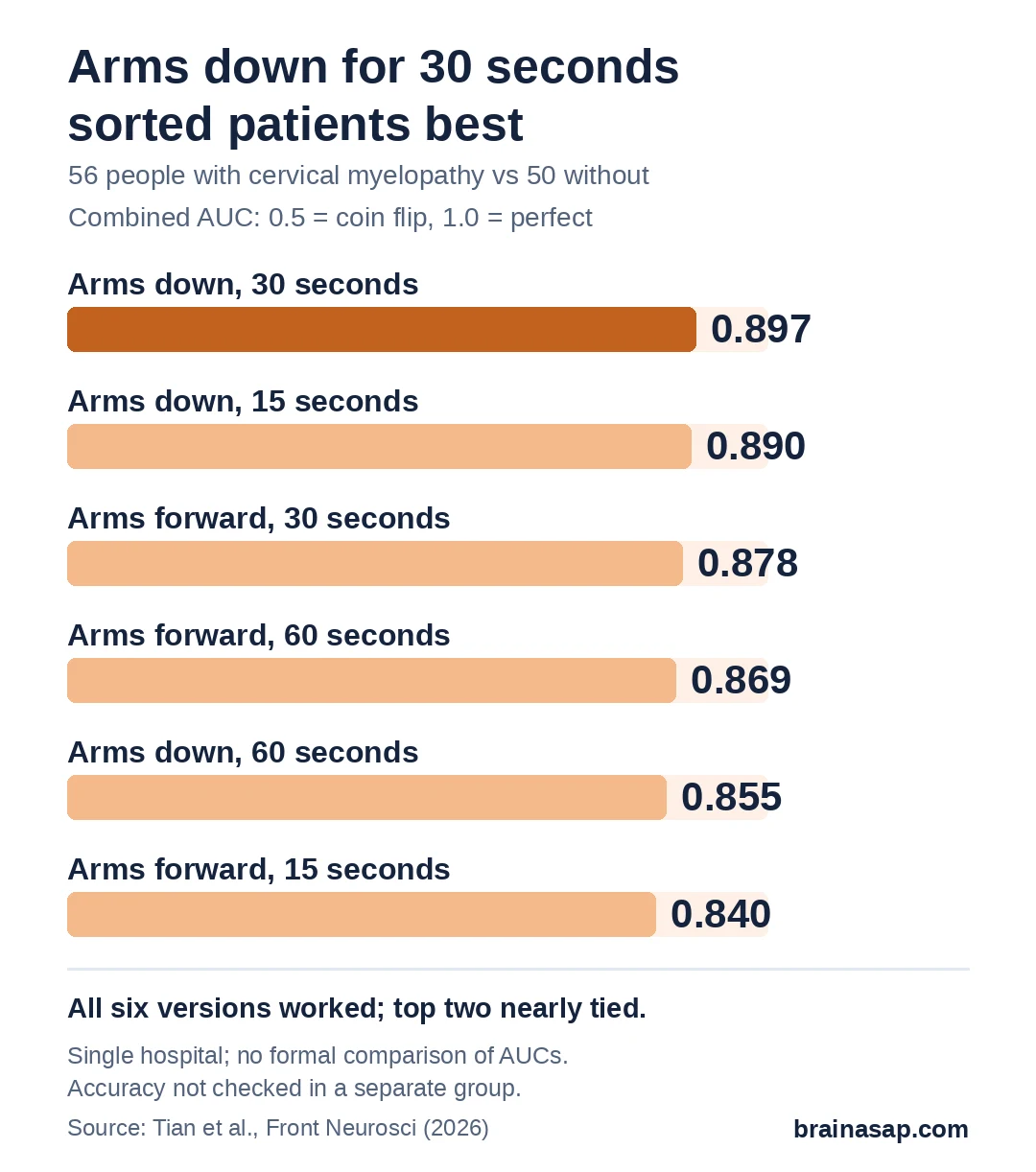
Why would arms down work better? The authors suggest that holding the arms forward lets people shift their weight to steady themselves, which can hide small balance problems. With the arms hanging, there is no such help, so the cord-related wobble shows more clearly.
The best version also varied by measure. Side-to-side speed and total sway path worked best at 15 seconds arms down, while front-to-back speed worked best at 60 seconds with arms forward, perhaps because of arm fatigue.
Close Scores, One Hospital, No Outside Check
- Small single-hospital sample: 106 people, all from one center in China.
- Close results: The top two versions differed by only 0.007 in AUC, with no formal comparison.
- Same people used to judge: Accuracy was not checked in a separate group.
- Clear-cut groups: Patients already diagnosed, compared with people without symptoms; 14 patients who could not finish the tests were excluded.
- No severity breakdown: Results were not split by how advanced the condition was.
A Quicker Standard Test Is Worth Checking in Early Cases
The study supports a simple, fast balance check: stand still, feet together, eyes closed, arms down, for 15 to 30 seconds on a force plate. It is not a stand-alone diagnosis, and it does not replace imaging or a neurological exam.
The real test is still ahead: whether this short protocol can spot people with early, mild compression who have not yet been diagnosed.
Citation: DOI: 10.3389/fnins.2026.1905226. Tian Z, Mao K, Zhang B, et al. Standardization and optimization of force platform testing for balance assessment in cervical spondylotic myelopathy. Front Neurosci. 2026;20:1905226.
Study Design: Single-center cross-sectional case-control study comparing six force-platform protocols (2 arm positions × 3 durations).
Sample Size: 56 patients with CSM and 50 asymptomatic controls (from 219 recruited).
Key Statistic: Combined AUC 0.897 for 30 seconds arms down; range 0.840 to 0.897 across protocols.
Caveat: Small single-center sample; no external validation or formal AUC comparison.