TL;DR: Nesting chinstrap penguins sleep in thousands of naps lasting just a few seconds each. A math model suggests this choppy pattern can make sense as a trade-off between getting rest and staying alert at a crowded nest.
Key Findings
- Real penguins: An estimated 14,300 naps a day, averaging 3.9 seconds.
- Model came close on counts: About 15,000 simulated naps a day.
- Matched the longest nap: 34 seconds in both.
- Fell short on total sleep: 11.6 simulated hours versus 14.9 real.
- Switching was almost free: So constant dozing on and off paid off.
Source: Nature and Science of Sleep (2026) | Phillips et al.
Imagine getting a full night's rest in naps of four seconds each, more than 600 times an hour. That is roughly how nesting chinstrap penguins sleep, according to earlier brain recordings. Over a day they pile up around 15 hours of sleep without ever sleeping for long.
Why sleep like that? A team of economists at Brigham Young University and an independent researcher treated it as a decision problem and built a model to find out.
Sleep as a Second-by-Second Choice
The model imagines a penguin deciding every second whether to sleep or stay awake. Staying awake has value: guarding the nest, watching neighbors, reacting to a disturbance. Sleeping lowers sleep pressure, the drive to sleep that builds up the longer an animal is awake. The model also includes a daily body clock and a cost for switching between sleep and waking.
The researchers did not record new penguins. They tuned the model to published data from 14 nesting chinstrap penguins, adjusting it until simulated sleep matched five key numbers from the real birds as closely as possible.
Close on Nap Counts, Short on Total Sleep
The model captured the striking choppiness of penguin sleep. It produced about 15,000 naps a day, close to the roughly 14,300 estimated from published summaries, and its longest nap was 34 seconds, matching the real birds almost exactly.
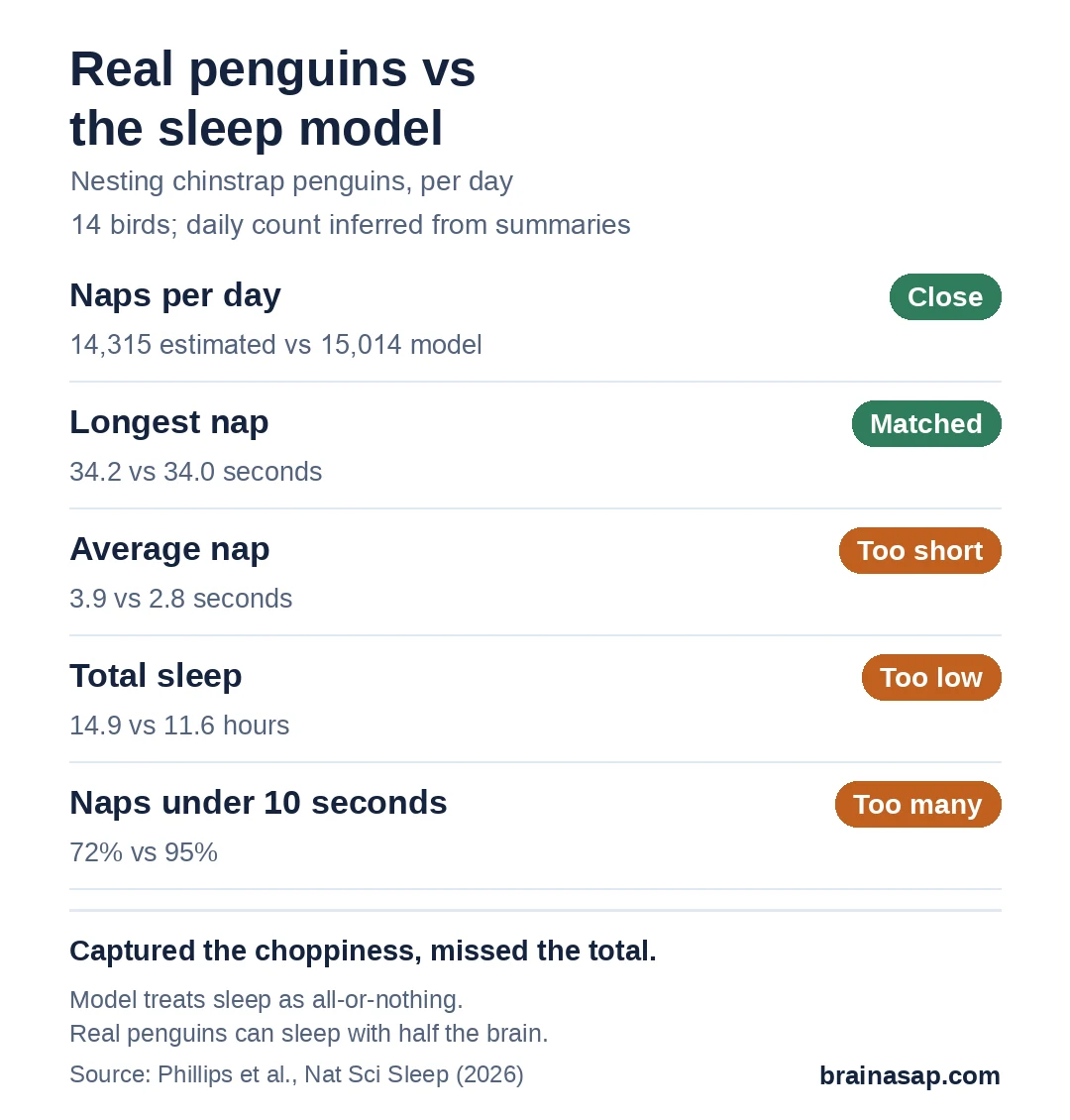
It got other things wrong. Simulated naps were too short on average, 2.8 seconds versus 3.9, and 95% lasted under 10 seconds compared with 72% in real birds. Total sleep came out at 11.6 hours a day, well below the real 14.9.
Why Dozing On and Off Made Sense
The best-fitting model had almost no cost for switching between sleep and waking, and sleep pressure that rose and fell within about 30 seconds. Under those conditions, the smartest strategy was to slip in and out of sleep constantly rather than commit to long stretches.
The authors suggest this fits a nesting penguin's life: surrounded by neighbors and with eggs or chicks to protect, it can grab rest a few seconds at a time without letting its guard down for long.
Half-Asleep Brains Are Missing From the Model
- Asleep or awake only: Real penguins can sleep with one brain half while the other stays alert. The model can't represent that.
- Too little sleep: Likely because sleeping in the model means fully giving up alertness.
- Borrowed data: Calibrated to summary numbers from one earlier study of 14 birds.
- No day-to-day variation: The model produced none, while real birds varied by about an hour.
Could Half-Brain Sleep Close the Gap?
The study shows that seconds-long naps can be a sensible choice, not just a broken version of normal sleep. Whether adding one-sided brain sleep to the model would bring its totals up to match real penguins is the obvious next test.
Citation: DOI: 10.2147/NSS.S612907. Phillips KL, Showalter MH, Eide ER, Cardon JH. A Dynamic Model of Microsleep and Vigilance Tradeoffs in Nesting Chinstrap Penguins. Nat Sci Sleep. 2026;18:612907.
Study Design: Dynamic optimization model of sleep choice, calibrated by simulated method of moments to published penguin data.
Sample Size: Published summary data from 14 nesting chinstrap penguins; 21 simulated days.
Key Statistic: Simulated 15,014 sleep events per day vs 14,315 estimated from published summaries (+4.9%).
Caveat: Modeling study; treats sleep as all-or-nothing; underestimates total sleep by 22%.