TL;DR: Mice given a stress hormone daily for 5 days before a frightening experience didn't show the usual rise in fear the next day, while mice given a single dose just beforehand did. The finding hints that long-term stress before trauma may change how fear memories form, a question relevant to PTSD.
Key Findings
- Male mice, 3 main groups: No hormone, one dose, or 5 daily doses before a fear-training session.
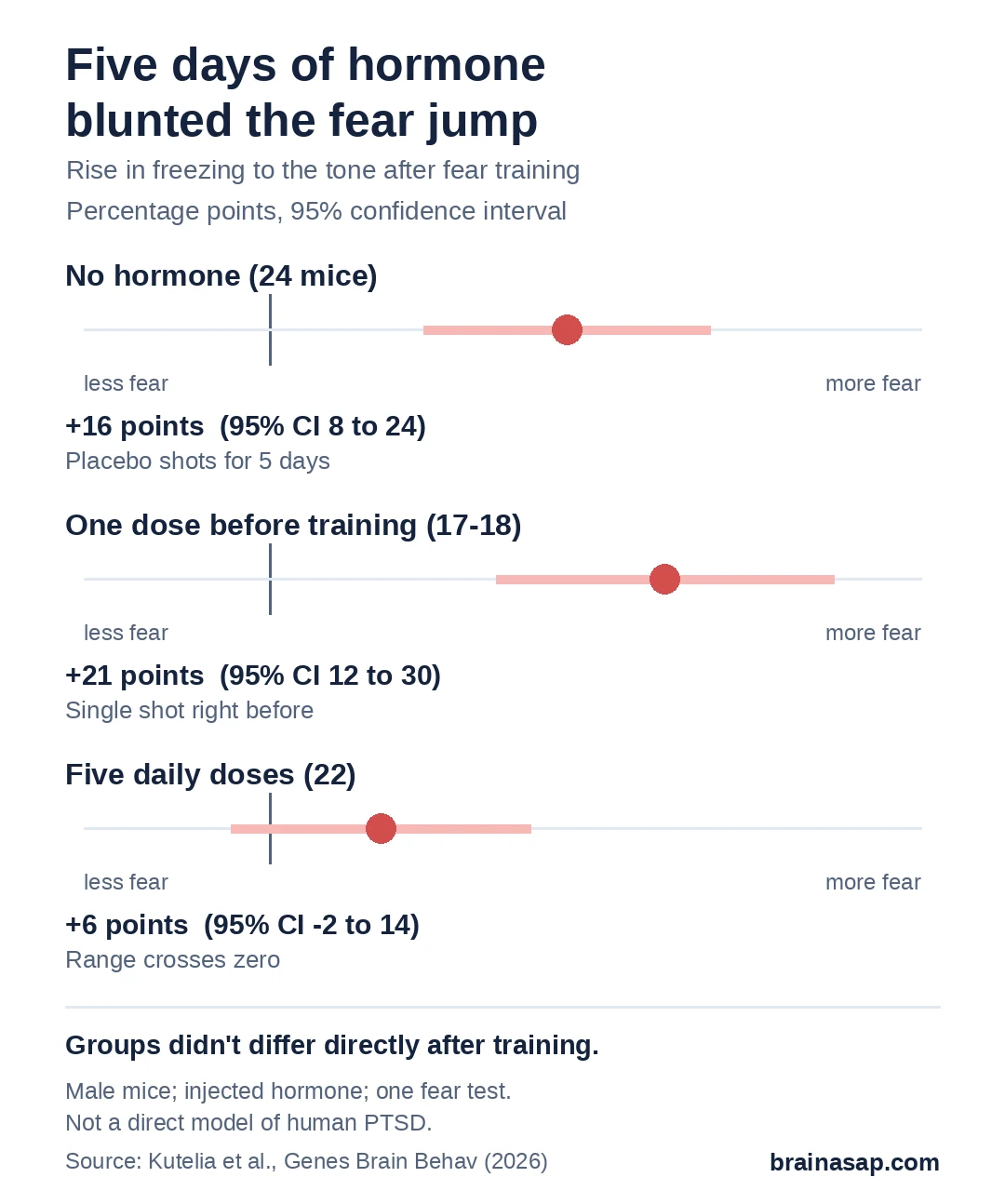
- Usual fear jump: Freezing rose by about 16 to 21 percentage points in the no-hormone and one-dose groups.
- Blunted with 5 doses: Rise of about 6 points, not statistically clear.
- Groups didn't differ directly after training, leaving uncertainty about how large the effect is.
- Stress-receptor gene shifted in memory and decision areas only with 5 doses.
Source: Genes, Brain and Behavior (2026) | Kutelia et al.
Not everyone who lives through a trauma develops PTSD. One clue may be the stress hormone cortisol. People with PTSD often have unusual cortisol patterns, but studies disagree on whether high or low levels are the problem.
Researchers at Tbilisi State University in Georgia tested in mice whether the timing of stress-hormone exposure, a single burst versus days of it, changes how a fearful memory forms.
A Tone, a Shock and a Stress Hormone
Mice have their own version of cortisol, called corticosterone. Adult male mice were split into groups:
- No hormone: 5 days of placebo shots, then fear training.
- One dose: 5 days of placebo, then one corticosterone shot right before training.
- Five doses: Corticosterone shots daily for 5 days, then training.
Fear training paired a tone with a mild foot shock five times. The next day, the team played the tone again and measured freezing, a natural fear response in mice, along with how much the mice explored. Separate groups of mice were used to check stress-related genes two hours after training.
Five Days of Hormone Blunted the Fear Response
In the no-hormone and one-dose groups, freezing to the tone rose clearly after training. In the five-dose group, it barely budged.
Exploration showed the same pattern. It dropped by about 19 to 20 points in the no-hormone and one-dose groups but only about 5 points with five doses.
There's an important catch. When the researchers compared the groups directly after training, none differed significantly. However, the groups did differ in how much freezing changed after training.
A Stress-Receptor Gene Moved Differently
The brain senses stress hormones through two receptor types. One, the mineralocorticoid receptor, is thought to help open a short window for memory formation.
Normally, fear training lowered this receptor's gene activity in the hippocampus, a memory hub. With five doses, that drop didn't happen. In the anterior cingulate cortex, a decision and emotion area, five doses led to higher activity after training. One dose did neither. The authors suggest that long-term hormone exposure may reshape how these areas work together while a trauma memory forms.
Mouse Shocks Aren't Human Trauma
- Mice only: Fear conditioning is a simplified model of trauma.
- Males only: Females may respond differently.
- Uncertain group differences: Freezing changed differently across groups, but post-training levels did not clearly differ.
- Injected hormone: Not the same as natural chronic stress.
- One time point: Genes checked at 2 hours, memory at 24 hours.
- Correlation, not cause: Gene changes weren't tested as the reason for the behavior.
Does Prior Stress Change How Trauma Memories Stick?
This small mouse study suggests the stress history someone brings into a traumatic event may matter as much as the stress of the event itself. Whether weaker early fear learning is protective or a setup for problems later, and whether the same holds for people, are the next questions to test.
Citation: DOI: 10.1111/gbb.70067. Kutelia G, Kuchukashvili Z, Ansiani R, Bukia R, Chikovani M, Chkhartishvili B, Doreulee N. Chronic Pre-Trauma Corticosterone Attenuates Trauma Memory Formation and Alters Gene Expression in Glucocorticoid Signalling Pathways. Genes Brain Behav. 2026;25:e70067.
Study Design: Controlled mouse experiment (auditory fear conditioning; qPCR in separate cohorts).
Sample Size: Behavior: 24 (fear only), 17-18 (acute), 22 (chronic), 15 (chronic, no shock); genes: 6-9 per group.
Key Statistic: Freezing increase: fear only +15.95 (95% CI 8.25 to 23.65); acute +21.23 (12.15 to 30.31); chronic +5.97 (-2.07 to 14.02); treatment x time p = 0.0301.
Caveat: Male mice only; no significant between-group differences after conditioning.