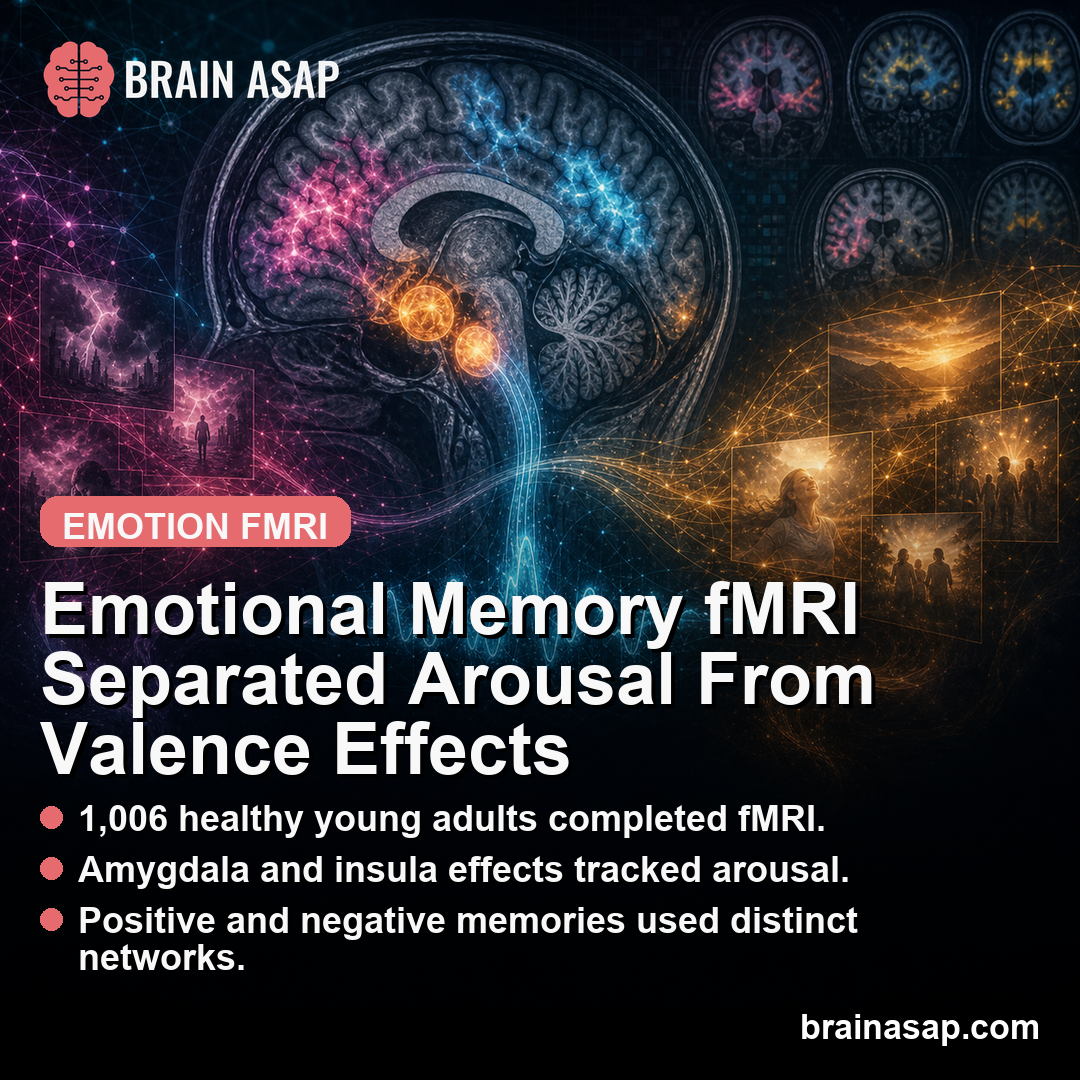
Emotional Memory fMRI Separated Arousal From Valence Effects

Emotional Memory fMRI Separated Arousal From Valence Effects

TL;DR: A 2026 Imaging Neuroscience functional MRI (fMRI) study found that emotional pictures were recalled better than neutral pictures, but amygdala and insula activity appeared tied mainly to arousal rather than whether memories were negative or positive. Key Findings Large fMRI sample: The main imaging analysis used 1,006 healthy young adults from a single center. …

Read more

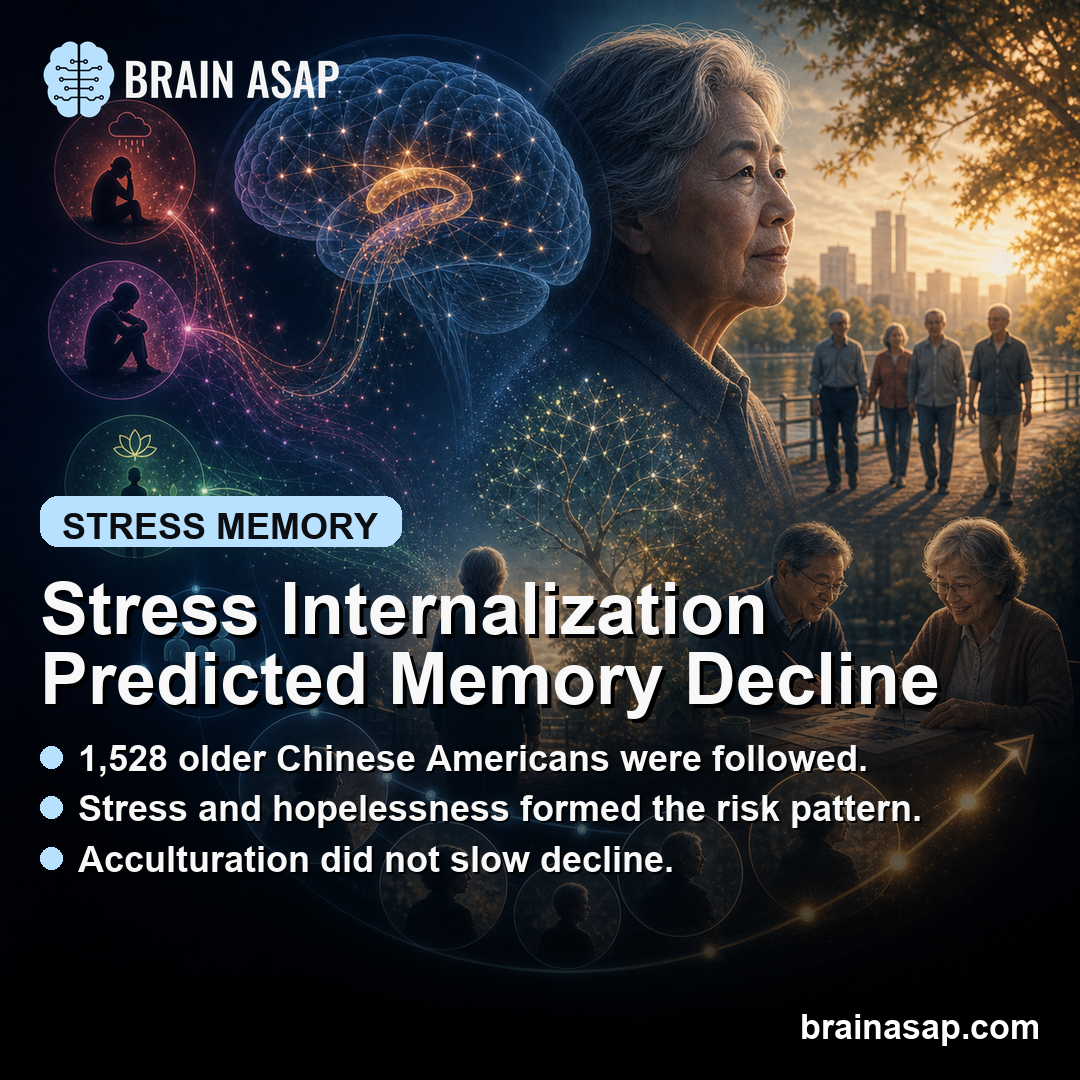
Stress Internalization Predicted Memory Decline in 1,528 Older Chinese Americans Across Three Waves

Stress Internalization Predicted Memory Decline in 1,528 Older Chinese Americans Across Three Waves

TL;DR: A 2025 study in The Journal of Prevention of Alzheimer’s Disease found that stress internalization, not acculturation or activity engagement, predicted memory decline across three waves in 1,528 older Chinese Americans. Key Findings Stress internalization predicted longitudinal memory decline: A latent factor combining greater perceived stress, greater hopelessness, and lower conscientiousness was the single …

Read more

Hippocampus Encoded Trauma Memory Meaning in PTSD

Hippocampus Encoded Trauma Memory Meaning in PTSD

TL;DR: A 2026 PTSD neuroimaging and language-analysis study in Neuropsychopharmacology found that hippocampal activity encoded specific semantic content of traumatic and neutral autobiographical memories, while greater hippocampal sensitivity to autobiographical semantic content related to higher PTSD symptom severity. Key Findings Study type: a study combining natural-language semantic quantification with brain activity during traumatic and neutral …

Read more

Hippocampal CA3 Connectivity Transformed From Dense-Random to Sparse-Structured Across Postnatal Development

Hippocampal CA3 Connectivity Transformed From Dense-Random to Sparse-Structured Across Postnatal Development

TL;DR: A 2026 Nature Communications study found that mouse hippocampal CA3 connectivity shifts from dense-random early wiring to sparse-structured adult wiring, with weaker single synapses that make memory-network output depend on coordinated input rather than one strong connection. Key Findings CA3 connectivity transforms from random to structured during postnatal development: Early in life (P7-8 mice) …

Read more

Generational Memory Gains May Help Explain Declining Dementia Incidence

Generational Memory Gains May Help Explain Declining Dementia Incidence

TL;DR: A 2026 preprint longitudinal cohort analysis in medRxiv found that later-born cohorts showed higher memory levels entering old age and slower rates of memory decline, while the projected 20-year cohort advantage at age 80 was large enough in the model to account for a reported 13% per-decade decline in dementia incidence. Key Findings Birth-cohort …

Read more

Memorable Faces Made Names Stick

Memorable Faces Made Names Stick

TL;DR: A 2026 study in Journal of Experimental Psychology: Learning, Memory, and Cognition found that across 12 online experiments, memorable faces helped people remember paired names, but memorable scenes did not give the same boost to paired city names or first names. The result suggests that some faces are better retrieval cues, and that face …

Read more

Image Memorability Predicted N400 Encoding Signals More Than Recognition

Image Memorability Predicted N400 Encoding Signals More Than Recognition

TL;DR: A 2026 study in Cognitive, Affective, & Behavioral Neuroscience found that image memorability, the stable tendency of an image to be remembered across people, predicted N400 brain responses at encoding even after later recognition success was modeled. Key Findings 24 analyzed participants: Researchers recorded event-related potentials (ERPs), scalp-measured brain responses time-locked to image viewing, …

Read more

FTL1 Iron Protein Reversed Memory Loss in Old Mice

FTL1 Iron Protein Reversed Old Mouse Memory Loss

FTL1 Iron Protein Reversed Old Mouse Memory Loss TL;DR: In old mice, an iron-associated hippocampal protein called FTL1 rose with cognitive decline, made young brains look older when boosted, and improved old-mouse cognition when targeted. Key Findings Aged hippocampi carried more FTL1: Transcriptomic and mass-spectrometry analyses found neuronal FTL1 increased in the hippocampus of old …

Read more

Amygdala Astrocytes Helped Store and Extinguish Fear Memories

How Astrocytes Help the Amygdala Store Fear Memories

How Astrocytes Help the Amygdala Store Fear Memories TL;DR: Amygdala astrocytes were not passive support cells: their calcium signals tracked learned fear states and were required for neuronal fear-memory representations in mice. Key Findings In vivo BLA imaging across multiple mouse cohorts: The team combined astrocyte and neuronal calcium imaging, electrophysiology, and circuit manipulations in …

Read more

Loneliness Impaired Memory Without Accelerating 6-Year Decline

Loneliness Lowered Memory Without Speeding Decline

Loneliness Lowered Memory Without Speeding Decline TL;DR: In 10,217 older Europeans, loneliness was linked to lower immediate and delayed recall at baseline, but it did not make memory decline faster over 6 years. Key Findings 10,217 SHARE participants: The analysis included adults aged 65 to 94 from 12 European countries who participated in waves 5, …

Read more