TL;DR: Researchers exposed tiny roundworms to copper, iron, or both, then measured how well the worms swam and wriggled and looked at the nerve cells that control movement.
Worms exposed to both metals moved less and lost more nerve cells than worms exposed to either metal on its own.
Key Findings
- Worse together than apart: worms given copper and iron together did fewer head thrashes and body bends than worms given either metal alone, which the authors describe as synergy. The abstract does not give the comparison needed to quantify it.
- Two nerve types damaged: both dopamine-making and GABA-making nerve cells degenerated more under the combined exposure.
- Oxidative stress led the damage: reactive oxygen species rose inside cells and inside mitochondria, and mitochondria showed ruptured membranes and lost internal folds under an electron microscope.
- An antioxidant helped, but not completely: N-acetylcysteine restored movement and protected the nerve cells, yet only partly reversed the molecular damage in the combined-exposure worms.
Source: Ecotoxicology and Environmental Safety (2026) | Zijia Wang, Ruo Zhang and colleagues, Southeast University, Nanjing
Copper and iron are both essential: nerve cells cannot run without them. Both are also toxic above a certain dose, and they often show up together in soil, drinking water and industrial waste.
Toxicity testing usually examines one metal at a time. A 2026 study in Ecotoxicology and Environmental Safety asked what happens when a nervous system meets both at once.
Why Test Metals on a Roundworm?
Caenorhabditis elegans is a small transparent roundworm often used in nerve research. Researchers can see individual nerve cells through its transparent body and count how many survive an exposure.
It also moves in ways that are easy to score. Head thrashes count how often the worm whips its head side to side in liquid; body bends count the waves it makes crawling on a plate. Both drop when the nerve cells controlling movement are damaged.
Two Metals, More Damage Than One
Worms were exposed to copper alone, iron alone, or both together, then tested on movement and examined for nerve cell loss.
Combined exposure suppressed both movement measures more than either metal by itself. Nerve cell counts followed the same pattern: dopamine-making and GABA-making neurons both degenerated more under the 2 metals together.
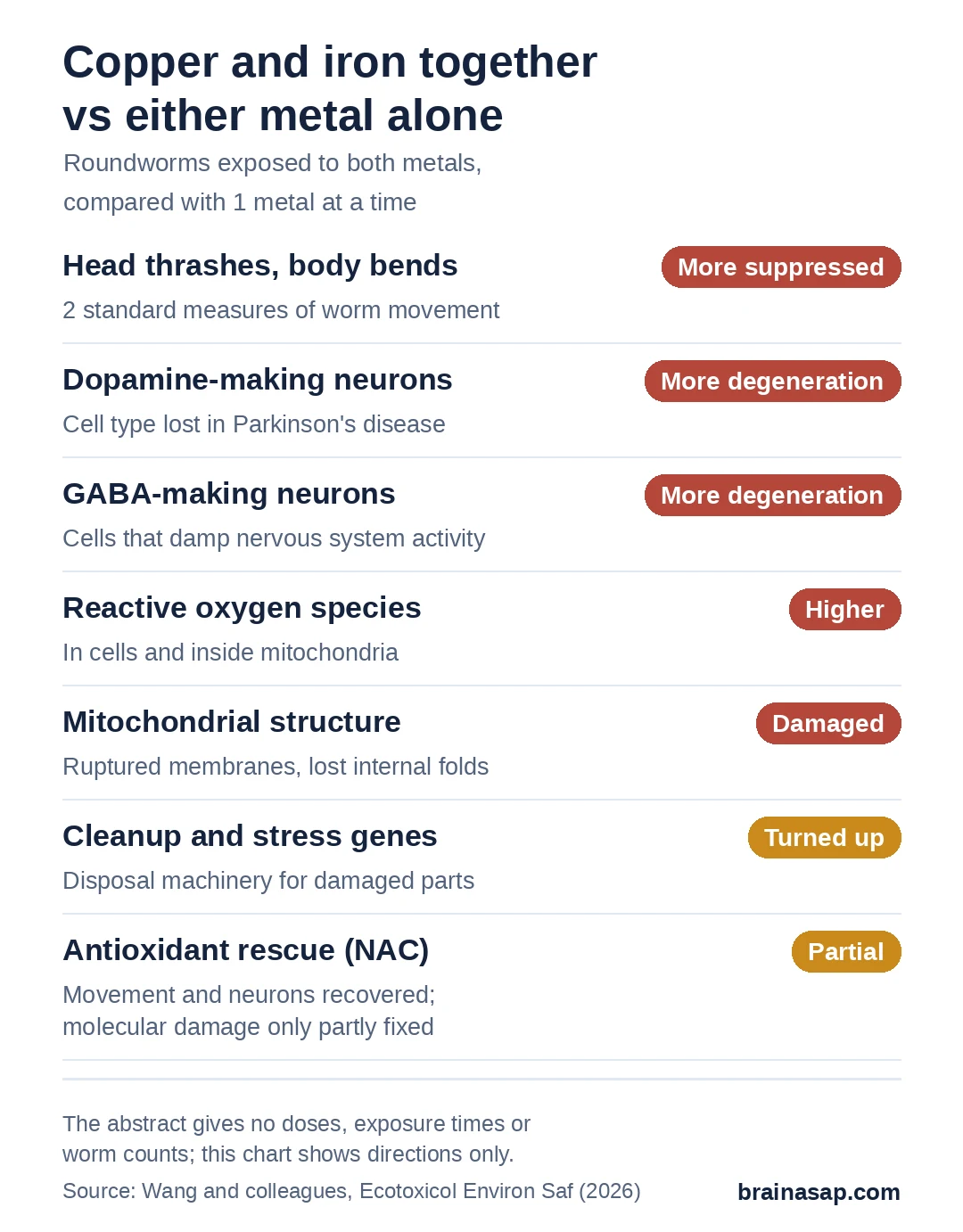
Those 2 cell types matter for different reasons. Dopamine-making neurons are the ones lost in Parkinson's disease, and the worm versions are a standard test for substances suspected of harming them. GABA-making neurons act as the brakes in a nervous system, damping activity.
What Went Wrong Inside the Cells
Reactive oxygen species, the reactive byproducts of normal energy production, rose both in the cells generally and inside their mitochondria.
Mitochondria took visible damage. Under an electron microscope, their outer membranes had ruptured and the folds inside, where energy production happens, were lost. Their electrical charge dropped as well.
Cells responded by switching on their disposal machinery. Genes for clearing out damaged mitochondria and for general cellular cleanup were turned up, along with a mitochondrial stress signal.
Blocking the Oxidative Damage
To test whether oxidative stress was driving all this, the team treated exposed worms with N-acetylcysteine, a compound that mops up reactive oxygen species.
Movement recovered and nerve cells were protected, which supports a role for oxidative stress in the observed damage. But in worms exposed to both metals, the molecular signs of damage improved only partly.
That gap is the paper's own argument for why the combination is worse: something about 2 metals together outruns what an antioxidant can repair.
What This Says About People
- Worms, not people: the roundworm experiment screens for possible toxic mechanisms, not a model of human exposure
- Abstract only: this article is based on the published abstract, which gives no doses, exposure times, worm counts or effect sizes
- Dose unknown: without the concentrations used, there is no way to judge how they compare with what a person encounters in water or food
- Not an argument against supplements: copper and iron are required nutrients, and deficiency carries its own harms; this study tested excess, not normal intake
- No antioxidant advice: N-acetylcysteine here was a laboratory tool for testing a mechanism in worms
Do Mixed Metal Exposures Deserve Their Own Limits?
The co-exposure results give researchers a reason to study how metals interact. The abstract does not report the concentrations used, so they cannot be compared with human exposure thresholds.
Testing that properly would mean moving the same combined exposure into a mammal, at concentrations matched to what people actually encounter, and checking whether the same mitochondrial damage shows up.
Citation: DOI: 10.1016/j.ecoenv.2026.121030. Wang Z, Zhang R, and colleagues. Combined exposure of copper and iron induces nerve damage in Caenorhabditis elegans through ROS-induced autophagy/mitophagy. Ecotoxicology and Environmental Safety. 2026;326:121030. PMID 42998597.
Study Design: Laboratory toxicology study in Caenorhabditis elegans: copper alone, iron alone and combined exposure compared on head thrashes, body bends, dopaminergic and GABAergic neuron degeneration, cellular and mitochondrial reactive oxygen species, mitochondrial membrane potential and ultrastructure by transmission electron microscopy, expression of PINK-1, HSP-6, LGG-1 and HLH-30, plus a rescue experiment with the antioxidant N-acetylcysteine.
Sample Size: Not reported in the abstract.
Key Statistic: Abstract reports directions only: combined copper and iron exposure synergistically inhibited head thrashes and body bends beyond either metal alone, worsened dopaminergic and GABAergic neuron degeneration, raised cellular and mitochondrial reactive oxygen species, reduced mitochondrial membrane potential with rupture and cristae loss, and upregulated PINK-1, HSP-6, LGG-1 and HLH-30. N-acetylcysteine rescued neurodegeneration and motor deficits but only partially mitigated molecular damage in the co-exposure group.
Caveat: Article based on the published abstract alone; no doses, exposure durations, worm counts or effect sizes are available. Invertebrate model, not mammals or people, and the exposures cannot be compared with human intake without the concentrations used.