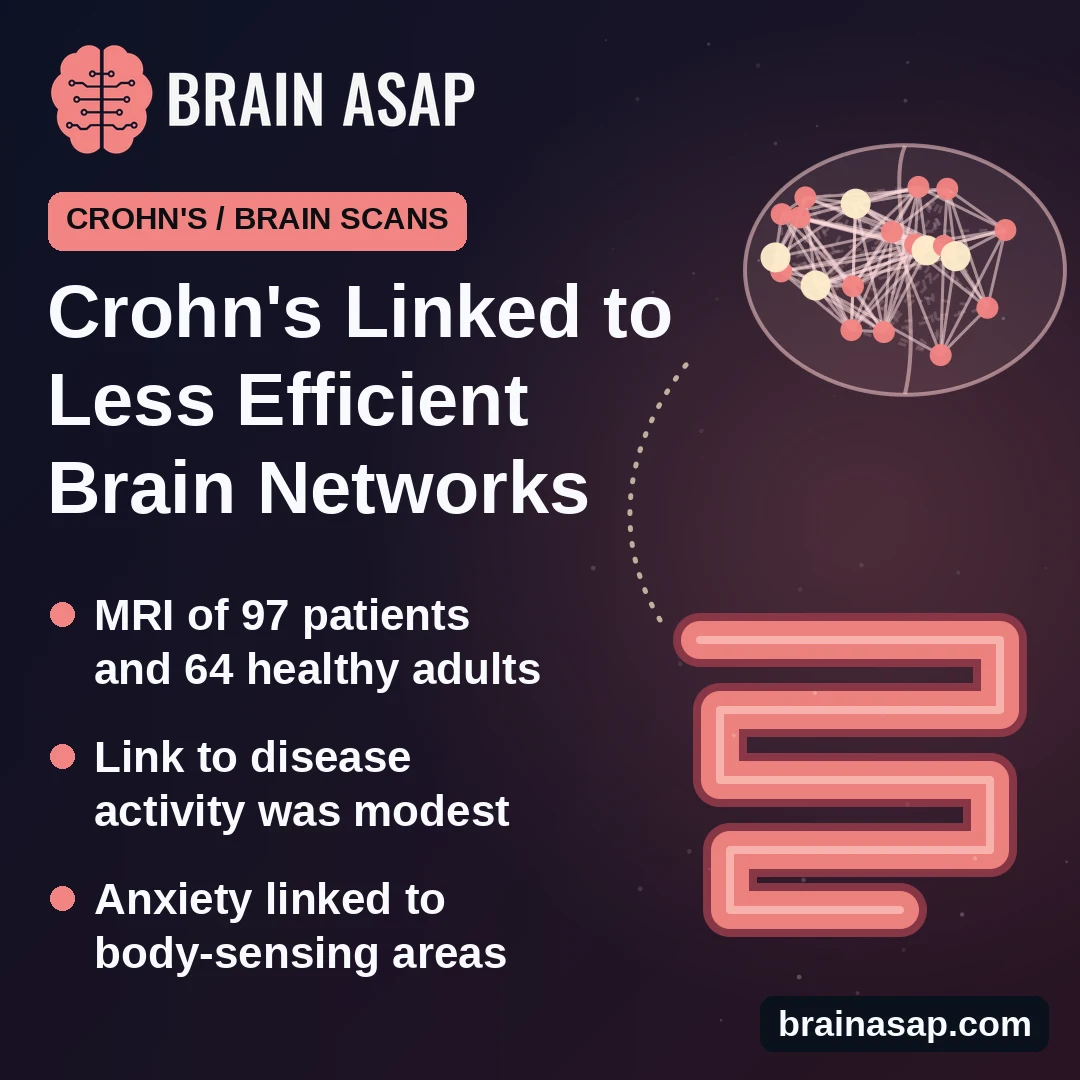
TL;DR: In a 2026 brain scan study from Shanghai, 97 adults with Crohn's disease, a long-term bowel inflammation, lay quietly in a brain scanner, along with 64 healthy adults. The brain networks estimated from resting MRI signals had lower efficiency scores in the Crohn’s disease group. Within that group, the associations with disease activity were small.
In people with Crohn’s disease, higher anxiety scores were associated with differences in the way a model connected brain areas involved in sensing the body.
Key Findings
- Less efficient brain networks: Functional networks estimated from resting MRI scored lower on efficiency in the Crohn’s group than in healthy controls.
- Small link to disease activity: People with more active Crohn's disease had slightly less efficient networks, and squared correlations corresponded to only about 4% to 6% of the variation in each of the charted measures.
- Body-sensing areas stood out: The insula and thalamus, regions that help the brain read signals from the gut and the rest of the body, had fewer strong connections in people with Crohn's disease than in healthy adults.
- Anxiety linked to signaling: Among people with Crohn's disease, higher anxiety scores went along with 28 differences in how a set of body-sensing brain areas appeared to drive one another, based on a computer model.
Source: CNS Neuroscience & Therapeutics (2026) | Xu, Bao, Wu and colleagues
Crohn's disease inflames the gut, but many people living with it also deal with anxiety, low mood and fatigue. That has made researchers wonder what the illness does to the brain.
A brain scan study from Shanghai looked at how brain regions work together in people with Crohn's disease, and whether the patterns were associated with anxiety scores.
Who Had Brain Scans?
A 2026 study in CNS Neuroscience & Therapeutics, by Shuai Xu, Chunhui Bao, Huangan Wu and colleagues at Fudan University and Shanghai University of Traditional Chinese Medicine, compared 2 groups of right-handed adults:
- People with Crohn's disease: 97 adults, average age 32, who had lived with the disease for about 4.5 years on average
- Healthy adults: 64 people of similar age with no major long-term illness
People with Crohn's disease had not taken steroids, drugs that calm the immune system, biologic drugs, or psychiatric medicines in the past 3 months, and none had a diagnosed psychiatric disorder. Most had fairly mild disease.
Their average disease activity score was 126, below the usual cutoff of 150 for active disease.
Each person lay still in an MRI scanner with eyes closed. Scans tracked how activity in 280 brain regions rose and fell over time.
The map links regions whose MRI signals fluctuate together.
People with Crohn's disease also filled out a standard anxiety questionnaire. Their average score was 6 out of 21, which falls below the usual threshold for elevated symptoms. The paper reports the group average.
How Were Brain Networks Different in Crohn's Disease?
Xu's team treated the brain like a road map, with regions as towns and connections as roads. From that map they calculated measures such as:
- Network efficiency: how short the paths were between regions in the statistical network
- Local efficiency: how well each region's neighbors were linked to one another
- Path length: how many steps it took, on average, to get from one region to another
Compared with healthy adults, people with Crohn's disease had less efficient networks, both across the whole brain and within local neighborhoods, and longer paths between regions. These differences held after accounting for age, sex, years of schooling and head movement in the scanner.
Connections among the brain's best-linked hub regions, and between those hubs and other regions, were also weaker in people with Crohn's disease.
Did More Active Crohn's Disease Mean Bigger Brain Changes?
Slightly. People whose Crohn's disease was more active had somewhat less efficient brain networks. But each link was modest, with correlations of about 0.19 to 0.24 on a scale where 0 means no link and 1 means a perfect match.
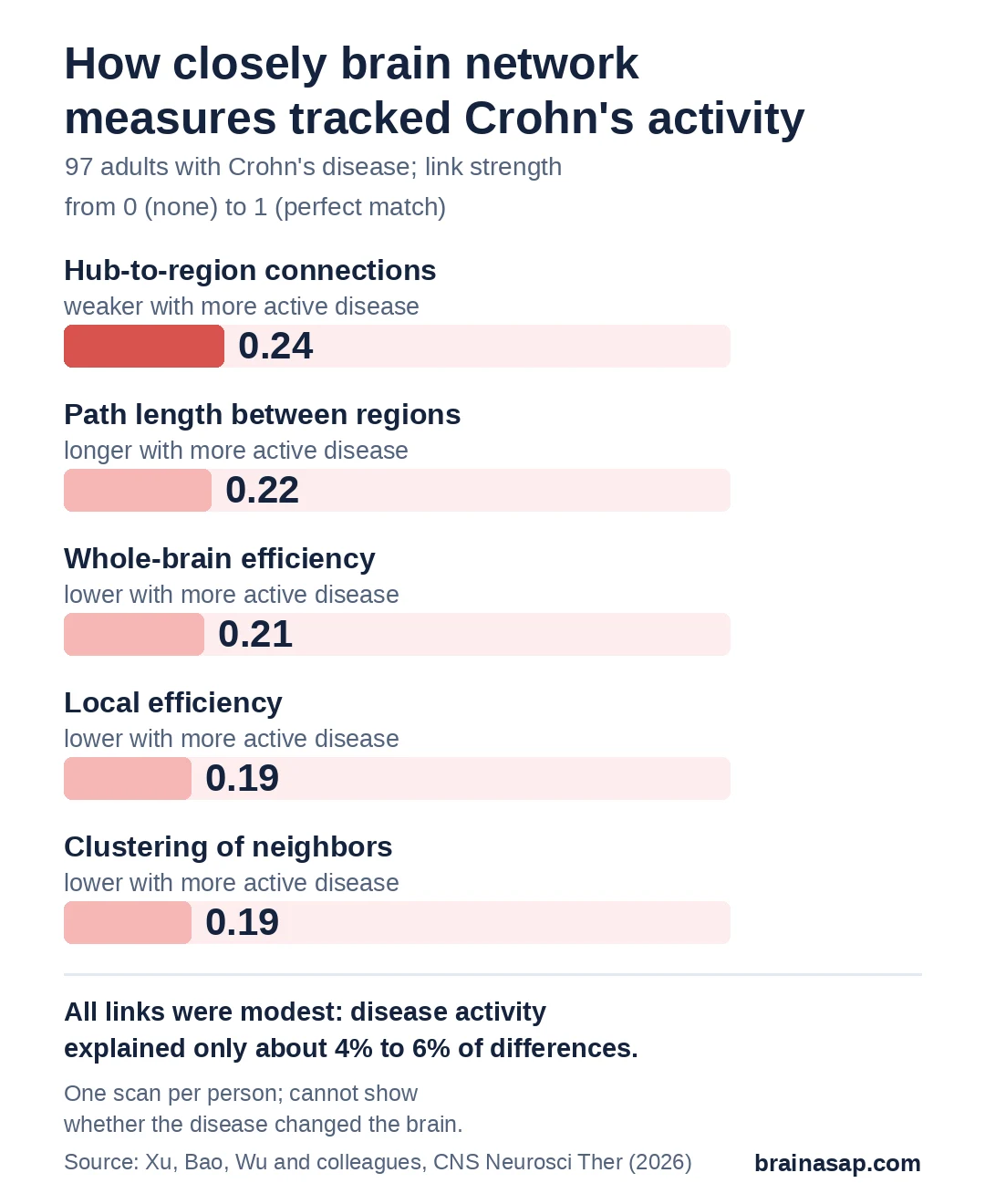
Squaring the correlations gives roughly 4% to 6% shared variation between disease activity and each charted measure. This describes how the scores varied together across patients.
Which Brain Areas Stood Out?
Several regions had fewer strong connections in people with Crohn's disease than in healthy adults. Among them were:
- Insula: a region deep in the brain that helps sense what is going on inside the body, such as gut discomfort, and links it to emotion
- Thalamus: a relay station that passes sensory signals on to the rest of the brain
- Postcentral gyrus: a strip of brain that handles touch and body sensation
People with Crohn's disease also had slightly more gray matter in the putamen, a region involved in movement and reward. In patients, more active disease went with fewer strong connections in the putamen.
Xu and colleagues suggested these changes may reflect how ongoing gut signals reshape the brain's body-sensing systems. This study, which scanned each person only once, could not show which came first.
Where Does Anxiety Come In?
Next, a computer model was used to estimate how 5 body-sensing regions, including the insula, thalamus and putamen, drove one another's activity.
In people with Crohn's disease, higher anxiety scores were associated with 28 of these estimated links.
For example, anxiety was associated with changes in how strongly the insula excited itself and in signals running between the thalamus and putamen.
Xu and colleagues described this as evidence that anxiety "causally" shapes these circuits. That goes further than a single scan can show.
This kind of model estimates direction of influence within the brain, but it can't tell whether anxiety changed the circuits or the circuits contributed to anxiety. Anxiety was also not measured in the healthy adults, so the 2 groups could not be compared on it.
What Are the Limits?
- One scan per person: can't show whether Crohn's disease changed the brain or something else explains both
- Groups not well matched: 77% of people with Crohn's disease were men vs 59% of healthy adults, and patients had about 2 fewer years of schooling; both were adjusted for, but some imbalance may remain
- Milder disease only: people on steroids, immune-calming drugs or biologics were left out, so results may not apply to more severe Crohn's disease
- Low anxiety overall: the group average was below the usual symptom threshold, and people with psychiatric disorders were excluded
- No gut data: gut bacteria and inflammation markers weren't measured, so the gut-to-brain pathway wasn't tested directly
Results held up when the team repeated the analysis with a different brain map and in subgroups matched for sex and other traits.
Could Treating Anxiety Help the Gut-Brain Link in Crohn's Disease?
Xu and colleagues suggested that treatments aimed at anxiety might help people with Crohn's disease, since anxiety and gut symptoms seemed to share brain circuits. This study didn't test any treatment.
A useful next step would be to scan the same people over time, as their disease flares and calms, to see whether brain network changes follow the gut or the mood.
Citation: DOI: 10.1002/cns.71113. Xu S, Bao C, Zhu X, Wang Q, Zhang B, Wu L, Li H, Yu X, Hao Z, Chen Z, Wang H, Wu H. Disrupted Functional Network Organization in Crohn's Disease: Interoceptive Alterations Linked to Anxiety. CNS Neuroscience & Therapeutics. 2026;32(9):e71113. PMID: 42669140. Full text: PMC13526404.
Study Design: Cross-sectional resting-state fMRI study; graph-theory network measures, rich-club and gradient analyses, gray matter volume, and spectral dynamic causal modeling of 5 interoceptive regions; adjusted for age, sex, education and head motion; FDR-corrected.
Sample Size: 97 adults with Crohn's disease (75 men, 22 women) and 64 healthy adults (38 men, 26 women).
Key Statistic: Lower global efficiency in Crohn's disease (t = −3.46, q = .001); correlations with disease activity (CDAI) between 0.19 and 0.24 in size (q = .038 to .045); 28 anxiety-related effective connections.
Caveat: Single scan per person; sex and education imbalance between groups; untreated, mostly mild disease; low average anxiety; anxiety not measured in healthy adults; no gut microbiome or inflammation data. Full published text reviewed.