TL;DR: In 21 stroke survivors with swallowing problems, one acupuncture session at a point under the chin was linked to more activity in movement and touch areas on the healthy side of the brain, compared with 29 healthy adults. There was no fake-needle comparison, and swallowing itself wasn't measured.
Key Findings
- 50 adults: 21 stroke survivors with swallowing trouble, 29 healthy.
- Brain activity rose in patients: Movement and touch areas on the healthy side.
- No change in healthy adults during the needling.
- Stronger needle sensation: Patients reported more aching and fullness.
- One session, no sham: Swallowing results not tested.
Source: Frontiers in Neurology (2026) | Chen et al.
Between a third and three-quarters of stroke survivors have trouble swallowing at some point. It can lead to choking, pneumonia and poor nutrition. In China, acupuncture at a point just under the chin, called Lianquan or CV23, is a common add-on treatment.
Doctors at Guangxi Medical University in Nanning wanted to see what happens in the brain while that needle is in place.
One Needle, Light-Based Brain Readings
The study included two groups of similar age, around 55:
- Stroke survivors (21): Swallowing problems after a stroke, typically about 7 months earlier.
- Healthy adults (29): No stroke or swallowing trouble.
Everyone wore an fNIRS cap, which shines near-infrared light through the scalp to track oxygen-rich blood in the brain's outer layer. An experienced acupuncturist placed one needle at CV23 and twirled it in three 30-second bursts. Afterward, participants rated needle sensations like aching, fullness and heaviness, which traditional practice calls deqi.
Patients' Brains Lit Up on the Healthy Side
In stroke survivors, oxygen-rich blood rose during needling in three areas on the side of the brain not damaged by the stroke: the main movement area and two touch-processing areas. Healthy adults showed no significant change anywhere.
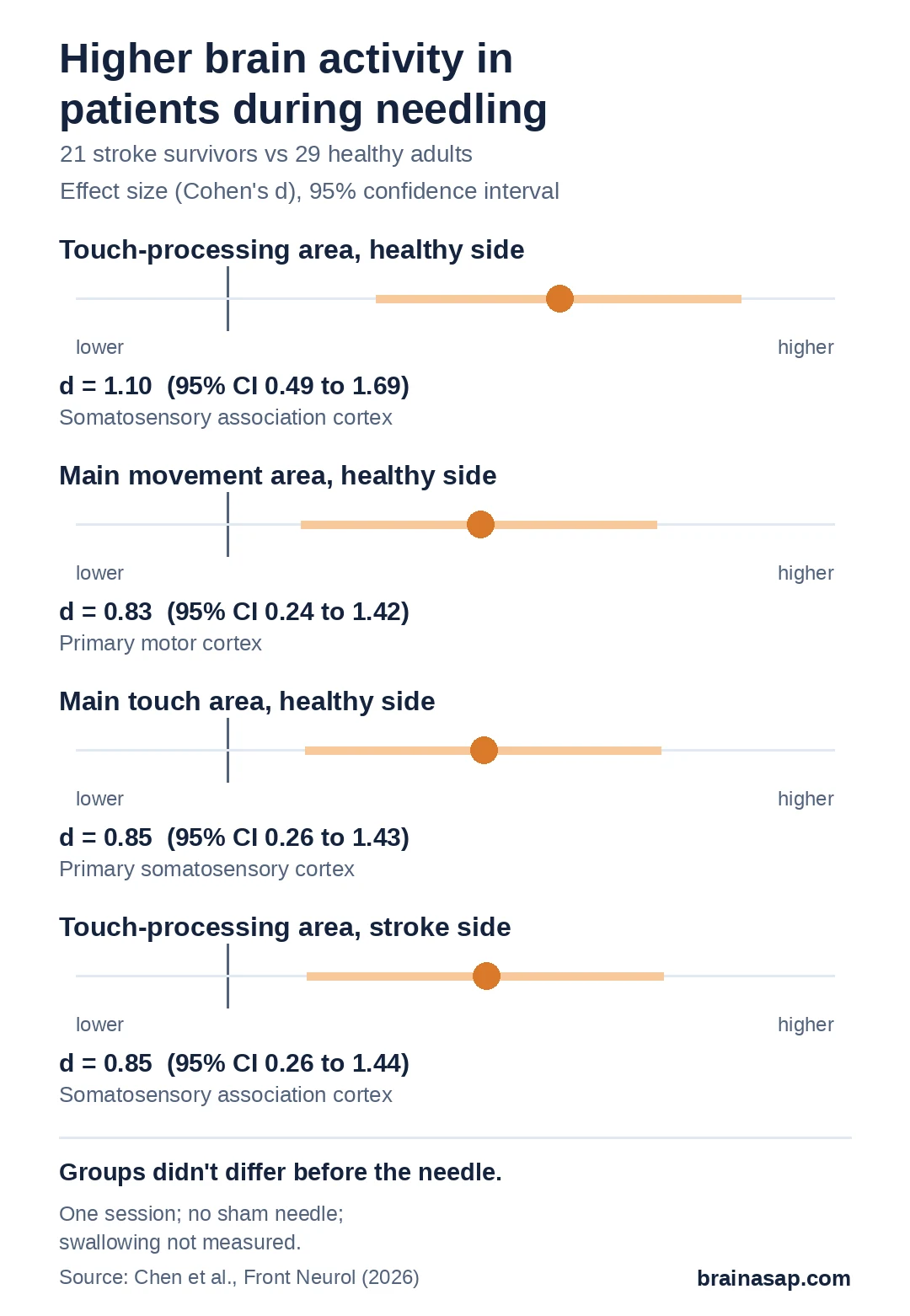
Compared directly, patients had higher activity than healthy adults in five areas during needling. Before the needle went in, the groups didn't differ.
Stronger Sensations Went With More Activity
Stroke survivors reported stronger overall needle sensations than healthy adults, especially aching and fullness. In patients, stronger sensations went along with more activity in some of these brain areas. No such link showed up in healthy adults. The authors call these links exploratory.
No Sham Needle and No Swallowing Test
- No sham control: Any needle or touch might cause similar changes.
- One session: Immediate brain response only.
- Swallowing not measured: No link to recovery shown.
- Small groups: 21 patients and 29 controls.
- Surface readings only: fNIRS can't see deep brain areas, and scalp signals weren't filtered out.
- Sensations recalled afterward: Rated once after the needle came out.
Next Up: A Sham-Controlled Trial That Tracks Swallowing
This study shows the brain of a stroke survivor with swallowing problems reacts differently to chin acupuncture than a healthy brain does. It can't show that the needle helps people swallow. The next study needs a fake-needle group and real swallowing outcomes over weeks of treatment.
Citation: DOI: 10.3389/fneur.2026.1921352. Chen H, Liu Y, Tang Y, Nong F, Huang Y, Xiao C, Long Y. Cortical hemodynamic responses to acupuncture at Lianquan (CV23) in patients with post-stroke dysphagia: a functional near-infrared spectroscopy study. Front Neurol. 2026;17:1921352.
Study Design: Single-center cross-sectional fNIRS study of one acupuncture session.
Sample Size: 21 post-stroke dysphagia patients, 29 healthy controls.
Key Statistic: Between-group HbO during needling: contralesional SAC d = 1.097 (95% CI 0.489 to 1.694), M1 d = 0.834, S1 d = 0.847, ipsilesional SAC d = 0.854; total deqi higher in patients (p = 0.004).
Caveat: No sham control; single session; no swallowing outcomes; small sample.