TL;DR: Among 10 people with dementia who finished a 6-month therapy garden program in Germany, restlessness ratings were lower than at the start. With no comparison group, the study cannot show the garden caused the change.
Key Findings
- Lower restlessness ratings: Scores fell significantly from start to 3 months (11 residents) and start to 6 months (10 residents). Change was large in both.
- Agitation and low mood moved together: At 6 months, higher agitation scores went with higher depression scores (r = 0.84 and 0.83 on two scales).
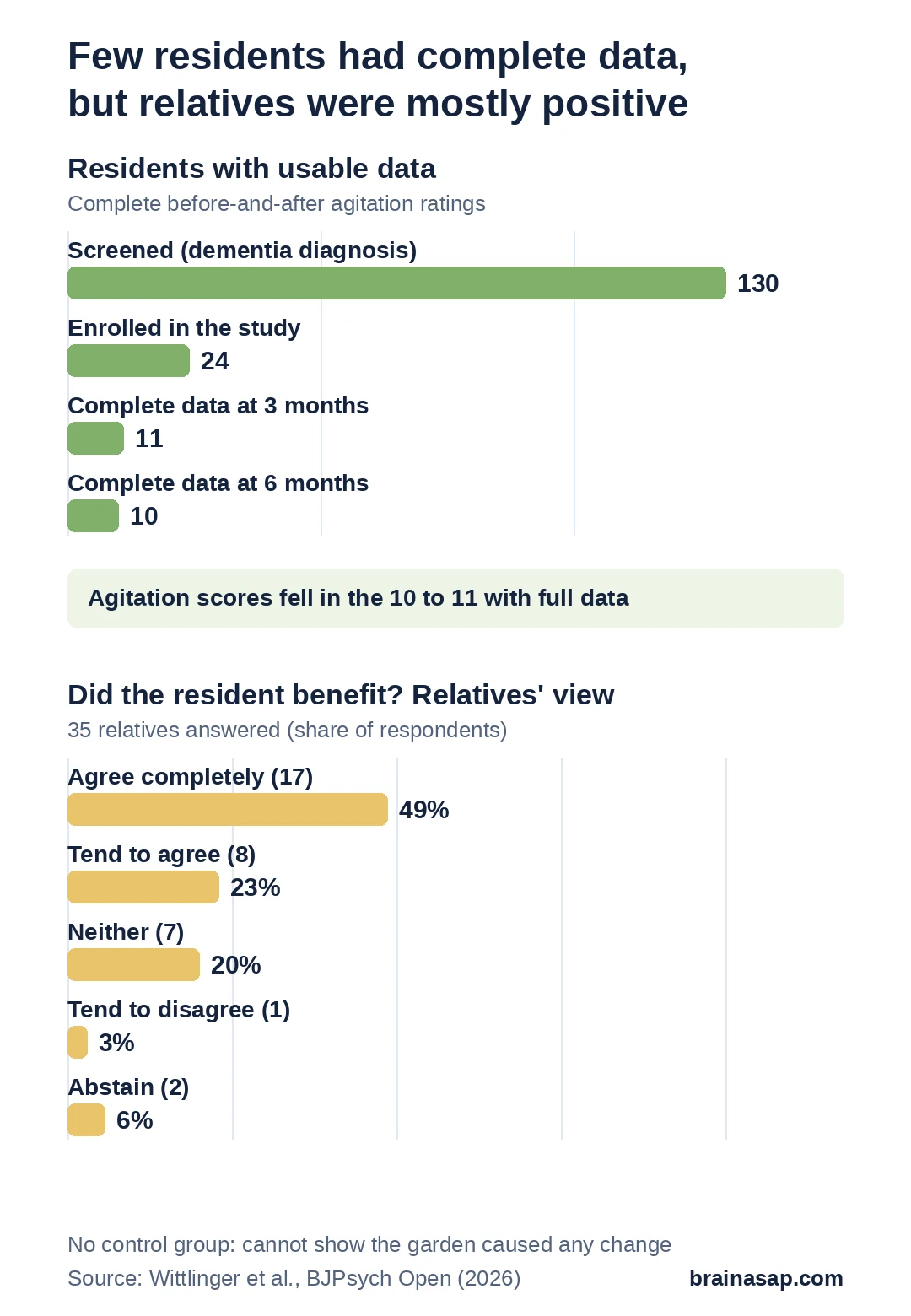
- Relatives mostly positive: Of 35 relatives, 17 (49%) fully agreed the resident benefited and 8 (23%) tended to agree. Seven said neither; one tended to disagree.
- Most left the analysis: Complete before-and-after data for only 11 of 24 residents at 3 months and 10 at 6 months.
- No control group: Everyone got the garden, so time, season, staff attention, and family visits could all play a part.
Source: BJPsych Open (2026) | Wittlinger et al.
Can a garden calm the restlessness that comes with dementia? In one German residential village, restlessness ratings fell over six months among the residents who stayed in the analysis. But that was only 10 people, and everyone got the garden, so there was no one to compare them with.
Agitation is one of the hardest parts of living with dementia, for the person and for the people around them. It can look like pacing, fidgeting, or a constant inability to settle. Medications are sometimes used, but they carry risks, which is why care teams keep looking for gentler options. Time in nature is one popular idea. Reviews suggest it may help, but the individual studies are often small and hard to compare.
The Therapy Garden and Program
The study took place in Das Dorf, an inclusive residential village in Mülheim an der Ruhr, Germany, where older people, people needing care, and people with and without disabilities live side by side. Landscape architects had designed the garden for people with dementia and built it into the village. Dementia specialists evaluated it afterward, so the research team did not control who used it or how.
The garden was built to adapt to different stages of the disease:
- Circular walking paths, with signposts to help people find their way.
- Plant stations used for physiotherapy and occupational therapy, aimed at balance, strength, and fine hand skills.
- Raised beds that people with physical limits could still garden in.
- Shaded pavilions.
Over 6 months, mostly from March to September, residents received 2 to 3 hours of nature-based occupational therapy a week. Depending on how advanced their dementia was, they also did 4 hours of mobility exercise or simply spent 4 hours outdoors. On average, they spent about an hour a day in the garden, on their own or with help. Around 70 relatives, volunteers, and staff members were trained on dementia and on how to use the garden well.
Who Took Part
Of 130 village residents with a dementia diagnosis, 24 joined the study. The others were left out because they or their relatives had not consented, or because of language loss (aphasia), motor problems, or too little physical resilience for the program.
- Age: 61 to 95, averaging 81.
- Sex: 22 of 24 were women.
- Severity: 6 mild, 11 moderate, and 7 severe dementia at the start.
How Restlessness Was Measured
Clinicians rated three items from a standard dementia assessment (the non-cognitive part of the Alzheimer’s Disease Assessment Scale): motor restlessness, pacing, and tremor. Added together, they give a score from 0 to 15, where higher means more agitation. This is not a dedicated agitation scale. The authors used these items because they capture visible, physical signs of agitation and are quick to use in an outpatient setting. Tremor can also have other causes, which is one reason to treat this as a rough gauge.
Depression was rated with two standard scales, the MADRS and the HAM-D, which the paper uses as a stand-in for psychological well-being. Assessments happened before the program (start), after 3 months, and after 6 months. Because participation was voluntary and not always feasible for people with dementia, many residents missed at least one assessment. The analysis used only people with complete before-and-after data.
Restlessness Ratings and Relatives’ Views
Agitation scores were significantly lower than at the start after 3 months (11 residents) and after 6 months (10 residents). The paper reports these as paired comparisons of each person against themselves, with large effect sizes of about 1.2 both times. Larger than 0.8 is usually called a large effect. The paper does not report the actual average scores, and gives the significance only as p below 0.05, so we cannot say how many points of the 15-point scale the change amounted to.
The paper also compared agitation with depression scores at 6 months. Residents with higher agitation scores tended to have higher depression scores, with correlations of 0.84 (MADRS) and 0.83 (HAM-D). The authors caution that the two ratings may partly measure overlapping things, and that the correlation was measured at one point in time, so it cannot tell us that less agitation leads to a better mood, or the reverse.
What relatives said
A separate survey collected answers from 35 relatives. The questionnaire was newly developed for this study, and there are more respondents than residents, so some residents likely had more than one relative answering. Their answers leaned positive:
- “The garden enriches the village”: 28 (80%) strongly agreed and 7 (20%) somewhat agreed. Nobody was negative or neutral.
- “It is a therapeutic service”: 24 (69%) said this was completely accurate and 11 (31%) somewhat.
- “The resident has benefited”: 17 (48.6%) agreed completely, 8 (22.9%) tended to agree, 7 (20%) said neither, and 1 (2.9%) tended to disagree. Two abstained.
Answers on whether the garden made relatives more likely to visit, or involved families in activities, were mixed.
Limits of the Study
- No control group: Agitation in dementia rises and falls on its own; weather, extra activity, and staff attention may matter. Authors say the design cannot establish that the garden caused any change.
- Very small numbers: Only 10 to 11 people had usable paired data, of 24 enrolled and 130 screened. Those who kept taking part may differ from those who did not.
- Selected group: Residents with language loss, motor problems, or low resilience excluded, so results may not apply to more advanced illness.
- No masking described: Paper does not say whether raters knew program details; relatives’ questionnaire was not validated.
- Other factors not adjusted for: Depression, family visits, and garden use per person; medication changes not reported.
- Crude agitation measure: Three items from a general dementia scale.
A Controlled Study of Therapy Gardens Is Warranted
If you have a relative with dementia, this study does not show that a garden will calm them. What it offers is a hopeful signal from a real care setting, in which a low-risk activity with several ingredients (fresh air, gentle movement, plants to touch and smell, and company) was linked to lower agitation ratings and mostly warm feedback from families. The authors tie this to the idea that agitation often reflects unmet needs such as boredom, loneliness, or lack of meaningful activity, which a garden can quietly address.
The logical next step is a controlled study, with a comparison group, more participants, and agitation measured with a dedicated scale, that can separate the garden itself from everything else that changes over a summer.
Citation: DOI: 10.1192/bjo.2026.12093. Wittlinger M, Jevtic S, Teimann S, Scherbaum N, Wiltfang J, Benninghoff J. The potential of nature exposure to reduce agitation: lessons from a naturalistic observational study in a stage-adaptive, dementia-friendly therapy garden. BJPsych Open. 2026;12:e242.
Study Design: Naturalistic observational before-and-after study of an existing therapy garden, with clinician-rated assessments at start, 3 months, and 6 months and a survey of relatives; no control group.
Sample Size: 24 residents with dementia (of 130 screened); complete paired agitation data for 11 at 3 months and 10 at 6 months; 35 relatives surveyed.
Key Statistic: Agitation (3 items of the ADAS-Noncog) fell after 3 months, t(10) = 4.07, dz = 1.23, and after 6 months, t(9) = 3.87, dz = 1.22 (both p < 0.05). Agitation correlated with MADRS (r = 0.84) and HAM-D (r = 0.83) at 6 months.
Caveat: No control group, so causation cannot be inferred; very small paired samples with high attrition; agitation measured with a three-item proxy; unvalidated relatives’ questionnaire.