TL;DR: In a hospital survey published in 2026 in eastern Turkey, 336 men whose partners were in the last months of pregnancy answered questions about their marriage, their feelings toward the coming baby and their mood over the past week.
Fathers-to-be who were happier with their marriage, or who already felt more bonded to the baby, scored lower on a depression screening questionnaire. Men with a past history of depression scored higher. A single survey can't show which came first.
Key Findings
- Marriage mattered most: Happiness with the marriage had the strongest link to lower depression scores of any factor checked.
- Bond with the baby: Men who felt closer to the unborn baby also scored somewhat lower.
- Other lower scores: University-educated men and those living as a couple, rather than with extended family, scored lower too.
- Past depression: The 11% of men with a history of depression scored higher.
- Partial picture: All factors together accounted for about 26% of the differences in depression scores.
Source: Healthcare (2026) | Kurt Can and Can
Depression around pregnancy and birth is usually discussed as a mothers' issue. But fathers go through a big change too, and some struggle with low mood before the baby even arrives.
A 2026 study in Healthcare, by Emine Kurt Can and Veysel Can at Van Yüzüncü Yıl University in Turkey, looked at what goes along with depression symptoms in fathers-to-be.
Who Took Part?
From January to September 2025, researchers interviewed men at a hospital in Turkey's Eastern Anatolia region. Each man's partner was between 28 and 40 weeks pregnant.
- Men: 336, aged 19 to 50, most aged 25 to 34
- Married: 88% for 5 years or less
- Living arrangement: 80% as a couple; 20% with extended family
- Past depression: 38 men (11%)
Interviews took 15 to 20 minutes in a quiet room at the hospital.
What Did the Men Answer?
Each man completed 3 questionnaires:
- Marriage satisfaction: 10 questions, scored from 10 to 50.
- Bond with the unborn baby: 16 questions about thoughts and feelings toward the baby, scored from 16 to 80.
- Depression symptoms: the Edinburgh scale, a 10-question screening tool widely used around birth, scored from 0 to 30. Scores of 13 or more usually flag possible depression.
Average depression scores were 8.4, below that cutoff, but they ranged up to 23.
What Went Along With Lower Depression Scores?
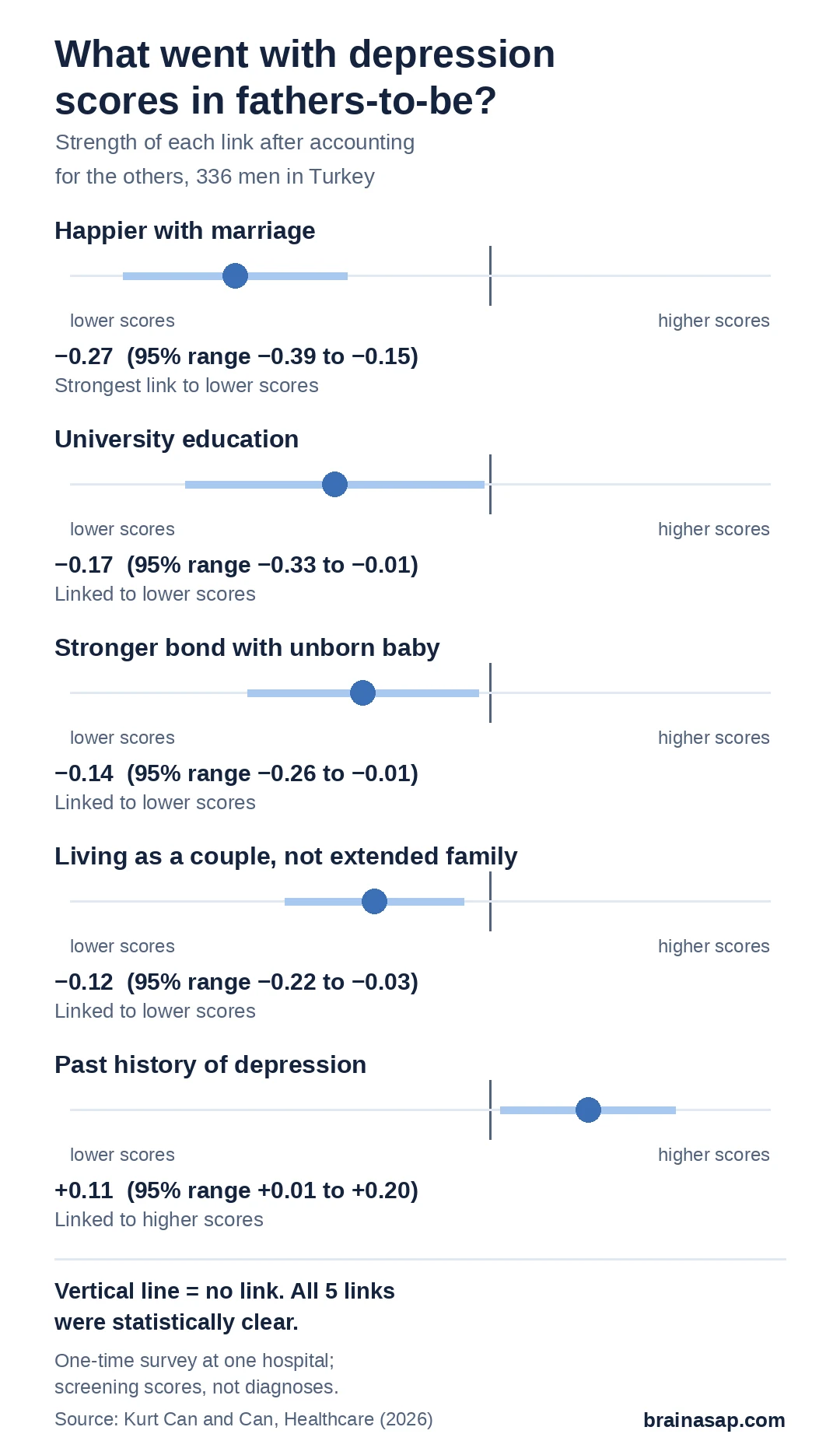
Researchers put all the factors into one model to see which still mattered once the others were accounted for.
- Happier marriage: strongest link to lower scores
- University education: lower scores
- Stronger bond with the baby: lower scores
- Living as a couple rather than with extended family: lower scores
- Past depression: higher scores
Income, where the family lived and the partner's education no longer made a clear difference.
In plain terms, how a man felt about his marriage lined up with his mood more than anything else measured. On its own, marriage satisfaction had a moderate link with depression scores.
What Are the Limits?
- Snapshot: Low mood could make a marriage feel worse, rather than the other way around.
- Screening, not diagnosis: The Edinburgh scale flags symptoms; nobody was clinically assessed.
- One hospital: Men who used a university hospital in one region, spoke Turkish and had at least primary schooling.
- Self-report: Men may underreport low mood or marriage problems in a face-to-face interview.
- Much unexplained: About 3 quarters of the differences in depression scores weren't accounted for.
Include Dads in Pregnancy Checkups
Kurt Can and Can suggested that prenatal care could screen fathers for depression too, especially men with a past history, and support couples' relationships and fathers' bonding with the baby.
A study following fathers from pregnancy through the baby's first year would show whether a stronger marriage actually protects against depression, or whether depression strains the marriage.
Citation: DOI: 10.3390/healthcare14172829 Kurt Can E, Can V. The Role of Marital Satisfaction and Paternal Attachment in Relation to Depression During the Transition to Fatherhood: Evidence from Turkey. Healthcare. 2026;14(17):2829.
Study Design: Descriptive cross-sectional, face-to-face interviews at one hospital in Eastern Anatolia, Türkiye (January–September 2025); Marital Life Scale, Paternal-Antenatal Attachment Questionnaire, Edinburgh Postpartum Depression Scale; multiple linear regression.
Sample Size: 336 expectant fathers aged 19–50 whose partners were at 28–40 weeks' gestation.
Key Statistic: EPDS mean 8.4 ± 5.4. Adjusted standardized β: marital satisfaction −0.273 (95% CI −0.393 to −0.153); university education −0.166 (−0.326 to −0.006); paternal attachment −0.136 (−0.260 to −0.012); nuclear family −0.124 (−0.220 to −0.028); history of depression +0.105 (0.011 to 0.199). Model R² = 0.284 (adjusted 0.264). Unadjusted r with EPDS: marital satisfaction −0.452, attachment −0.399.
Caveat: Cross-sectional; single center; self-report screening tool, not diagnosis; Turkish-speaking men with at least primary education only.