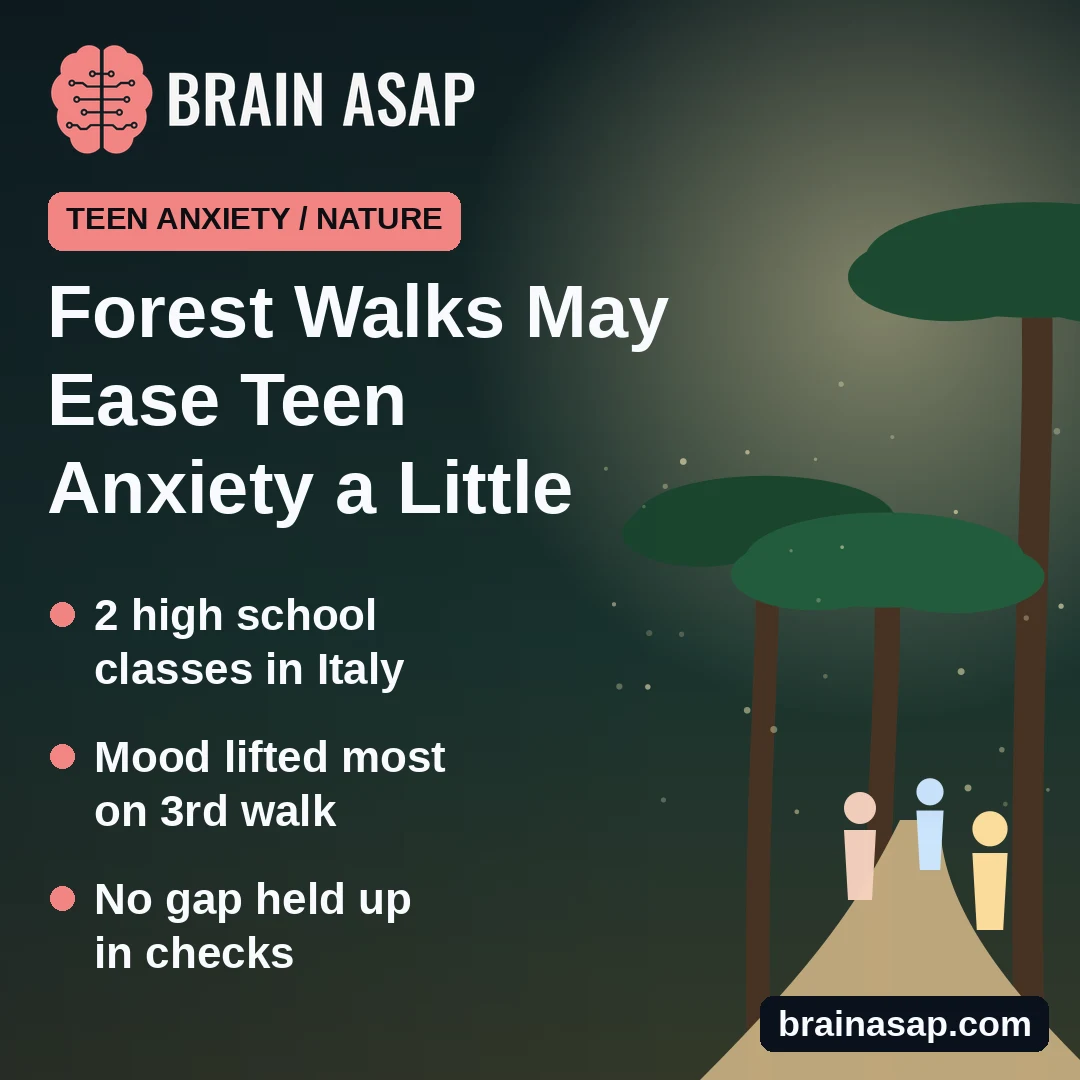
TL;DR: In a 2026 pilot at an Italian high school, one class of older teens took 4 guided, slow walks through a coastal pine forest while another class kept to its usual lessons. Students filled in an anxiety questionnaire before and for up to 11 weeks after.
Anxiety scores fell a little more in the forest class, but none of the four anxiety comparisons remained statistically clear after adjustment for multiple tests.
Key Findings
- Small edge for the forest class: At every check-in, anxiety scores had dropped more in the forest class than in the class that stayed at school.
- Not clear enough: The biggest gap, about 5 points on a 114-point scale at 8 to 9 weeks, didn't survive a check for chance findings.
- Mood after a walk: Students' mood improved clearly during the third forest session, but there was no school-day comparison for this.
- Some results went the other way: The forest class later had lower behavior grades and felt less connected to nature than the other class.
Source: Behavioral Sciences (2026) | Meneguzzo and Zabini
Anxiety often starts in the late teens, and schools are looking for simple ways to help. A walk in the woods sounds like an easy win.
A 2026 study in Behavioral Sciences, by Francesco Meneguzzo and Federica Zabini at Italy's National Research Council, tested whether a short forest therapy program could fit into a school term and whether it showed any early sign of easing anxiety.
What Did the Forest Class Do?
Everything took place at a public high school in Cecina, Tuscany, in early 2026. Two classes following the same curriculum took part, and students weren't picked for having anxiety.
- Forest class: 26 students who went on 4 weekly forest sessions in March
- School class: 28 students who kept their usual school activities
- Age: 17 to 18; 51 of the 54 students were girls
Each session lasted about 3 hours on a school morning in a protected pine forest by the sea. A school psychotherapist and psychologist led a slow, flat walk of about 1.5 km, with stops that invited students to notice what they could see, hear, touch and smell.
Attendance was good: 24 of the 26 forest-class students came to at least 3 sessions.
Did Anxiety Scores Fall More in the Forest Class?
All students filled in a standard anxiety questionnaire for young people, scored from 0 to 114, once before the program and 4 times afterward, up to 10 to 11 weeks after the last walk.
Both classes started at almost the same average score, about 42.
Average drops from the starting score:
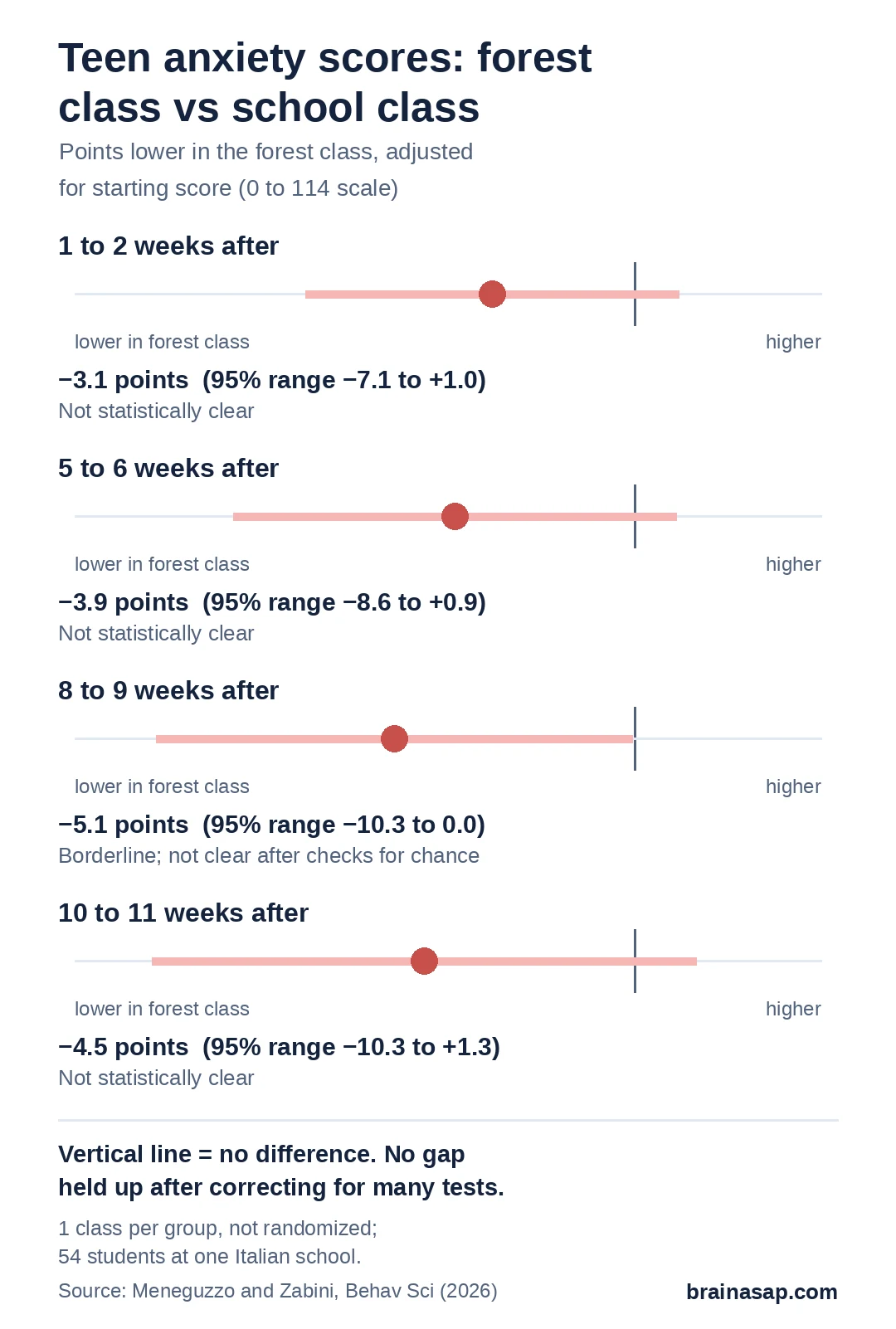
- 1 to 2 weeks after: forest class 5.2 points, school class 2.3
- 5 to 6 weeks after: forest 6.0, school 2.2
- 8 to 9 weeks after: forest 3.7; school class scores rose by 1.4
- 10 to 11 weeks after: forest 4.5, school 0
The largest gap, about 5 points at 8 to 9 weeks, just reached the usual cutoff for statistical significance. But many comparisons were run, and after correcting for that, none of the four anxiety gaps remained statistically clear after adjustment for multiple tests.
Mood Lifted During the Walks, but Not Every Time
The forest class also rated their mood, such as tension, anger, tiredness and energy, just before and just after each walk.
- Session 1: almost no change
- Session 2: a small improvement
- Session 3: a large improvement, the only one that held up statistically
- Session 4: a moderate improvement
The school class didn't fill in these mood ratings, so there's no way to know whether a morning out of class anywhere would have done the same. Weather also differed between sessions.
Students whose mood lifted most during the walks didn't show bigger drops in anxiety weeks later; if anything, the link ran the other way.
Two Surprises in the Other Direction
Researchers also looked at school records and a questionnaire about nature given at the end:
- Behavior grades: lower in the forest class after the program, compared with the school class
- Feeling connected to nature: also lower in the forest class
Nature connectedness was not measured before the program. Behavior grades were available beforehand, and the comparison adjusted for them. Even so, pre-existing classroom or teacher-rating differences could still explain the lower grades. Meneguzzo and Zabini cautioned that neither the good nor the bad differences can be pinned on forest therapy.
Why This Pilot Can't Settle the Question
- 1 class per group: Any difference could come from the class itself, its teachers or its mix of students.
- Not randomized: Classes, not students, were assigned, and not by chance.
- No fair comparison: The school class got no outing, attention or break from lessons.
- Small and mostly girls: 54 students, 94% of them girls, at one school.
- Not registered in advance: The analysis plan wasn't publicly logged before the study.
A Bigger Trial of School Forest Walks Is Needed
The pilot showed that 4 guided forest sessions can run smoothly within a school term. Whether they actually ease anxiety is still open.
Answering that would take many classes randomly assigned to forest walks or to a comparable outing, with the plan registered beforehand.
Citation: DOI: 10.3390/bs16091647 Meneguzzo F, Zabini F. Therapist-Guided Forest Therapy in Adolescents: Operational Feasibility and Anxiety-Symptom Signals from a Two-Classroom Quasi-Experimental Pilot Study. Behavioral Sciences. 2026;16(9):1647.
Study Design: Two-classroom, non-randomized quasi-experimental pilot; 4 weekly therapist-guided forest therapy sessions (March 2026) vs usual school activities; Spence Children's Anxiety Scale at baseline and 4 follow-ups; POMS-A before/after each session (intervention class only).
Sample Size: 54 students aged 17–18 (26 intervention, 28 control; 51 female), one public high school in Cecina, Italy.
Key Statistic: Baseline-adjusted classroom difference in SCAS: −3.05 (95% CI −7.05 to 0.95) at 1–2 weeks; −3.85 (−8.59 to 0.89) at 5–6 weeks; −5.14 (−10.25 to −0.04; p = 0.048, FDR q = 0.135) at 8–9 weeks; −4.50 (−10.33 to 1.33) at 10–11 weeks. Session 3 mood improvement 9.71 (q = 0.002).
Caveat: Condition confounded with classroom; no active comparator; no principal anxiety result survived multiplicity correction; some exploratory mood, behavior and nature findings did; not preregistered.