TL;DR: In a survey published in 2026 of 383 people on kidney dialysis in Gaza during the war, interviewers asked about home damage, anxiety and post-traumatic stress symptoms.
More than 8 in 10 had at least moderate anxiety and more than half scored in the post-traumatic stress range. Losing a home was only weakly linked to post-traumatic stress, and a statistical model placed that link through higher anxiety. It cannot establish a chain of causes.
Key Findings
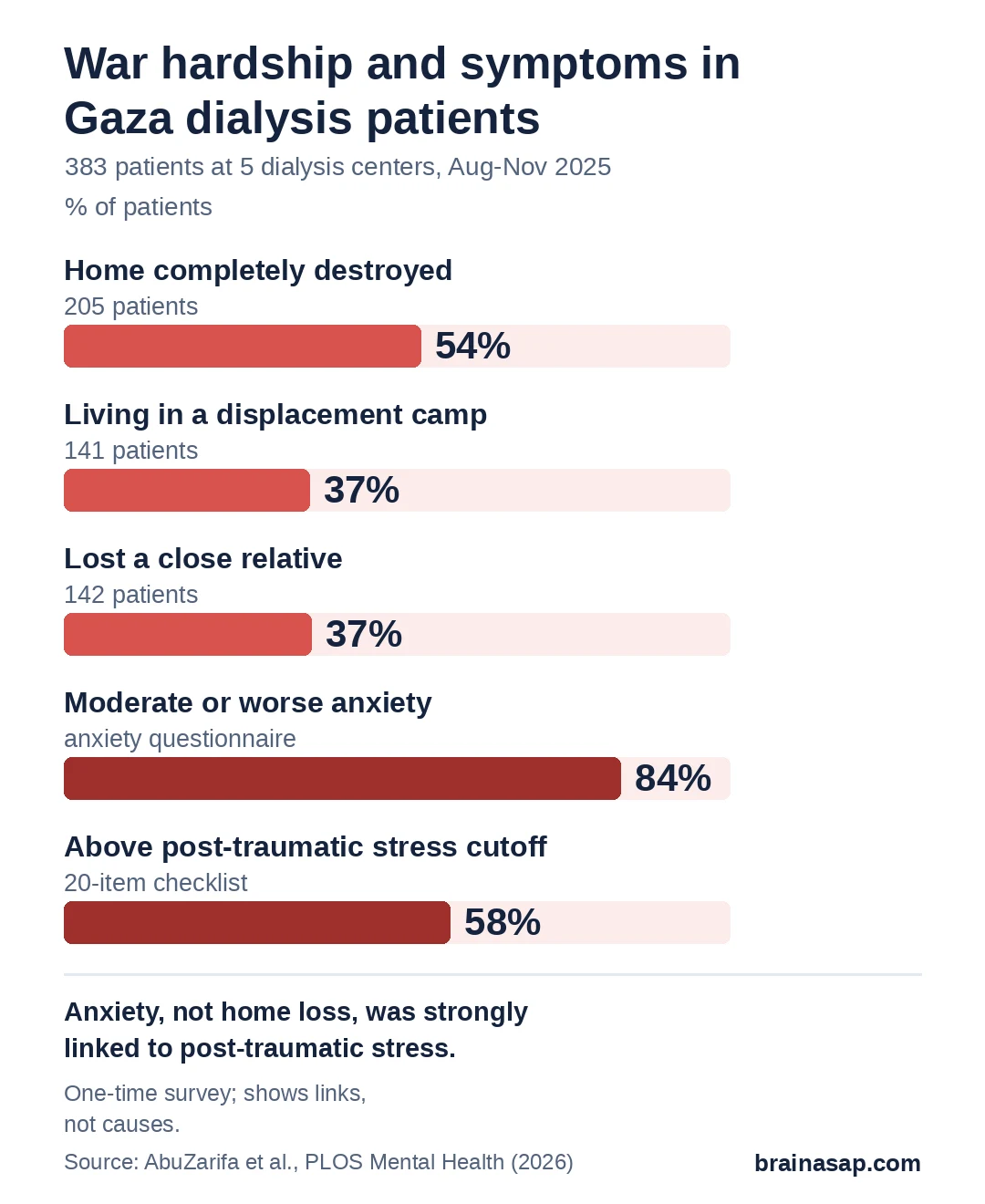
- Anxiety was very common: 84% of dialysis patients scored in the moderate to extremely severe range on an anxiety questionnaire.
- Post-traumatic stress too: 58% scored above a common cutoff on a post-traumatic stress checklist.
- Homes widely destroyed: 54% said their home was completely destroyed and 37% said it was partly destroyed.
- Anxiety mattered most: Patients with more anxiety had much higher post-traumatic stress scores, while home damage on its own went with only slightly higher scores.
- Statistical, not proven cause: The link between home loss and post-traumatic stress disappeared once anxiety was taken into account.
Source: PLOS Mental Health (2026) | AbuZarifa, Hamam, Hamam et al.
People whose kidneys have failed need dialysis, usually several sessions a week, to stay alive. In a war, that means reaching a working hospital again and again, whatever else has happened.
A 2026 study in PLOS Mental Health, led by Maha AbuZarifa of Al-Quds University with colleagues in Gaza, Egypt and Italy, looked at the mental toll on dialysis patients in Gaza during the war that began in October 2023.
Who Was Interviewed
Between August and November 2025, interviewers questioned 383 adults during their dialysis sessions at 5 centers in Gaza, including a field hospital run by Doctors Without Borders. About half were women, and more than a third were older than 55.
Each patient answered:
- A question about their home: not destroyed, partly destroyed (unlivable but standing) or completely destroyed
- An anxiety questionnaire with 7 items, such as feeling close to panic or having a racing heart without exertion
- A post-traumatic stress checklist with 20 items, such as unwanted memories, nightmares and feeling constantly on guard
What Patients Had Been Through
Hardship was widespread:
- 37% were living in a displacement camp
- 37% had lost a parent, child, sibling or spouse in the war
- 17% had been injured
- 74% had lost their main source of income
Most patients also had other long-term illnesses, such as high blood pressure (70%) or diabetes (24%).
Did Losing a Home Go With Post-Traumatic Stress?
Only weakly. Patients with more home damage had slightly higher post-traumatic stress scores, but home damage explained very little of the difference between patients.
Anxiety was a different story. Patients with higher anxiety scores had much higher post-traumatic stress scores, a strong link.
Researchers then tested whether the small link between home loss and post-traumatic stress ran through anxiety. Their model suggested it did:
- Home damage → anxiety: a small but statistically clear link
- Anxiety → post-traumatic stress: a strong link
- Home damage → post-traumatic stress, with anxiety accounted for: no clear link left
Together, home damage and anxiety accounted for about 42% of the differences in post-traumatic stress scores, mostly associated with anxiety in that model. Home damage alone accounted for only about 2% of the differences in anxiety.
Limits to Keep in Mind
- One-time survey: Anxiety and post-traumatic stress were measured at the same moment, so the study cannot show which came first.
- Overlapping questions: The anxiety and post-traumatic stress questionnaires share some symptoms, which can make their link look stronger.
- Home loss as 1 question: Home destruction also goes with injury, grief and lost income, which weren't separated out.
- Survivors only: Patients who died, left Gaza or stopped dialysis weren't included.
- Untested cutoff: The post-traumatic stress cutoff came from Western samples and hasn't been checked in Palestinian dialysis patients.
Could Anxiety Care Fit Into Dialysis Sessions?
AbuZarifa and colleagues suggested adding short anxiety-focused support, such as brief talk therapy or relaxation training, to routine dialysis care, since patients already come in several times a week. They noted that no trial has yet tested this for dialysis patients in a war zone, so it would need to be tried on a small scale first.
Citation: DOI: 10.1371/journal.pmen.0000682 AbuZarifa M, Hamam Y, Hamam M, Alaloul SW, Alinaby KM, Alaloul MW, Hijazi YM, AbuZarifa MB, AbuZarifa R, Veronese G. Exploring anxiety as a potential mediator of the association between home destruction and PTSD symptoms among hemodialysis patients in Gaza after 7th Oct 2023. PLOS Mental Health. 2026;3(8):e0000682.
Study Design: Cross-sectional interviewer-administered survey at 5 dialysis centers, August–November 2025; DASS-21 anxiety subscale, PCL-5 (cutoff >33), single-item home destruction; Spearman correlations and SEM mediation with 5,000 bootstrap resamples.
Sample Size: 383 adults on maintenance hemodialysis in Gaza (196 women, 187 men).
Key Statistic: Moderate-to-extreme anxiety 83.6%; PCL-5 >33 in 58%. Home destruction–PTSD rho = 0.14; home destruction–anxiety rho = 0.11; anxiety–PTSD rho = 0.62. Indirect effect 2.16 (95% CI 0.51–3.76); direct effect β = 1.36, p = 0.20; R² PTSD 0.42, anxiety 0.02. Adjusted for gender and residence: total effect not significant, indirect effect 3.28 (95% CI 0.90–5.80).
Caveat: Cross-sectional mediation; item overlap between DASS-21 anxiety and PCL-5; single-item exposure; survivor bias; PCL-5 cutoff not validated in this population.