TL;DR: A rare kind of sudden vision loss has been linked most consistently to injected semaglutide (Ozempic, Wegovy), not to every drug in its class, a new review finds. The authors say higher drug levels in the blood may matter, but the evidence is mostly observational.
Key Findings
- Strongest signal with injected semaglutide: Reported risks of the optic nerve stroke NAION ranged from about 1.3 to 7.6 times higher across studies.
- Weaker or no signal for others: Rybelsus at the doses covered by the review, dulaglutide, exenatide and tirzepatide showed no consistent link.
- Higher dose, stronger signal: Wegovy had about 4 times the reporting signal of Ozempic in a safety database.
- Retina worsening linked to fast sugar drops: Diabetic retinopathy worsening fit best with big, rapid HbA1c falls of 2 points or more.
- No case for class-wide limits: Authors favor choosing drug, form and dose per patient.
Source: Biomolecules and Biomedicine (2026) | Malluhi et al.
Since 2024, people taking Ozempic and Wegovy have heard warnings about a frightening side effect: sudden, painless vision loss in one eye. But GLP-1 drugs are a big family, with pills, daily shots and weekly shots at very different doses.
A team at Qatar University asked a practical question. Is the eye risk shared by the whole family, or does it follow specific drugs and doses?
What NAION Is, and How Rare It Stays
The condition is called non-arteritic anterior ischemic optic neuropathy, or NAION. It is a kind of stroke of the optic nerve: blood flow to the spot where the nerve leaves the eye drops, and part of the nerve is damaged. People usually notice it on waking. Vision loss is often permanent, and there is no proven treatment.
It is also uncommon. In the United States, about 2 to 10 people per 100,000 aged 50 and over develop NAION each year. Diabetes, high blood pressure, sleep apnea and a crowded optic disc all raise the baseline risk.
Semaglutide Shots Carry the Clearest Signal
The review pulled together human trials, observational studies and meta-analyses found in PubMed up to June 2026, plus FDA drug labels. It is a narrative review, so the authors did not pool the studies into one new number.
Across studies, reported hazard ratios for NAION ranged from 1.29 to 7.64. The first 2024 study found about a 4-fold higher risk with semaglutide, and a larger follow-up found a much smaller increase of 1.3 to 1.5 times.
One cohort of nearly 4 million older adults with type 2 diabetes is a good example of the pattern across drugs:
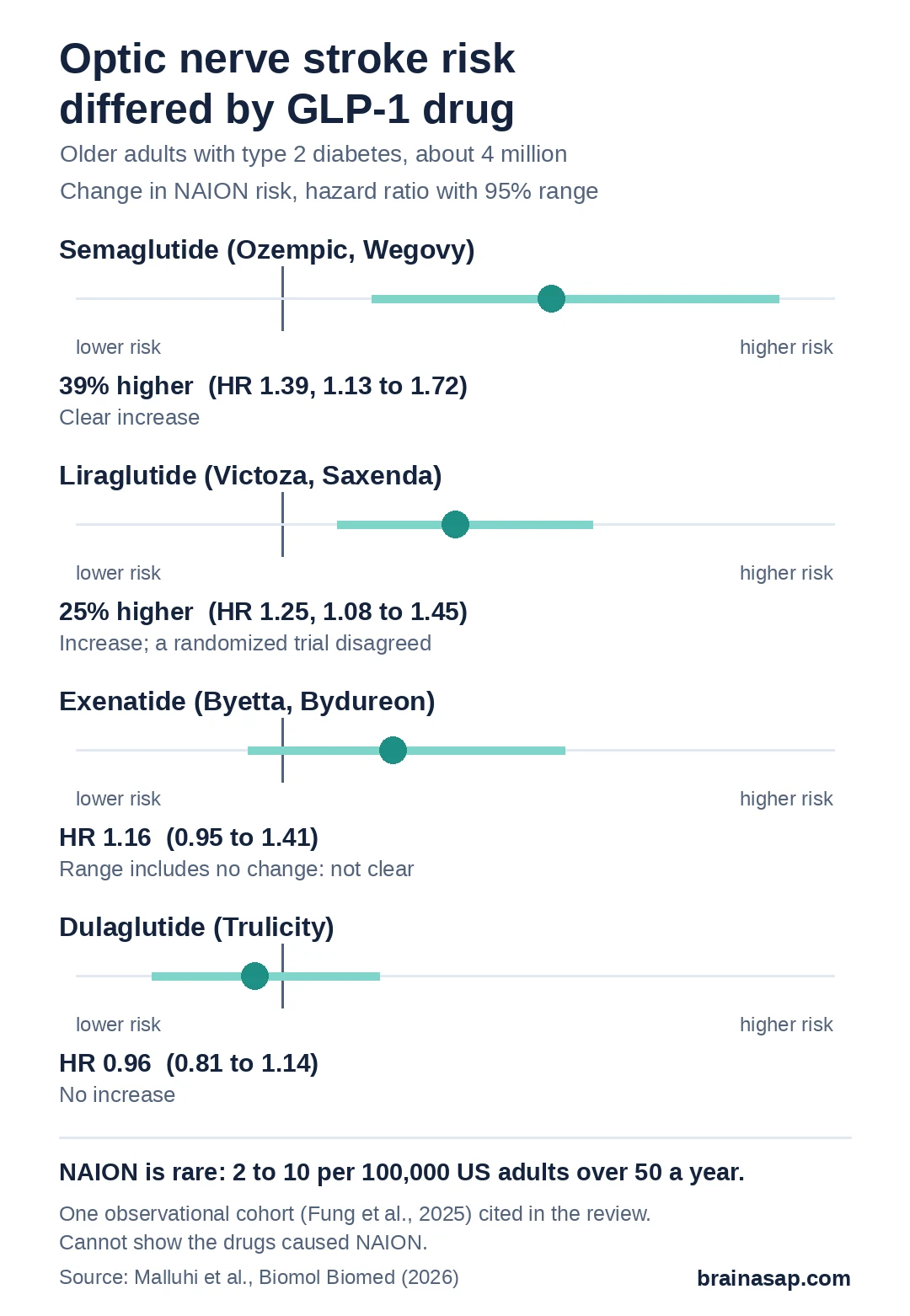
Liraglutide's link is shaky: a randomized trial found fewer NAION cases with liraglutide than with placebo. For tirzepatide (Mounjaro, Zepbound), the only positive report lumped it together with semaglutide; studies of tirzepatide alone found no signal.
Dose and Form May Explain the Gap
The authors' main idea is that how much drug reaches the blood matters. The Rybelsus doses covered by the review absorb poorly, at about 1%, while injections are close to fully absorbed. In an FDA safety-report database:
- Wegovy (up to 2.4 mg shot): 28 NAION reports out of 3,070, about 0.91%.
- Ozempic (up to 2 mg shot): 47 out of 20,608, about 0.23%.
- Rybelsus (pill): 0 out of 186.
From this, the authors propose a rough danger zone: average steady blood levels of about 30 to 55 nmol/L. The authors place Ozempic and Wegovy injections above it, and the Rybelsus doses reviewed, exenatide and dulaglutide below it. Tirzepatide reaches high levels but acts more weakly on the GLP-1 receptor, which may be why it looks like an exception.
This comparison does not apply to every semaglutide pill. The FDA Wegovy label reports that the 25 mg tablet can reach average blood levels comparable to the 2.4 mg weekly injection in adults with overweight or obesity. That does not establish its NAION risk; the review does not resolve that question.
They flag two newer drugs for close watching. Wegovy HD (7.2 mg weekly, approved March 2026) is estimated to reach about 230 nmol/L, though the review reported no NAION cases in the evidence it covered. Orforglipron (Foundayo), a new GLP-1 pill, is absorbed far better than semaglutide pills.
Retina Problems Follow Fast Blood Sugar Drops
Diabetic retinopathy is a separate, slower eye disease. In the SUSTAIN-6 trial, semaglutide shots were linked to more retinopathy complications than placebo (hazard ratio 1.76). But a meta-analysis of 6 large heart-outcome trials found no clear overall effect for GLP-1 drugs (odds ratio 1.10, 95% CI 0.93 to 1.30).
The review argues this looks less like a drug effect on the eye and more like a known effect of lowering blood sugar too fast. Drops in HbA1c of 2 points or more can briefly worsen retinopathy, and starting intensive insulin does the same. A trial called FOCUS, with 1,500 patients and proper eye exams, is expected to report in 2027.
Why the Threshold Is Still a Hypothesis
- Mostly observational data: Health records and claims, not trials built to measure eye outcomes.
- Different patients: People on stronger shots often have worse diabetes, obesity, sleep apnea or eye disease to begin with.
- Unconfirmed diagnoses: Many NAION cases lacked an eye specialist's confirmation.
- Safety reports have no denominator: Report shares are not true risk rates.
- Not final text: This is an "advanced online" version before copyediting.
Two eye-specialist societies have judged the overall NAION risk with semaglutide to be low and causation unproven.
Weighing Eye Risk Against Big Benefits
The authors do not call for stopping these drugs. They argue that the heart, kidney and weight benefits are real, and that quitting carries its own risks. Instead, they suggest doctors consider a person's eye risk factors when choosing the drug, form and dose.
For readers on semaglutide, the practical point is simple: sudden vision loss in one eye needs urgent medical attention, and anyone with existing optic nerve or retina problems can raise the question of drug choice with their doctor. The open question is whether blood levels truly predict risk, which only prospective studies with real eye exams can answer.
Citation: DOI: 10.17305/bb.2026.14701. Malluhi M, Al-Naemi A, Akhtar S. GLP-1 receptor agonists and ocular safety: Pharmacokinetic insights into ischemic optic neuropathy and diabetic retinopathy risk: A review. Biomol Biomed. 2026.
Study Design: Narrative review of human trials, observational studies and meta-analyses (PubMed through June 2026) plus FDA labeling and drug-level data.
Sample Size: Not applicable (review); cited cohorts include about 4 million older adults with diabetes.
Key Statistic: Reported NAION hazard ratios 1.29 to 7.64; proposed blood-level threshold about 30 to 55 nmol/L.
Caveat: Hypothesis-generating; evidence mostly observational; advanced-online version before copyediting.