TL;DR: In a small 2026 lab study, Chinese college students filled out an anxiety questionnaire and then tried to solve 8 timed math puzzles. Students with high anxiety solved about 1 fewer puzzle than the rest, while those with mild or moderate anxiety did about the same.
Brain scans during the puzzles hinted at differences between the groups, but none held up after a standard check for chance findings.
Key Findings
- Fewer correct answers with high anxiety: Students with high anxiety scores got 47% of the timed math puzzles right, compared with 55% for students with mild anxiety and 57% for those with moderate anxiety.
- Mild and moderate anxiety, about the same: A 2-point gap between those 2 groups works out to well under 1 puzzle out of 8.
- Brain differences not confirmed: Gaps in how brain areas worked together, measured with a light-based sensor cap, disappeared after a standard check for false positives.
- Faces showed more negative emotion: Students with moderate or high anxiety looked sadder, angrier or more disgusted on camera during the task than students with mild anxiety.
Source: Brain and Behavior (2026) | Ma, Tan and colleagues
A little nervousness before a test is often said to sharpen the mind. Too much, and thinking seems to fall apart.
A small study from China put that old idea to a quick test with a math game, a camera and a cap that tracks blood flow in the brain.
Who Took Part, and How Was Anxiety Measured?
A 2026 study in Brain and Behavior, by Yutong Ma, Yingfeng Tan and colleagues at Chengdu Medical College, recruited 58 healthy college students aged 18 to 22. None had a diagnosed mental illness.
Before the task, each student filled out the Self-Rating Anxiety Scale, a common 20-question form about anxiety symptoms over the past week. Scores were converted to a standard scale, and students were sorted into 3 groups using the usual cutoffs:
- Mild anxiety (called "low" in the paper): 18 students, standard scores of 50 to 59
- Moderate anxiety: 28 students, scores of 60 to 69
- High anxiety: 12 students, scores of 70 or more
Every student scored at least 50, which already counts as mild anxiety on this scale. So the study compared different amounts of anxiety, with no group of calm students for reference.
What Was the Math Puzzle?
Students played a version of the "24 game." Each puzzle showed 4 numbers on a screen, and the goal was to combine them with adding, subtracting, multiplying or dividing to make 24.
- 8 puzzles, each with a 1-minute time limit
- Answers written on paper, then scored
- 4 of the 8 needed division, which most students rarely tried
The time limit was meant to add pressure, and each choice of math step was treated as a small decision.
While students worked, a camera recorded their faces, a monitor tracked heart rate, blood pressure and blood oxygen, and a cap with light sensors measured changes in blood oxygen in the outer layer of the brain. This method, called functional near-infrared spectroscopy (fNIRS), is a portable technique that uses light instead of a magnetic field.
Did Higher Anxiety Mean Fewer Correct Answers?
For the highest-anxiety students, yes. Here's how many puzzles each group solved:
- Mild anxiety: 55% correct
- Moderate anxiety: 57% correct
- High anxiety: 47% correct
The paper reported an overall difference across the three groups (p = .04). It did not report which pair of groups differed in a direct test. With 8 puzzles each, the high-anxiety group solved roughly 1 fewer puzzle on average than the other 2 groups.
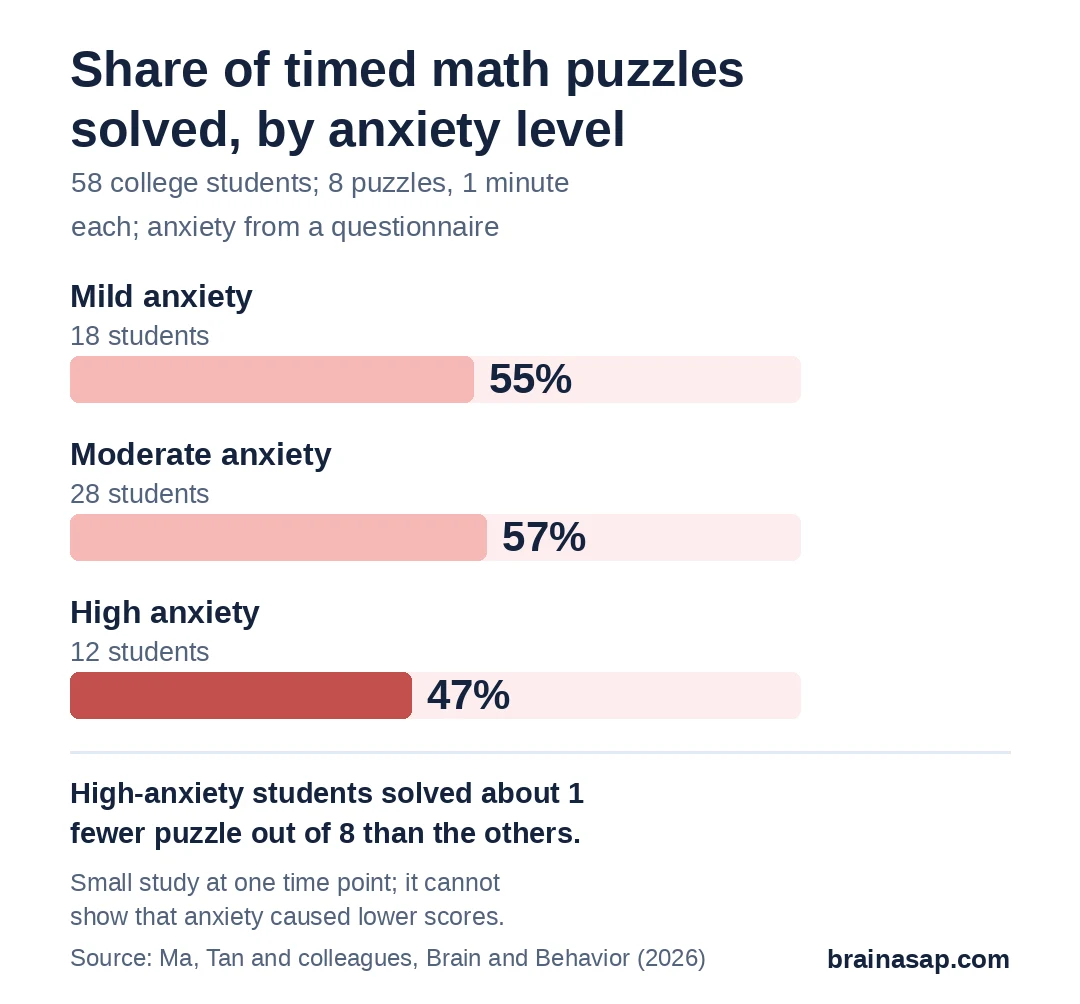
Mild and moderate anxiety groups scored almost the same. In its summary, the paper describes the moderate-anxiety group as performing best, but the 2-point edge over the mild-anxiety group is small, and the paper didn't report a direct test between those 2 groups.
What Did the Brain Sensors Show?
Less than the paper's summary suggests. One measure was how strongly signals from different brain areas rose and fell together, a rough sign of those areas working as a team.
- Moderate vs high anxiety: 5 pairs of sensor spots, mostly at the front of the head, looked different at first
- Mild vs moderate anxiety: blood oxygen differed at 2 spots, one over a touch-sensing area and one over a vision area
Neither set of differences survived a standard correction for testing many spots at once, which guards against results that turn up by chance. Ma and colleagues acknowledged this and called the brain findings exploratory.
Over the course of the task, blood oxygen levels looked steadiest in the moderate-anxiety group, while the mild and high groups showed a sharp swing midway through. The authors also reported a difference in average blood oxygen signals between the mild and moderate groups. That separate analysis was exploratory and relied on the areas covered by the sensors.
What About Faces and Heartbeats?
Facial-expression software found more sadness, anger and disgust on the faces of students with moderate or high anxiety than in the mild-anxiety group. Happy expressions didn't differ.
Heart rate, heart-rate variability, blood pressure and oxygen levels in the blood also differed between some pairs of groups. Students with high anxiety had a slightly lower heart rate but bigger swings in heart rate and blood oxygen. Most of these numbers sit in supplementary tables that weren't reviewed for this article.
Why Be Careful With These Results?
- Small groups: only 12 students had high anxiety, and none were calm
- One questionnaire: anxiety was measured once, before the task, not as a diagnosis
- A math test as "decision-making": the authors noted that the task also leans heavily on arithmetic and memory
- Few puzzles: with only 8 puzzles, a single answer moves a score by about 12 points
- No cause and effect: the design can't show that anxiety caused the lower scores; students who find math harder may also feel more anxious
- Reporting gaps: one standard anxiety score listed in the paper (101) is above the scale's usual maximum of 100
Is a Little Anxiety Actually Helpful?
In this study, students with the highest anxiety scores solved fewer timed puzzles on average. It doesn't show that moderate anxiety helps, since moderate and mild anxiety groups performed about the same and the channel-level brain differences did not survive correction for multiple comparisons.
A clearer test would include truly calm students, use more puzzles or a purpose-built decision task, and follow the same people as their anxiety rises and falls.
Citation: DOI: 10.1002/brb3.71704. Ma Y, Tan Y, Xu F, Chen J, Chen Y, Liu F, Fan M, Han Q. The Impact of Different Severities of Anxiety on Decision-Making. Brain and Behavior. 2026;16(9):e71704. PMID: 42779109. Full text: PMC13601735.
Study Design: Cross-sectional lab study; students grouped by standardized Self-Rating Anxiety Scale score (50 to 59, 60 to 69, 70 or more); 8 timed "24-point" arithmetic puzzles; fNIRS (54 channels), facial-expression analysis and vital-sign monitoring during the task.
Sample Size: 58 healthy college students aged 18 to 22 (18 mild, 28 moderate, 12 high anxiety).
Key Statistic: Puzzle accuracy 55.15% (mild), 57.05% (moderate) and 46.67% (high); group difference p = 0.04. Functional connectivity differences (moderate vs high, 5 channel pairs) and channel-level blood oxygen differences (mild vs moderate, 2 channels) did not survive false discovery rate correction.
Caveat: Small sample with no low-anxiety (below 50) group; arithmetic task used as a proxy for decision-making; no pairwise accuracy tests reported; brain findings exploratory; supplementary tables not reviewed. Full published text reviewed.