
TL;DR: Researchers in Munich tested 28 people who hear a near-constant low hum that the people around them usually can't. For most of them, the tests didn't support either of two hearing explanations: unusually sensitive hearing for deep sounds, or hearing sounds made by their own inner ears. Only 2 of 28 showed clearly unusual sensitivity. The authors suggest low-frequency tinnitus explains many cases — while noting that real outside sounds aren't ruled out.
Key Findings
- The hum is deep: The 23 hum hearers who could match their hum to a test tone put it at a median of 50 Hz, a deep rumble far below the pitch of most speaking voices.
- Most hum hearers had ordinary deep-sound hearing: 89% of their low-frequency hearing measurements fell inside the normal range set by the comparison volunteers.
- A few clear exceptions: 2 of 28 hum hearers had thresholds far more sensitive than normal at one frequency each — about 20 and 30 decibels below the normal range.
- No low-pitched sounds from the ear itself: Faint sounds made by the inner ear turned up in 8 of 28 hum hearers and 8 of 12 comparison volunteers tested, but all were between 861 and 4,637 Hz — nowhere near the hum's pitch.
- Tinnitus is the authors' leading suggestion: They propose low-frequency tinnitus for many, but not all, cases. They didn't test it directly.
Source: PLOS ONE (2026) | Baumann et al.
Some people describe it as a diesel engine idling somewhere down the street. Others call it a throb, a rumble, or a pulse. It's there at night when the house is quiet, and it may follow them from room to room. And often, the person lying next to them can't hear a thing.
This is sometimes called "the Hum." Newspapers have reported clusters of complaints in places like Oslo, Darmstadt, and Windsor, Ontario. Estimates cited by the researchers suggest that roughly 2–4% of people report an almost constant low sound like this.
The big question is where it comes from. Sometimes a real outside source is suspected, but studies have reported finding one only rarely. So a team from the University of Munich, the Technical University of Munich, and the Norwegian University of Science and Technology looked inside the ear instead.
Two Ideas About Why Only Some People Hear It
The researchers tested two explanations that start in the ear itself.
Idea 1: Unusually sensitive hearing for deep sounds. Low-frequency noise is common in the industrialized world, yet most people aren't bothered by it. Your hearing threshold is the quietest level at which you can just detect a tone, and people differ a lot at low pitches. If hum hearers had unusually low thresholds, they might simply be picking up real sounds that everyone else misses.
There's a twist. Hearing thresholds aren't smooth. Across tiny steps in pitch — even 1 or 2 Hz — a person's threshold can jump up and down by as much as 20 decibels. Routine hearing tests check only a handful of widely spaced pitches, so a sharp pocket of extra sensitivity could go unnoticed.
Idea 2: Hearing sounds your own ear makes. The inner ear doesn't just receive sound. Tiny cells that amplify incoming sound can also give off faint, steady tones of their own. These are called spontaneous otoacoustic emissions, or SOAEs.
A sensitive microphone in the ear canal can pick them up, and roughly half of people have measurable ones. Usually their owners never notice them. If some people produced a low-pitched one and could hear it, that might feel like a hum no one else can hear.
28 Hum Hearers, 38 Comparison Volunteers
The study compared two groups:
- Hum hearers: 28 people who reported hearing a persistent low sound (13 men, 14 women, and 1 gender-diverse person; median age 53.5). They were recruited in 2019 from a social media group where people who hear the hum gather.
- Comparison volunteers: 38 young university students with normal hearing who didn't report any hum (median age 22 to 24).
Before coming to the lab, each hum hearer used an online tone generator at home to match the pitch of their hum. That step mattered, because the hum can come and go. Only 11 of the 28 said they could hear it during their lab visit.
In the lab, everyone sat in a sound-proofed booth for about three hours of testing. Deep test tones were piped into one ear through a long tube from a subwoofer outside the booth, and on each trial people picked which of two moments contained the tone.
For hum hearers, the researchers tested nine closely spaced pitches around each person's own hum. That was fine-grained enough to catch the sharp ups and downs in thresholds that routine tests miss.
The researchers used one group of 31 comparison volunteers to define a normal range: the middle 95% of their low-frequency thresholds, a band about 23 decibels wide. A second group of 7 volunteers did the same fine-grained test as the hum hearers, so the fine structure could be compared directly.
What Hum Hearers Reported
The questionnaire painted a consistent picture:
- The 23 who could match their hum put it at a median of 50 Hz. The other 5 said it was too complex to match with a single tone.
- 86% found the hum stressful.
- 68% said family or household members couldn't hear it.
- 68% heard it only in certain places.
- 68% couldn't tell which ear it was in.
- 39% also heard other unexplained sounds, which most described as high-pitched tinnitus.
About 45% had tried to measure an outside source, on their own or with professional help. About 20% said they had confirmed one.
Most Hum Hearers Didn't Have Unusually Sensitive Hearing
If hum hearers were extra sensitive to deep sounds, a lot of their thresholds should have landed at or below the bottom of the normal range. They didn't.
- 89% of their low-frequency measurements fell inside the normal range.
- 5% were more sensitive than the range, and 6% were less sensitive.
- Almost exactly half (48%) were better than the comparison volunteers' average, and half (52%) were worse — no lean toward extra sensitivity.
Two people were real exceptions. One hum hearer's threshold at 28 Hz was about 20 decibels better than the bottom of the normal range, and another's at 62 Hz was about 30 decibels better. The authors call these individuals unusually sensitive. They suggest a very small share of people who hear the hum may have ears that are, for anatomical reasons, genuinely better at picking up deep sounds.
The sharp ups and downs in thresholds showed up too, but in both groups. Hum hearers' threshold swings had a median depth of 16.3 decibels versus 12.6 for the comparison volunteers. That difference was not statistically significant. The peaks and dips also didn't cluster around each person's hum pitch any differently than in the volunteers. So the fine structure was real, but it didn't set hum hearers apart.
Their Ears Didn't Make Low-Pitched Sounds
To look for low-pitched SOAEs, the team used two microphone systems, including a two-microphone probe designed to cut background noise at low pitches.
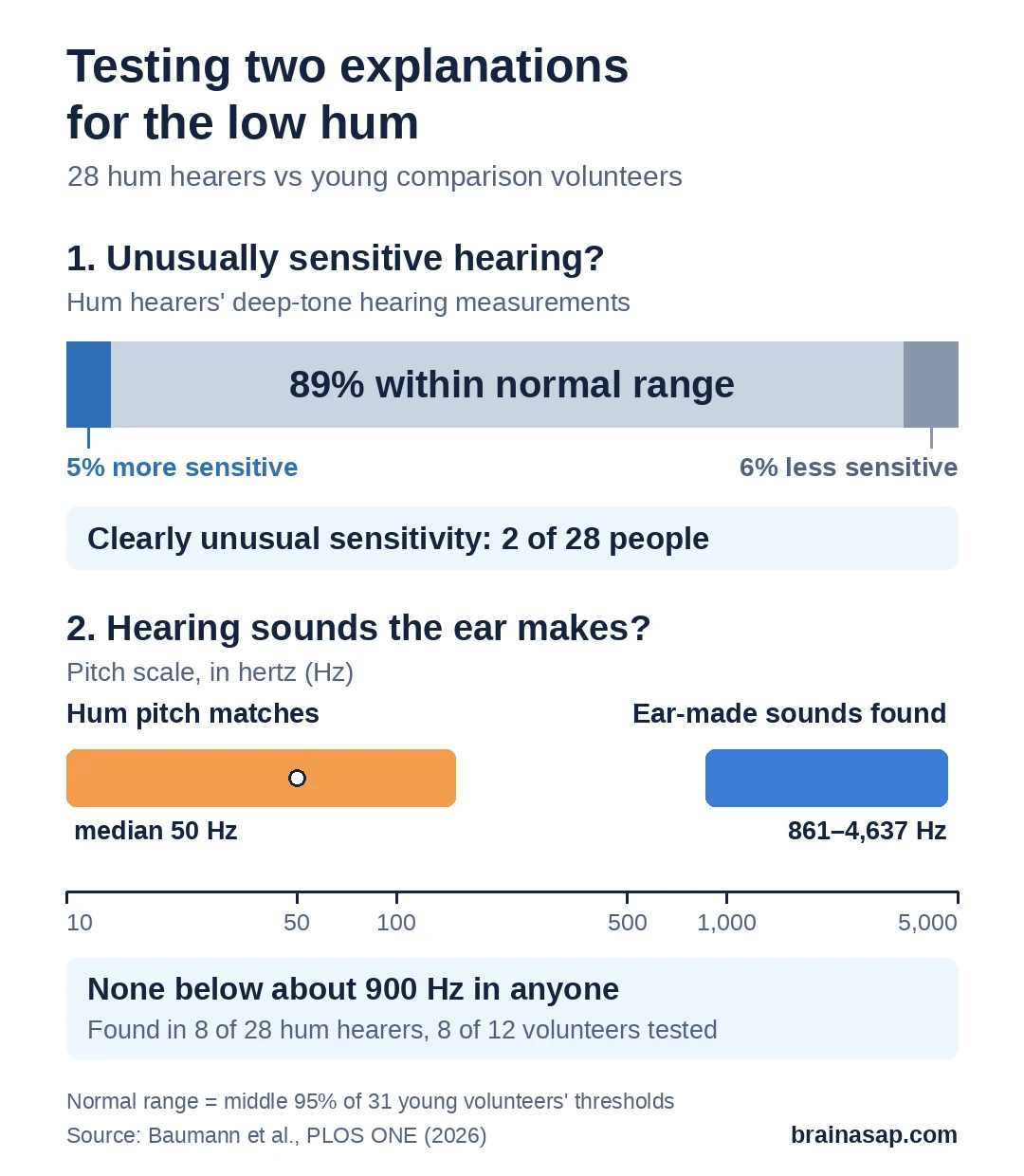
SOAEs turned up in 8 of 28 hum hearers and 8 of 12 comparison volunteers tested. Every one of them fell between 861 and 4,637 Hz. None appeared below about 900 Hz in anyone — far above a hum around 50 Hz.
The authors point out that two rare things would have to happen together for this idea to work: an ear would need to produce a low-pitched emission loud enough to hear, and its owner would need to actually notice it. They conclude this is an unlikely explanation. Background noise is naturally worse at low pitches, though, so the measurements can't prove such emissions never exist.
Why Tinnitus Fits Many Cases
Tinnitus usually means hearing a sound with no outside source. Most people picture a high-pitched ring, but it can take many forms, and cases matched to pitches as low as 29 Hz have been reported.
If most hum hearers have ordinary hearing and no low-pitched ear sounds, low-frequency tinnitus is a natural candidate. The authors suggest it may explain many cases where no outside source can be found.
Many people who hear the hum resist that idea because the sound seems to come from outside their heads. Typical tinnitus feels internal. The authors offer a possible reason for the difference: our ears are poor at pinpointing where deep sounds come from, especially indoors. With so few location cues, even a sound generated inside the auditory system might feel like it's coming from the room.
That's an interpretation, not a diagnosis. The study didn't test for tinnitus directly, and the authors say the hum probably has different causes in different people. Some hum hearers may be hearing a real outside sound, especially the few with unusually sensitive hearing.
What the Study Can't Tell Us
- Small, self-selected group. The 28 hum hearers came from a single online community, so they may not represent everyone who hears a hum.
- A different kind of comparison group. The comparison volunteers were young students, decades younger than the hum hearers and not their family members. The authors suggest future studies test household members who don't hear the hum.
- The hum wasn't always present. Pitch matching was done at home with consumer equipment, and only 11 hum hearers could hear the hum in the lab.
- Only hearing explanations were tested. The study didn't measure sound at participants' homes or look at causes outside the auditory system.
- A competing interest. One author administers the social media group participants were recruited from. The paper states he wasn't involved in recruiting.
For someone who hears the hum, the takeaway is modest but useful. Routine hearing tests don't check these very deep pitches, and in most of these participants the ear's deep-sound hearing looked ordinary when it was checked closely. When no outside source can be found, the authors see low-frequency tinnitus as a plausible explanation — one worth discussing with a hearing specialist.
Citation: DOI: 10.1371/journal.pone.0326818. Baumann B, Voss A, Jurado C, Drexl M. On the potential sources of a low-frequency sound percept that only a few can perceive. PLOS ONE. 2026;21(3):e0326818.
Study Design: Laboratory case-control study of fine-grained low-frequency hearing thresholds and spontaneous otoacoustic emissions, plus a questionnaire and at-home pitch matching.
Sample Size: 28 hum hearers and 38 young comparison volunteers with normal hearing (31 and 7 in two control groups).
Key Statistic: 89% of hum hearers' low-frequency thresholds were within the normal range; 2 of 28 were clearly unusually sensitive; no ear-made sounds were found below about 900 Hz in either group.
Caveat: Peer reviewed, published 27 March 2026. Small, self-selected sample recruited from a hum social media group administered by one author; controls were much younger; tinnitus is the authors' untested interpretation, and outside sound sources are not ruled out.