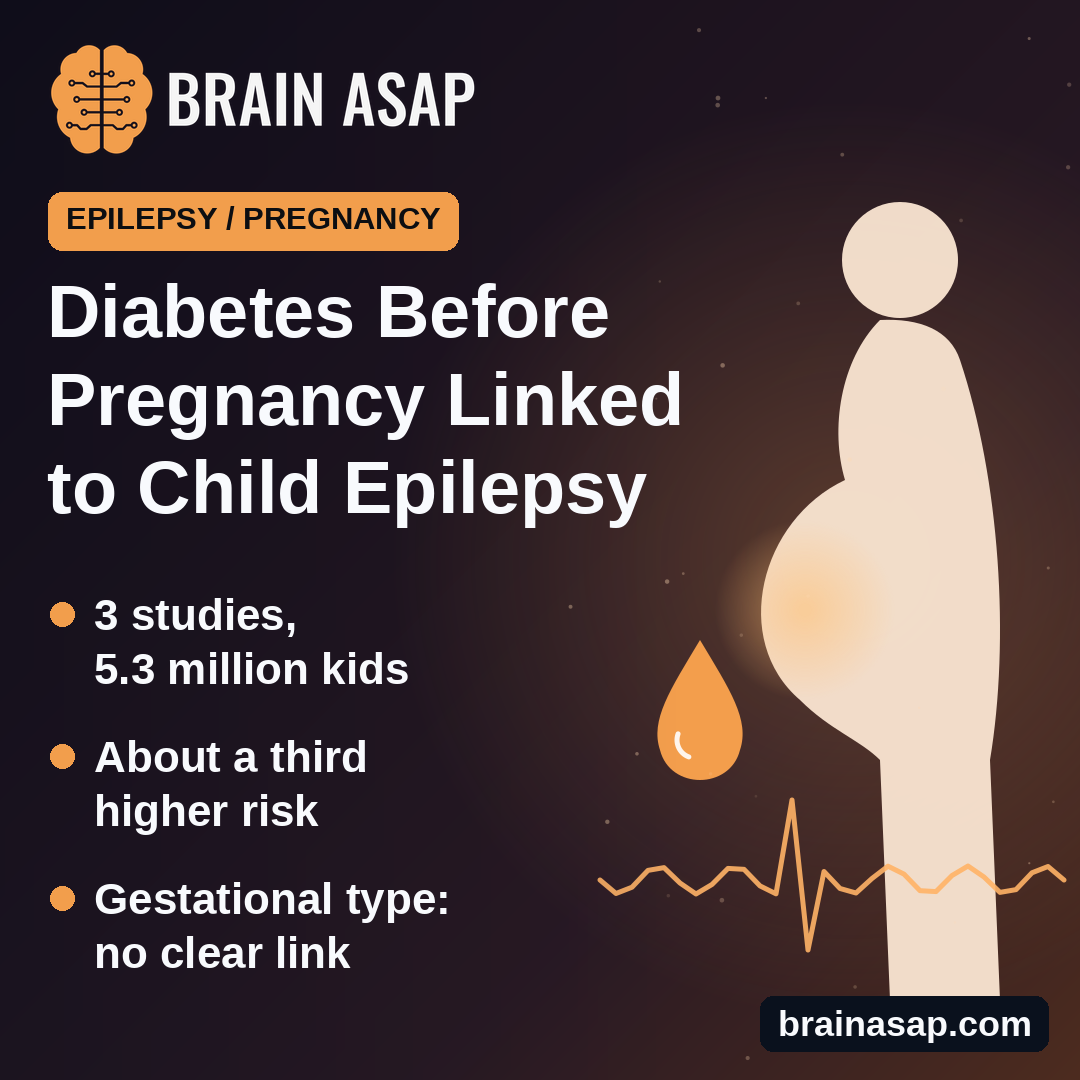
TL;DR: In 3 large birth studies covering 5.3 million children, kids whose mothers had type 1 or type 2 diabetes before pregnancy were about a third more likely to develop epilepsy. Diabetes that first appears during pregnancy showed no clear link, and none of this proves diabetes is the cause.
Key Findings
- 3 studies, 5.3 million children: National records from Taiwan, Canada (Ontario) and Sweden.
- Type 1 diabetes before pregnancy: 33% higher epilepsy risk in children.
- Type 2 diabetes before pregnancy: 38% higher risk.
- Gestational diabetes: No clear link, and the result was unstable.
- Observational only: Shared genes and other factors could explain part of the link.
Source: Frontiers in Endocrinology (2026) | Zeng et al.
Epilepsy is one of the most common brain conditions in children, and in about half of cases no cause is found. At the same time, more women are entering pregnancy with diabetes, or developing it along the way.
Maternal diabetes has already been linked to several other developmental conditions in children. This review asked whether it is also linked to epilepsy.
3 Kinds of Maternal Diabetes
The researchers kept the types separate, because they differ in timing and severity:
- Type 1 before pregnancy: The immune system attacks the cells that make insulin. It can start at any age.
- Type 2 before pregnancy: Linked to insulin resistance, often with higher body weight.
- Gestational diabetes: High blood sugar that first appears during pregnancy, usually in the second half.
They searched 4 databases through July 2026 and found 3 studies that met their criteria. All 3 followed large groups of children using health records and compared those whose mothers had each type of diabetes with those whose mothers did not.
A Third Higher Risk With Diabetes Before Pregnancy
For both pre-existing types, the link held in every study, with little variation between them:
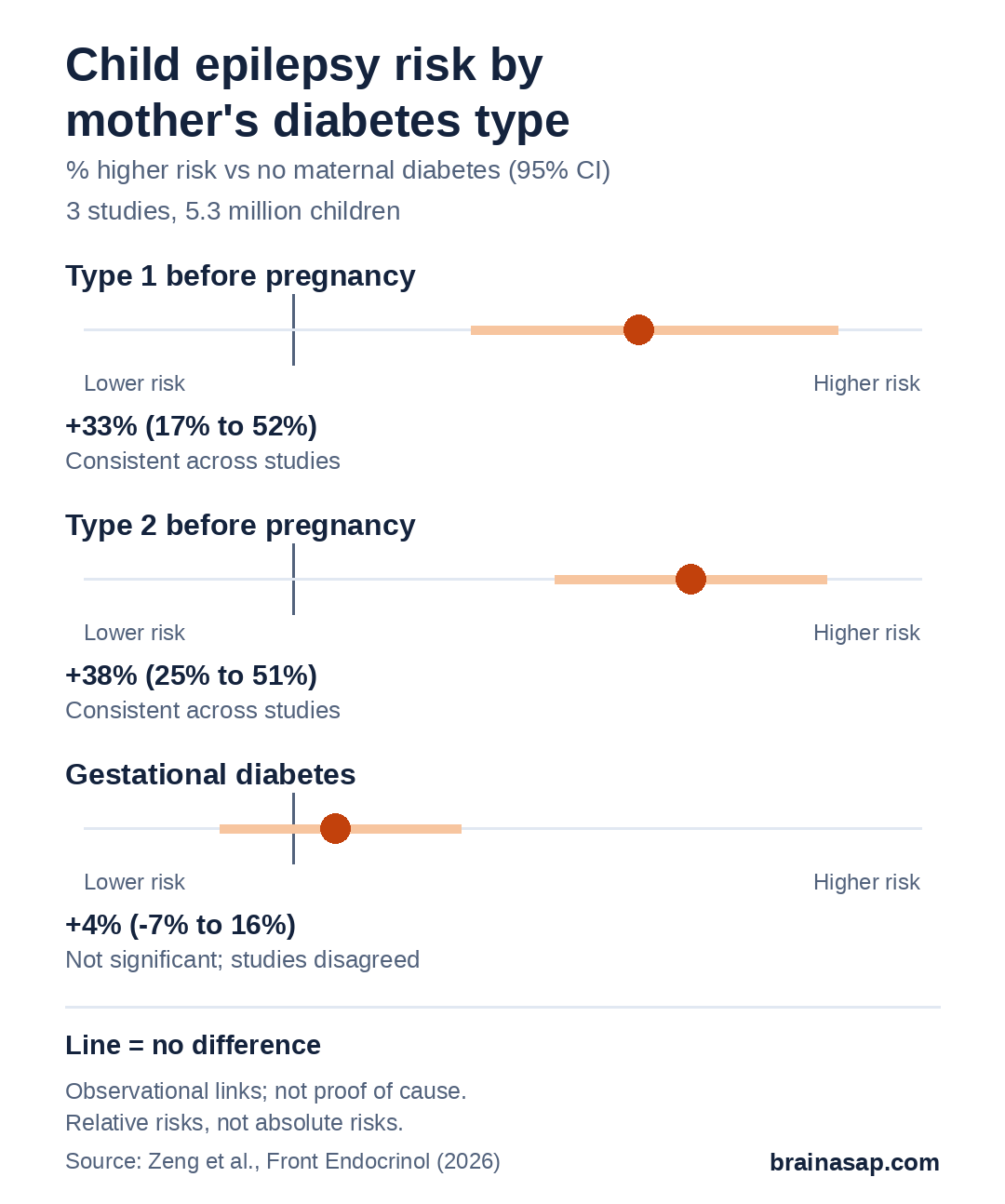
- Type 1: 33% higher risk (hazard ratio 1.33).
- Type 2: 38% higher risk (hazard ratio 1.38).
Each study adjusted for things like the mother’s age and the child’s sex. Most also accounted for factors such as income, weight, high blood pressure or smoking, though the lists differed.
Gestational Diabetes Was Unclear
Pooled, gestational diabetes showed essentially no link (4% higher, not significant). But the 3 studies disagreed a lot. Leaving out the Taiwan study produced a clear link with higher risk. The authors say the evidence can neither support nor rule out a link.
Why This Is Not Proof
- Only three studies, despite millions of children.
- Observational: Diabetes may travel with other factors that raise epilepsy risk.
- Family history: Not every study adjusted for parents’ own epilepsy or brain conditions.
- No blood-sugar data: The studies could not show whether better control lowers risk.
- Possible missing studies: Too few to test for publication bias.
What Families Can Take From This
For women with type 1 or type 2 diabetes planning a pregnancy, good blood-sugar control before and during pregnancy is already standard advice for many reasons. This study did not test whether it lowers epilepsy risk. The authors suggest closer developmental follow-up for children of these mothers.
The open question is whether the link comes from high blood sugar in the womb or from shared genes and circumstances, which studies comparing siblings or blood-sugar levels could help answer.
Citation: DOI: 10.3389/fendo.2026.1960502. Zeng H, Long D, Geng Y, Li X, Zhou H, Liu X, Lei Y. The association between maternal diabetes and the risk of epilepsy in offspring: a systematic review and meta-analysis. Front Endocrinol. 2026;17:1960502.
Study Design: Systematic review and meta-analysis of 3 birth-cohort studies using health records.
Sample Size: 5,287,837 participants.
Key Statistic: Pregestational T1DM HR 1.33 (95% CI 1.17 to 1.52); T2DM HR 1.38 (1.25 to 1.51); GDM HR 1.04 (0.93 to 1.16).
Caveat: Three observational studies; residual confounding; unstable GDM estimate.