TL;DR: After a burst brain aneurysm, patients given the heart drug milrinone through an IV had about half the odds of delayed brain injury from narrowed arteries. There was no clear recovery or survival benefit, and the finding was fragile.
Key Findings
- 7 studies, 1,045 patients; only 1 was a randomized trial.
- Less delayed brain injury: 12% vs 23% with IV milrinone (3 studies).
- Not robust: Dropping single studies erased the significance.
- No clear gain in recovery or survival.
- Heart and blood-pressure side effects leaned higher, not significantly.
Source: Frontiers in Neurology (2026) | Gharaibeh et al.
When a brain aneurysm bursts and bleeds around the brain (aneurysmal subarachnoid hemorrhage), surviving the first days is only half the battle. Up to 30% of patients then develop delayed cerebral ischemia, a second injury when brain tissue gets too little blood days after the bleed. Artery spasm is one cause.
Milrinone, a drug usually used for heart failure, relaxes blood vessels and is already used off-label in some intensive care units to prevent this. A team at the University of Toledo pooled the evidence.
What the Review Compared
The researchers found 7 studies with 1,045 patients, about half of whom got milrinone. Only one was a randomized trial; the rest were observational, mostly single-center studies. The main analysis focused on milrinone given through an IV:
- Milrinone group: IV milrinone on top of standard care.
- Comparison group: Standard care (nimodipine and blood-pressure support) or, in some studies, other treatments such as IV magnesium.
Fewer Delayed Brain Injuries, but a Shaky Result
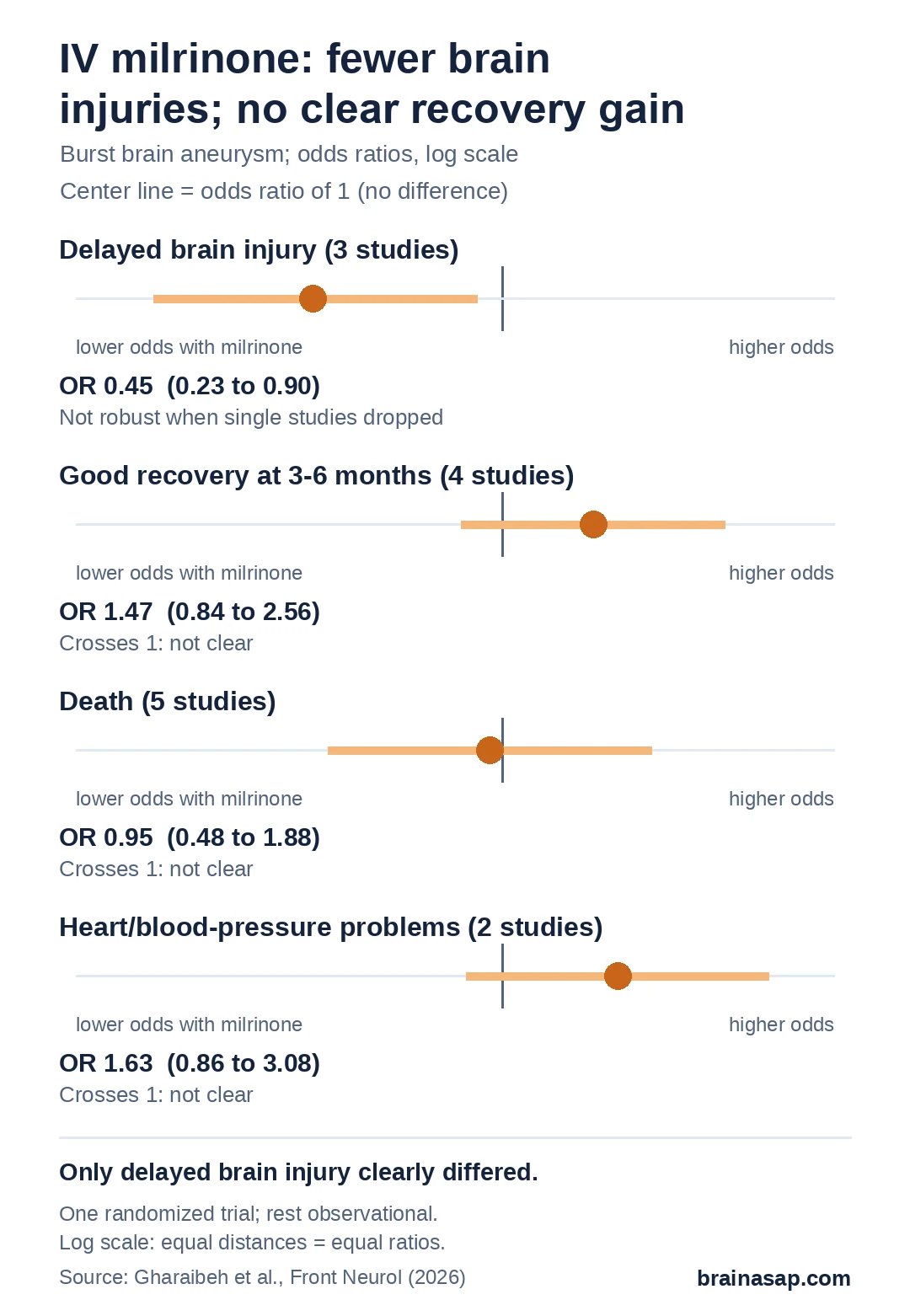
In three IV studies, delayed brain injury linked to artery spasm occurred in 31 of 254 patients on milrinone (12%) vs 63 of 274 without it (23%). That gave an odds ratio of 0.45 (95% CI 0.23 to 0.90), meaning roughly half the odds.
But when the researchers dropped one study at a time, the result was no longer statistically significant. So the signal depends heavily on which studies are included.
Recovery and Survival Did Not Clearly Improve
- Good recovery at 3 to 6 months (independent in daily life): 71% on milrinone vs 64% without; odds ratio 1.47 (0.84 to 2.56), not significant.
- Death: 10.6% vs 11.7%; odds ratio 0.95 (0.48 to 1.88).
- Heart and blood-pressure problems (such as low blood pressure or arrhythmia, 2 studies): 36% vs 26%; odds ratio 1.63 (0.86 to 3.08), not significant.
The authors note that delayed brain injury is a partial stand-in for what matters most, recovery and survival, and that the studies were too small to detect modest effects on those.
Why the Evidence Is Weak
- One randomized trial: The rest were observational and prone to bias.
- Different definitions: Delayed brain injury was measured in several ways.
- Different comparisons: Control groups got varied treatments.
- Different routes: Other studies gave milrinone into arteries or spinal fluid, analyzed separately.
A Case for a Proper Trial
Milrinone may reduce one serious complication of a burst aneurysm, but there is no solid evidence yet that it helps patients recover or survive, and it may strain the heart and blood pressure. The authors call for large randomized trials to settle whether it belongs in routine care.
Citation: DOI: 10.3389/fneur.2026.1872442. Gharaibeh K, Ali A, Aladamat N, Shuaib A, Zaidi SF, Jumaa MA. Efficacy and safety of milrinone infusion in patients with aneurysmal subarachnoid hemorrhage: a systematic review and meta-analysis. Front Neurol. 2026.
Study Design: Systematic review and random-effects meta-analysis of randomized and observational studies.
Sample Size: 7 studies, 1,045 patients (529 received milrinone); IV-only analyses used 3 to 5 studies per outcome.
Key Statistic: IV milrinone and vasospasm-related delayed cerebral ischemia: OR 0.45 (95% CI 0.23 to 0.90).
Caveat: Not robust in leave-one-out analysis; only one RCT; no clear effect on functional outcome or mortality.