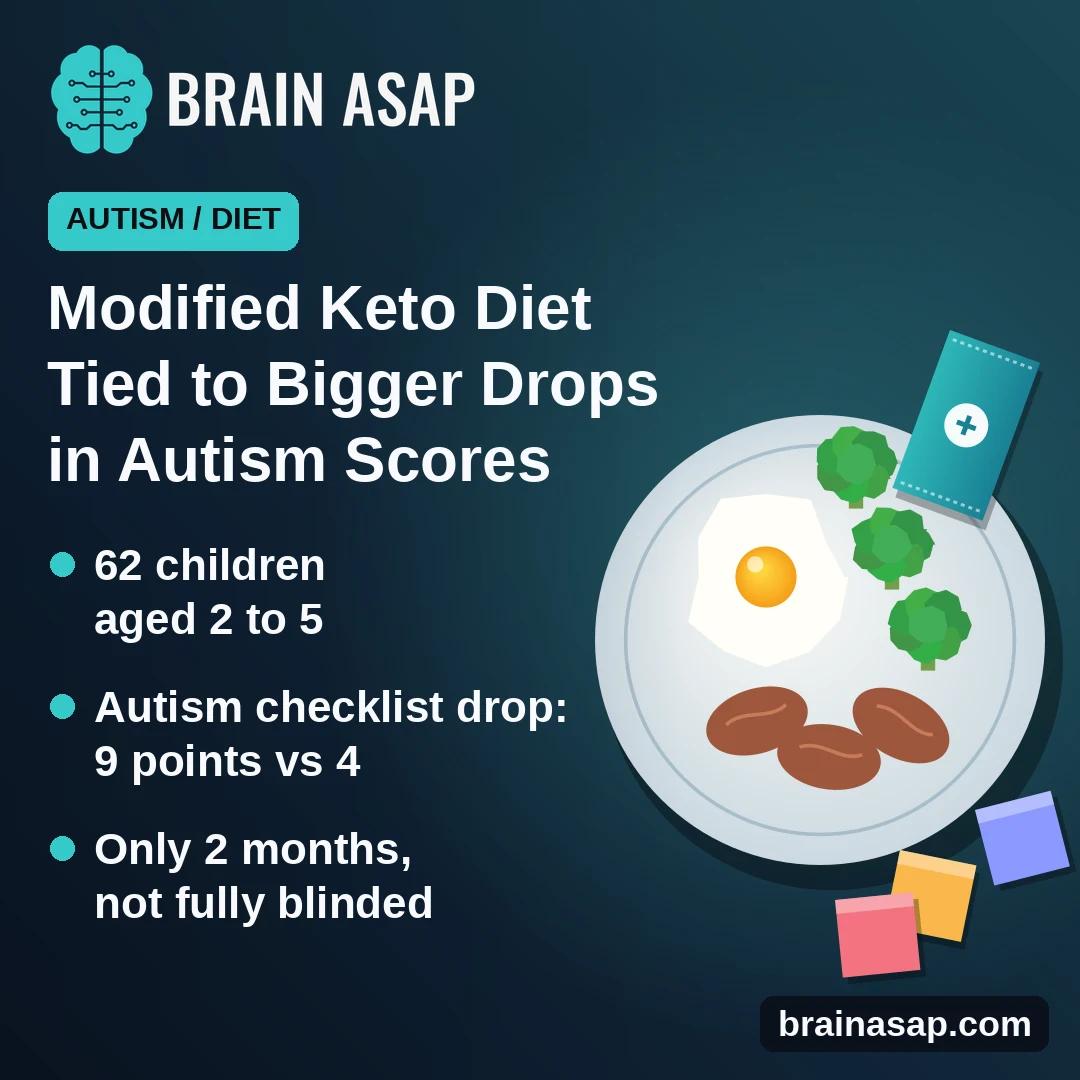
TL;DR: In a two-month trial of 62 children aged 2 to 5 with autism, adding a modified ketogenic diet to therapy brought bigger drops in two autism scores than a regular diet. The trial was small and not fully blinded.
Key Findings
- Autism Behavior Checklist (ABC): typical child improved 9 points in ketogenic-diet group versus 4 in regular-diet group.
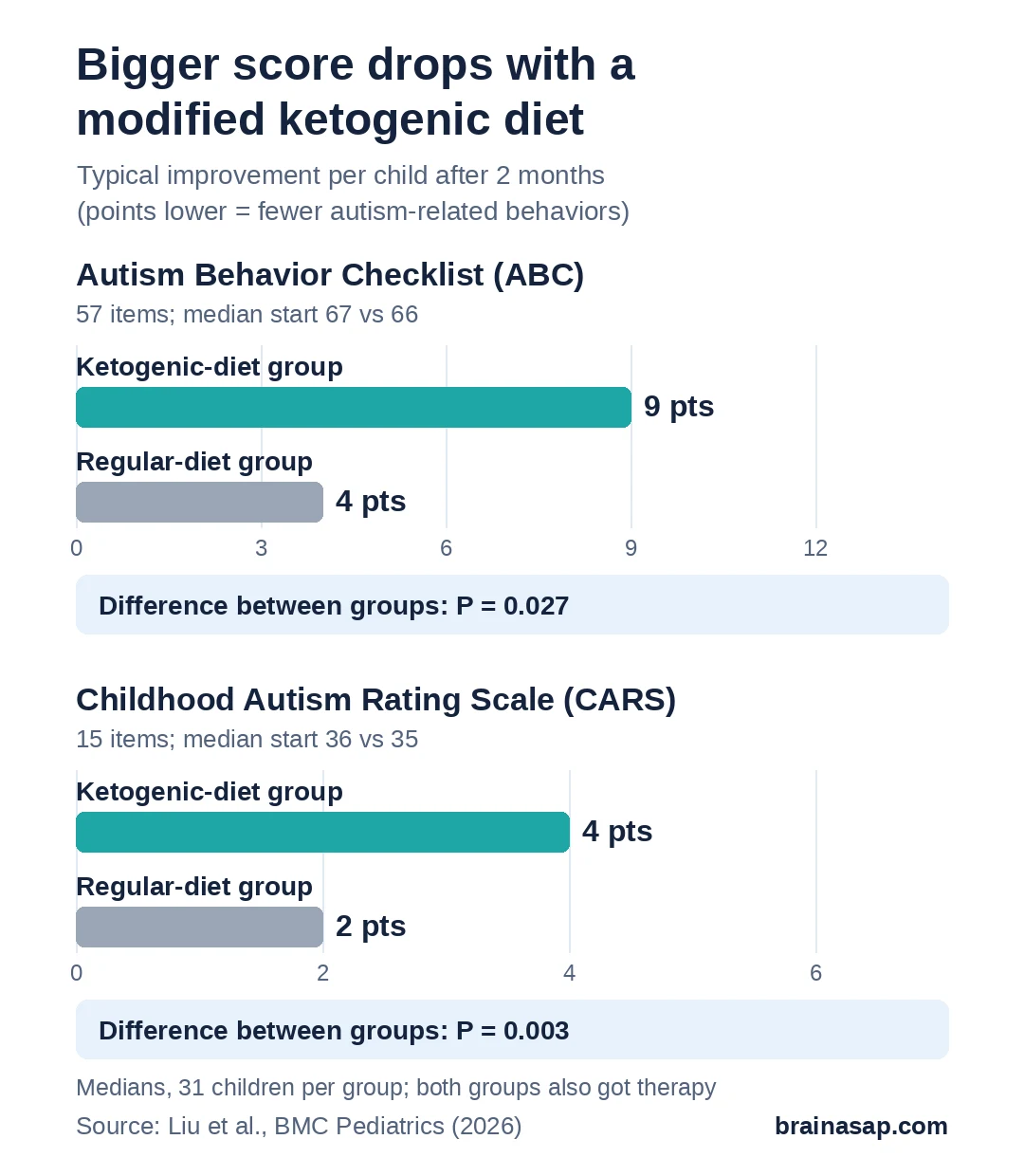
- Childhood Autism Rating Scale (CARS): typical improvement 4 points in ketogenic-diet group versus 2 in regular-diet group.
- Both groups improved: Expected, since every child was in an intensive therapy program.
- Diet was hard to keep up: 24 of 31 finished in ketogenic-diet group versus 27 of 31 in regular-diet group.
- Unknowns: Only two months, and authors say real-world importance of score changes is uncertain.
Source: BMC Pediatrics (2026) | Liu et al.
Could a gentler ketogenic diet help very young children with autism, and could families actually stick with it? Both groups in this trial improved. The question was whether the diet group improved more.
Parents of children with autism hear about a lot of diets. Most of the excitement outruns the evidence, and strict diets can be hard on a family. This trial from a children’s rehabilitation center in Hefei, China, tested a less rigid version in children aged 2 to 5.
What a Modified Ketogenic Diet Involves
A ketogenic diet is high in fat and very low in carbohydrates. With little sugar and starch available, the body burns fat for fuel and makes molecules called ketones. The diet has a long track record in children with epilepsy that does not respond to medication. Researchers have wondered whether the same shift in metabolism might also affect autism-related behaviors, but the human evidence so far is thin.
The classic version is tough to live with, especially for children who are already picky eaters. So this team used a modified version. Children took a ketogenic nutrition powder made mostly of fat, including a type called medium-chain triglycerides, plus whey protein and fiber. The powder supplied roughly 10% to 40% of their daily calories. Families also cut back on rice, noodles, buns, and sugary foods at breakfast and dinner. Lunch, served at the hospital on training days, leaned on vegetables, meat, and eggs.
How the Trial Worked
Sixty-two children aged 2 to 5 with a diagnosis of autism were randomly assigned to one of two groups of 31:
- Ketogenic-diet group: the modified ketogenic diet plus the therapy program.
- Regular-diet group: their usual diet plus the same therapy program.
Everyone followed the same schedule for two months: hospital-based rehabilitation on weekdays, including language and cognitive training, sensory integration work, and transcranial magnetic stimulation, then home exercises on weekends. Children on other psychiatric medications or metabolic supplements were excluded.
Dietitians trained caregivers for two hours, and the ketogenic-diet group had regular check-ins, plus urine ketone and blood sugar checks at home. The people who scored the children’s symptoms did not know which group each child was in, though families and clinicians could not be kept unaware of the diet.
Two Checklists, Where Lower Is Better
Two standard checklists were used, both given once before and once after the two months. Lower scores mean fewer or milder autism-related behaviors on both.
- The Autism Behavior Checklist (ABC) has 57 items covering sensory responses, relating to others, repetitive behavior, language, and self-help and social skills.
- The Childhood Autism Rating Scale (CARS) has 15 items rated by a clinician to gauge overall severity, on a scale that tops out at 60.
Both Groups Improved, the Diet Group More
Both groups improved. In the ketogenic-diet group, the middle ABC score fell from 67 to 56. In the regular-diet group it fell from 66 to 59. CARS scores went from 36 to 32 with the diet and from 35 to 34 without it.
The more useful comparison is how much each child changed, and here the diet group came out ahead:
- ABC: a typical child improved by 9 points in the ketogenic-diet group versus 4 points in the regular-diet group (P = 0.027).
- CARS: a typical child improved by 4 points versus 2 points (P = 0.003).
The authors’ main analysis was a model that adjusted for each child’s starting score, age, sex, and time since diagnosis. It pointed the same way. After adjustment, the ketogenic-diet group ended about 4 points lower on the ABC (95% CI: 1.6 to 6.7 points lower) and about 1.3 points lower on the CARS (95% CI: 0.3 to 2.4 points lower). A separate check that filled in missing scores statistically gave similar results.
Dropouts and Safety
Of the 62 children, 51 finished, and 11 dropped out. Seven of the 11 were in the diet group: three did not follow the diet, two left because of side effects (one had diarrhea, one had a rash), and two missed appointments. In the regular-diet group, four children missed sessions or follow-up.
The researchers say they saw no low blood sugar, dehydration, vomiting, or reflux, and caregivers did not notice clear weight loss. Blood sugar stayed in the normal range. Those checks only covered eight weeks, so they say nothing about longer-term effects such as cholesterol, kidney stones, or growth, which have been raised with long-term ketogenic diets.
Limits of the Trial
- Unequal time since diagnosis: Median 20 months in regular-diet group versus 1.5 in ketogenic-diet group. Authors adjusted, but leftover bias is possible.
- Extra attention: Ketogenic-diet families got more education, monitoring, and clinician contact. Authors say differences cannot be credited only to the diet.
- Only raters were unaware: Families and treating clinicians knew, and CARS also draws on parent reports.
- Scales built for diagnosis: ABC and CARS identify and grade autism, not detect treatment effects. No agreed meaningful change for a young child, so a 5-point ABC gap may or may not matter day to day.
- Dropouts: More left the ketogenic-diet group, which may leave families better able to keep up the diet. Early leavers were kept in the main analysis using their last available score.
- Mechanism untested: No blood ketones, brain chemistry, inflammation, or gut bacteria measured, so how the diet might work is speculation.
- Funding: Company donated the powder, and one author is affiliated with it. Paper states no competing interests.
Longer Trials With Equal Attention Are Warranted
This is a randomized comparison in very young children, and it shows that a powder-based, less rigid approach can be followed by many families for two months. The larger score drops in the diet group are worth following up.
But nothing here shows the diet is safe or worthwhile over the long run, or that it works for older or higher-functioning children. Because ketogenic diets can affect growth and nutrition, any family thinking about one should talk to their child’s doctor and a dietitian first.
A longer trial needs to show whether the gains last and still appear when the diet group gets no extra attention. The authors call for trials that also track biological markers, to learn which children, if any, benefit most.
Citation: DOI: 10.1186/s12887-026-07708-3. Liu L, Zhao Q, Zhou J, Liu Z, Wu D, He K. Evaluating the therapeutic efficacy of a modified ketogenic diet in children with autism spectrum disorder: a randomized controlled trial. BMC Pediatrics. 2026;26:893.
Study Design: Prospective randomized controlled trial (ChiCTR2300075057), 1:1 assignment. Modified ketogenic diet plus rehabilitation versus regular diet plus the same rehabilitation for 8 weeks. Raters blinded; participants, caregivers, and clinicians not blinded.
Sample Size: 62 children aged 2 to 5 with autism (31 per group) at Hefei Maternal and Child Health Hospital, China; 51 completed the study (24 in the ketogenic-diet group, 27 in the regular-diet group).
Key Statistic: Median ABC change 9 versus 4 points (U = 324.0, P = 0.027); median CARS change 4 versus 2 points (U = 273.5, P = 0.003). Adjusted ABC difference -4.12 points (95% CI -6.65 to -1.60).
Caveat: Two-month, single-center trial; groups differed in time since diagnosis; diet group received extra clinical contact; clinical importance of score changes unknown; powder supplied by a company with an author affiliation.