TL;DR: A Helsinki hospital offers people across Finland with social anxiety a 7-session online therapy course, with a therapist checking their progress. In records from more than 1,600 adults who started it, symptoms of social anxiety dropped a lot on average, and about 4 in 10 had a drop of at least 10 points on the study’s social anxiety questionnaire.
Key Findings
- Large drop in social anxiety: Questionnaire scores fell by a large amount on average among the 1,654 adults who started the course.
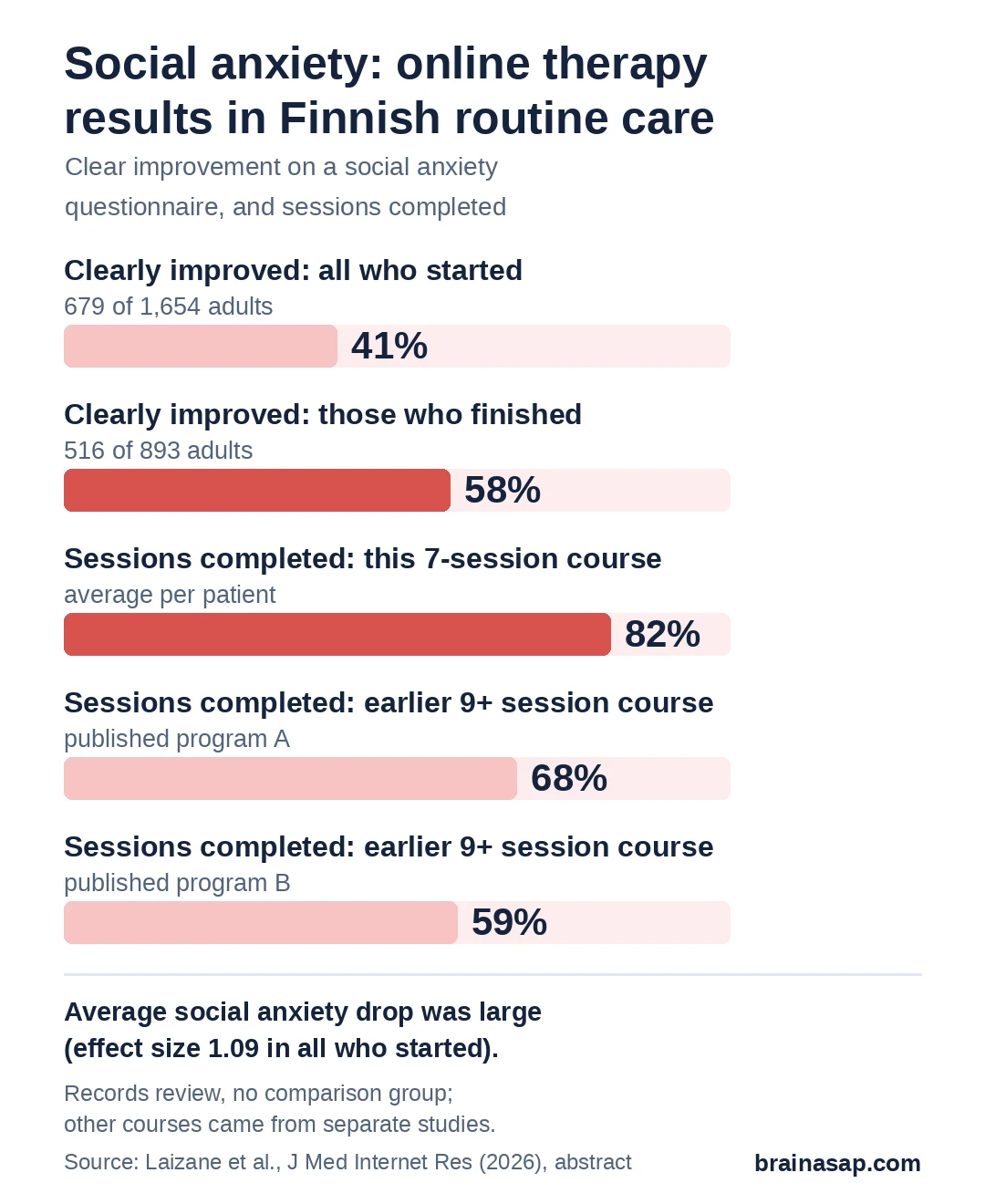
- Clear improvement: 41% of everyone who started, and 58% of those who finished, improved by more than normal score wobble.
- Most lessons done: On average people completed 5.7 of 7 sessions (82%), more than in earlier courses of 9 or more sessions (59% and 68%).
Source: Journal of Medical Internet Research (2026) | Laizane et al.
Social anxiety disorder is more than shyness. It's an intense fear of being judged that can make job interviews, phone calls or eating in front of others feel impossible.
Cognitive behavioral therapy (CBT) helps, but therapists are scarce. Online CBT courses work in research trials. Do they still work when a public health system hands them out to thousands of ordinary patients?
A Nationwide Online Course in Finland
Helsinki University Hospital runs an online CBT program for social anxiety that doctors anywhere in Finland can refer patients to. A 2026 study in the Journal of Medical Internet Research by A. P. Laizane and colleagues looked at its records from 2019 to 2022.
Its course has 7 sessions, fewer than the 9 or more in most earlier programs. Patients work through them on their own schedule, and a therapist reviews their progress and replies online.
Of 2,360 patients accepted for therapy, the analysis kept 1,654 adults who:
- Scored at least 21 on the Social Phobia Inventory at baseline
- Reached the first treatment session after the program introduction
- Were not repeating the course
The main measure was the Social Phobia Inventory, a questionnaire about fear and avoidance of social situations. Researchers also tracked overall anxiety and depression.
How Much Did Social Anxiety Improve?
On average, social anxiety scores dropped by a large amount, both for everyone who started (effect size 1.09) and for those who finished all 7 sessions (1.15).
A big average can hide a lot of variation, so researchers also counted people whose score fell by at least 10 points from the start to their last available assessment:
- Everyone who started: 679 of 1,654 (41%) improved clearly
- Those who finished: 516 of 893 (58%) improved clearly
Scores fell by a small amount on average among early dropouts and by a moderate amount among late dropouts. Patients who finished also improved on overall anxiety and depression scores.
Did a Shorter Course Help People Stick With It?
Dropping out is a known problem with online therapy. Here, 54% of patients finished all 7 sessions, and the average patient completed 82% of them.
Earlier programs with 9 or more sessions reported people completing 59% and 68% of sessions. One 6-session program reported 85%. Laizane and colleagues suggested that a shorter course may help people stay engaged. This comparison across studies cannot show whether course length caused the difference.
Limits of a Records Review
- No comparison group: Some improvement may have happened anyway, with time or other care
- Different studies compared: Completion rates come from other programs and patient groups, not a head-to-head test
- Many patients left out: About 700 of 2,360 accepted patients weren't in the analysis, for reasons such as scores below the study cutoff, never logging in, or being under 18
- Missing follow-up scores: Some patients stopped answering questionnaires, including some who completed the course. The reliable improvement analysis used the last available score.
What the Finnish Program Shows
For people with social anxiety, an online course that can be done from home, without facing a therapist in person, may be an easier first step. Many participants’ scores fell during the course. The records do not establish how much of the change was due to the course.
A useful next step would be a direct comparison: a 7-session course against a longer one in the same health system, to show whether shorter really is just as good.
Citation: DOI: 10.2196/85676 · Laizane AP, Ritola V, Rosenström TH, Saarni SE, Rutan ML, Karpov B, Pihlaja S, Stenberg JH, Joffe G. Internet-Delivered Cognitive Behavioral Therapy for Social Anxiety Disorder: Nationwide Retrospective Cohort Observational Study. Journal of Medical Internet Research. 2026. · Original journal article
Study Design: Retrospective registry-based observational cohort, Helsinki University Hospital iCBT register, 2019 to 2022.
Sample Size: 1,654 adults in the modified intention-to-treat population; 893 completers.
Key Statistic: SPIN Cohen d = 1.09 (95% CI 1.03 to 1.16) for all starters; reliable improvement in 41.1% of starters and 57.8% of completers; mean 5.74 of 7 sessions completed.
Caveat: No concurrent control group. Adherence comparisons use separate studies, and some follow-up scores were missing. The published abstract and journal methods and results were checked.