TL;DR: Three months after a mostly mild stroke, 589 patients in China answered a doctor's questions about mood and took a short thinking test. Losing interest in everyday activities was the mood symptom most closely linked to how disabled they were in daily life, while better language skills went with less disability.
Key Findings
- Low mood at the center: Feeling down, anxious worry and guilt were the symptoms most tightly connected to all the others.
- Losing interest and disability: Of the mood and thinking measures in this network, losing interest in work and activities had the strongest estimated direct association with disability.
- Language and disability: Better scores on the language part of a thinking test went with less disability.
- Brain damage location: Weaker language scores were linked to damage in a white-matter pathway on the left side of the brain, but losing interest had no single damage spot.
Source: Brain and Behavior (2026) | Du, Liang and colleagues
After a stroke, low mood, memory slips and trouble with daily tasks often arrive together. Doctors tend to measure each one separately, with its own score.
A different approach asks which individual symptoms hang together, and which ones sit closest to everyday disability. That is what this study set out to map.
Who Was Studied, and What Was Measured?
A 2026 study in Brain and Behavior followed people admitted to 3 large hospitals in Wuhan, China, within a week of an ischemic stroke, the kind caused by a blocked blood vessel. People with dementia, a psychiatric illness before the stroke, or severe language problems were left out.
Three months later, 589 patients were assessed with 3 standard tools:
- Mood: the Hamilton Depression Rating Scale, an interview in which a clinician scores symptoms such as low mood, guilt, worry, sleep and loss of interest
- Thinking: the Mini-Mental State Examination, a 30-point test of orientation, attention, memory and language
- Disability: the modified Rankin Scale, which rates daily independence from 0 (no symptoms) to 5 (severe disability)
Most strokes were mild. Patients averaged 26 out of 30 on the thinking test, and 39% (229 of 589) scored 8 or more on the mood interview, a threshold for at least mild depressive symptoms.
How Does a Symptom Map Work?
Researchers used network analysis. Each symptom becomes a point on a map, and lines connect symptoms that tend to rise and fall together, after accounting for every other symptom.
Symptoms with many strong lines are called central. A central symptom is closely tied to the rest of the web, though a one-time snapshot cannot show which symptom comes first.
Feeling down was the most central symptom, followed by anxious worry and feelings of guilt. These 3 sat at the heart of the map, and the pattern held up when the analysis was repeated on subsets of patients.
Which Symptoms Were Closest to Disability?
Only 3 symptoms had a direct line to the disability score. All 15 others were linked only indirectly, through other symptoms.
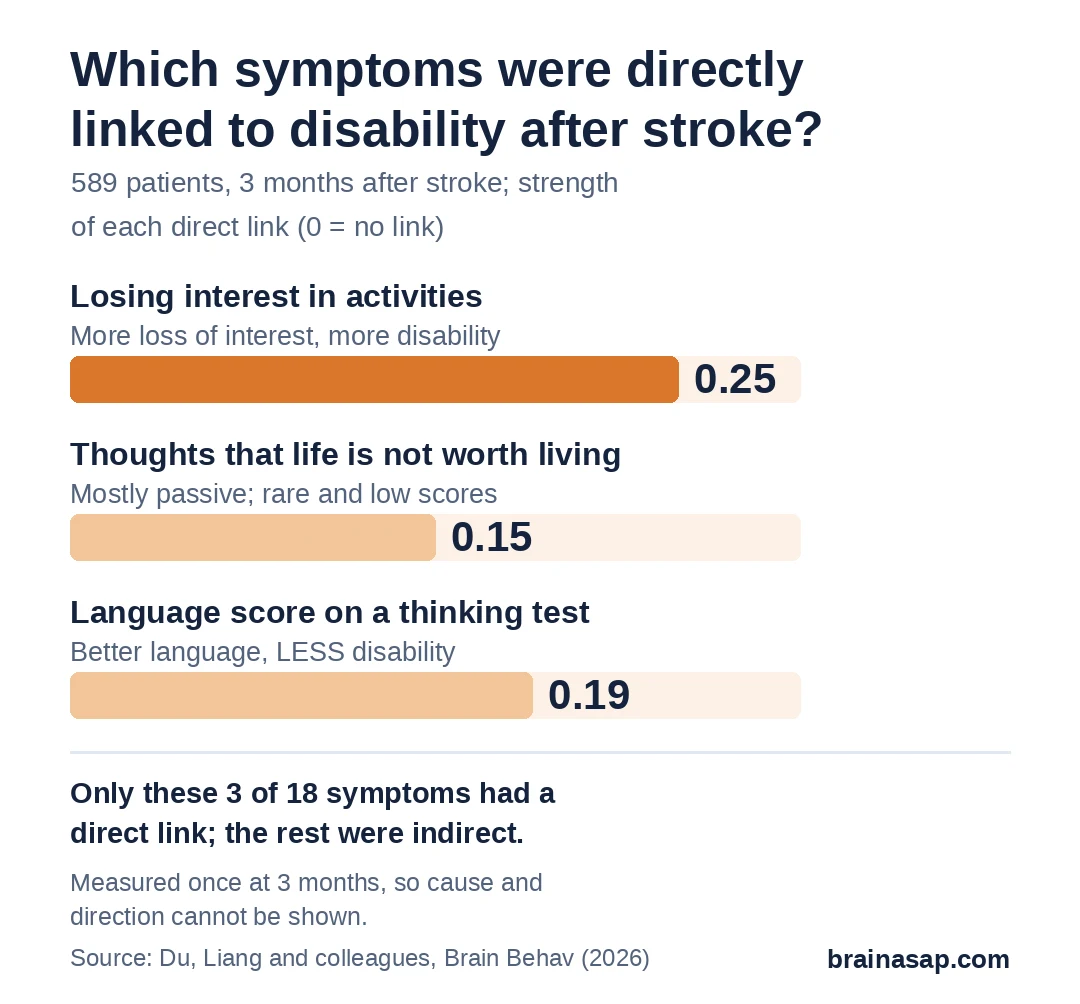
- Losing interest in work and activities: strongest link, with more loss of interest going with more disability
- Passive thoughts that life is not worth living: a weaker link in the same direction
- Language score: better language skills went with less disability
The second item needs context. On the mood interview it is labeled suicidality, but in this group scores were rare and low, averaging 0.14 on a 0-to-4 scale.
Scores consistent with active suicidal thoughts were very rare. The authors interpreted the result mainly as a sign of emotional distress in this group. This study did not assess whether the item predicts suicide risk.
Did the Brain Scans Point to a Cause?
For 429 patients with suitable MRI scans, the team checked whether damage in particular spots went with each of these 3 symptoms.
Weaker language scores were linked to damage in the left superior corona radiata, a bundle of white-matter fibers that contains pathways involved in language. Losing interest and passive thoughts about life not being worth living had no clear single damage spot.
Du and colleagues suggested those mood symptoms may come from disruption spread across brain networks rather than from one injured area.
What the Study Cannot Show
- One snapshot: everything was measured at 3 months, so the map cannot show whether losing interest leads to disability or disability leads to losing interest
- Overlapping questions: the interview item on loss of interest partly asks about work and activities, which overlaps with the disability scale and may have inflated their link
- Mostly mild strokes: most disability scores were 1 or 2, and people with severe language problems were excluded
- Coarse tools: language came from a 9-point section of a short screening test, and that test misses planning and visual skills
- Exploratory scan analysis: the language finding rests on 35 tiny brain-image units and needs repeating in larger groups
The study does not show that treating any one symptom will reduce disability. It does suggest that after a stroke, a patient who has stopped caring about activities they used to enjoy may deserve as much attention as one who simply says they feel sad.
Whether helping people regain interest in daily life speeds recovery is the question a follow-up or treatment trial would need to answer.
Citation: DOI: 10.1002/brb3.71759. Du Q, Liang W, Fang Y, Li T, Pan C, Li G, Zhu Z. Symptom Network and Lesion Mapping of Post-Stroke Depression, Cognitive Impairment, and Dysfunction: A Multicenter Cohort Study. Brain and Behavior. 2026;16(9):e71759. PMID: 42723393.
Study Design: Multicenter prospective cohort with cross-sectional network analysis at 3 months (regularized Gaussian graphical model of HDRS-17 items, MMSE subdomains and mRS), flow analysis around the disability node, and voxel-based lesion-symptom mapping in an imaging subset.
Sample Size: 589 patients with acute ischemic stroke from 3 hospitals in Wuhan, China; 429 with MRI suitable for lesion mapping.
Key Statistic: Direct edges with mRS: loss of interest 0.25, suicidality item 0.15, MMSE language −0.19; language mapped to left superior corona radiata (35 voxels, FWE-corrected); no cluster for suicidality and no labeled region for loss of interest.
Caveat: Cross-sectional network cannot establish direction; mostly mild strokes; HDRS loss-of-interest item overlaps with disability content; coarse MMSE language measure; severe aphasia excluded. Full published PDF reviewed.