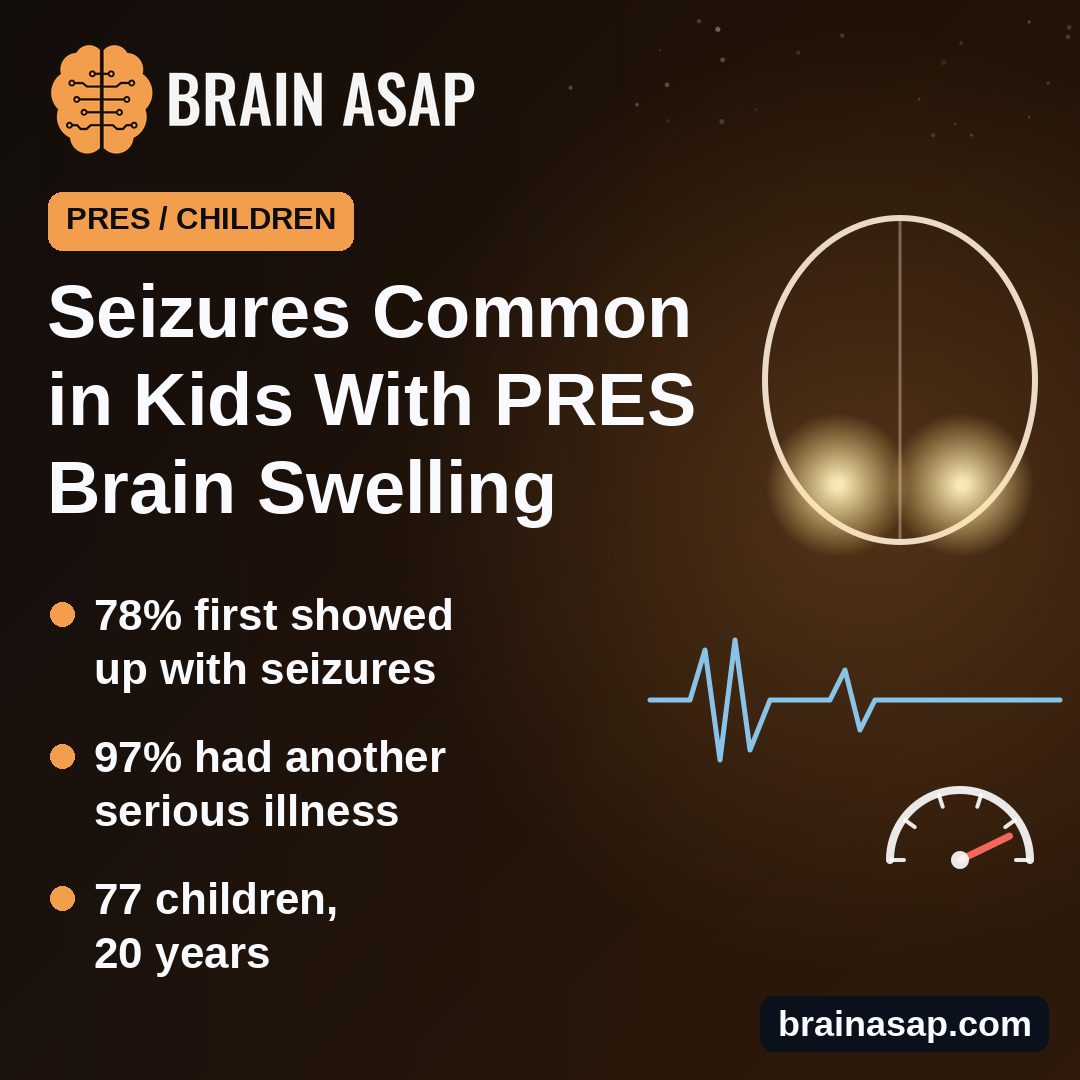
TL;DR: At a leading London children’s hospital, 77 children with PRES, a sudden brain-swelling syndrome, were reviewed over 20 years. Nearly 4 in 5 first showed up with seizures, almost all had another serious illness, and about a third of those given seizure medicine still needed it after 6 months.
Key Findings
- Seizures came first: 60 of 77 children (78%) presented with seizures.
- Sick children: 97% had other major conditions, mostly cancer, blood, kidney or immune disorders.
- Immune drugs common: 70% were taking immune-suppressing medicines.
- Atypical scans: 40 of 64 reviewed scans did not show the classic pattern.
- Not always fully reversible: 5 of 41 follow-up scans showed lasting scarring.
Source: Frontiers in Neurology (2026) | Bednarczuk, Ioannidou et al.
Posterior reversible encephalopathy syndrome, or PRES, is a sudden swelling of the brain, usually at the back of the head. It is linked to high blood pressure and certain drugs, and it can cause seizures, headache, vision problems and confusion. As the name says, it is usually reversible. But in children it is rare and less well described.
Doctors at Great Ormond Street Hospital in London reviewed every child treated for PRES there from 2005 to 2024, the largest such group reported in the UK.
Almost Every Child Had Another Serious Illness
The 77 children averaged 8.6 years old, and 64% were boys. Nearly all (97%) had a significant underlying condition:
- Cancer or blood disorders: 32%
- Kidney disease: 22%
- Immune conditions: 12%
Seventy percent were taking medicines that suppress or adjust the immune system, such as those used after transplants. About two-thirds had high blood pressure when PRES struck.
Seizures Were the Most Common First Sign
Seizures, usually full-body convulsions, were how most children came to doctors’ attention. Other symptoms were less common.
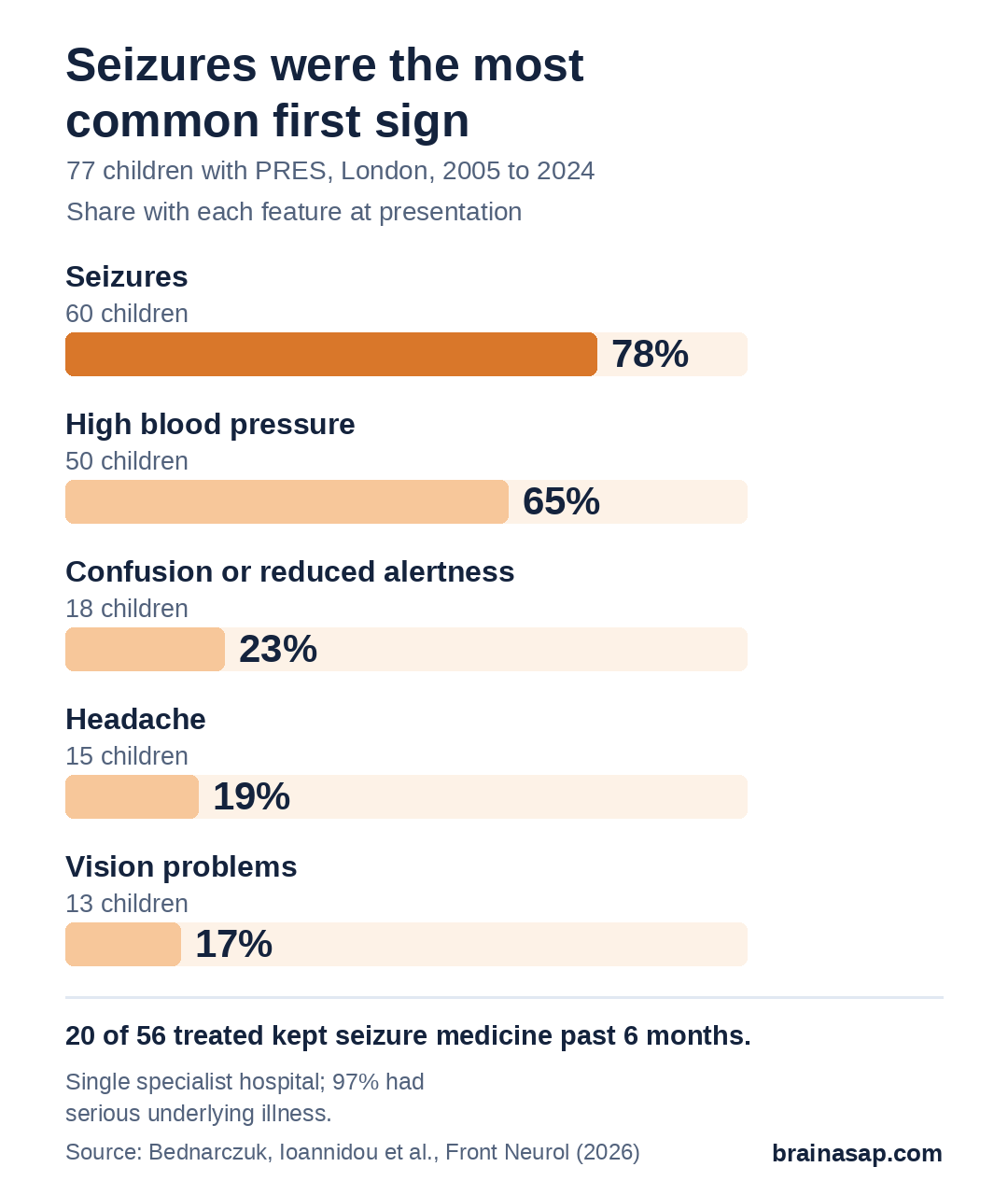
Almost all children had EEG brain-wave testing, and 9 in 10 of those tests were abnormal.
Many Scans Did Not Match the Textbook
PRES is named for swelling at the back of the brain. But of the 64 children whose scans could be fully reviewed, only 24 showed that classic pattern. Forty had atypical patterns, with swelling in other areas such as the deep brain or the cerebellum. This matters because doctors may not suspect PRES if the scan looks unusual.
Of 41 children who had a follow-up scan, 5 had a small lasting scar in the affected area, and all 5 had atypical patterns at the start. None showed PRES returning on scans, though 3 children had a clinical recurrence.
A Third Stayed on Seizure Medicine
Fifty-six children were given seizure medicine, most often levetiracetam. About two-thirds stopped within 6 months, while 20 (36%) stayed on it longer, mainly because of ongoing seizures. Almost all children with lasting seizures had complex conditions such as a past transplant.
One Hospital, Looking Back
- Retrospective: Records over 20 years, with changing practice and scanners.
- Specialist hospital: Very sick children; results may not fit general hospitals.
- Missing scans: 13 children’s original images were unavailable, and 8 of them later died.
- Underlying illness: 18% of the whole group died of their underlying disease, which makes PRES outcomes hard to separate.
Seizures in a Sick Child Should Raise the Question
For parents of children on transplant or cancer drugs, or with kidney disease, the practical point is that a sudden seizure, headache or vision change, especially with high blood pressure, needs urgent attention. Most children recover, but some need longer seizure treatment and follow-up.
The authors call for shared treatment pathways so that hospitals can learn which children need long-term seizure medicine and which can safely stop.
Citation: DOI: 10.3389/fneur.2026.1944274. Bednarczuk N, Ioannidou E, Mankad K, et al. Posterior reversible encephalopathy syndrome (PRES) in children – a summary of 20 years of tertiary neurology centre experience. Front Neurol. 2026;17:1944274.
Study Design: Retrospective single-center case series, 2005 to 2024.
Sample Size: 77 children; 64 with detailed imaging review; 41 with follow-up imaging.
Key Statistic: Seizures at presentation 60/77 (77.9%); long-term seizure medicine 20/56 (35.7%); follow-up gliosis 5/41.
Caveat: Single specialist center; retrospective records; missing imaging for 13 children.