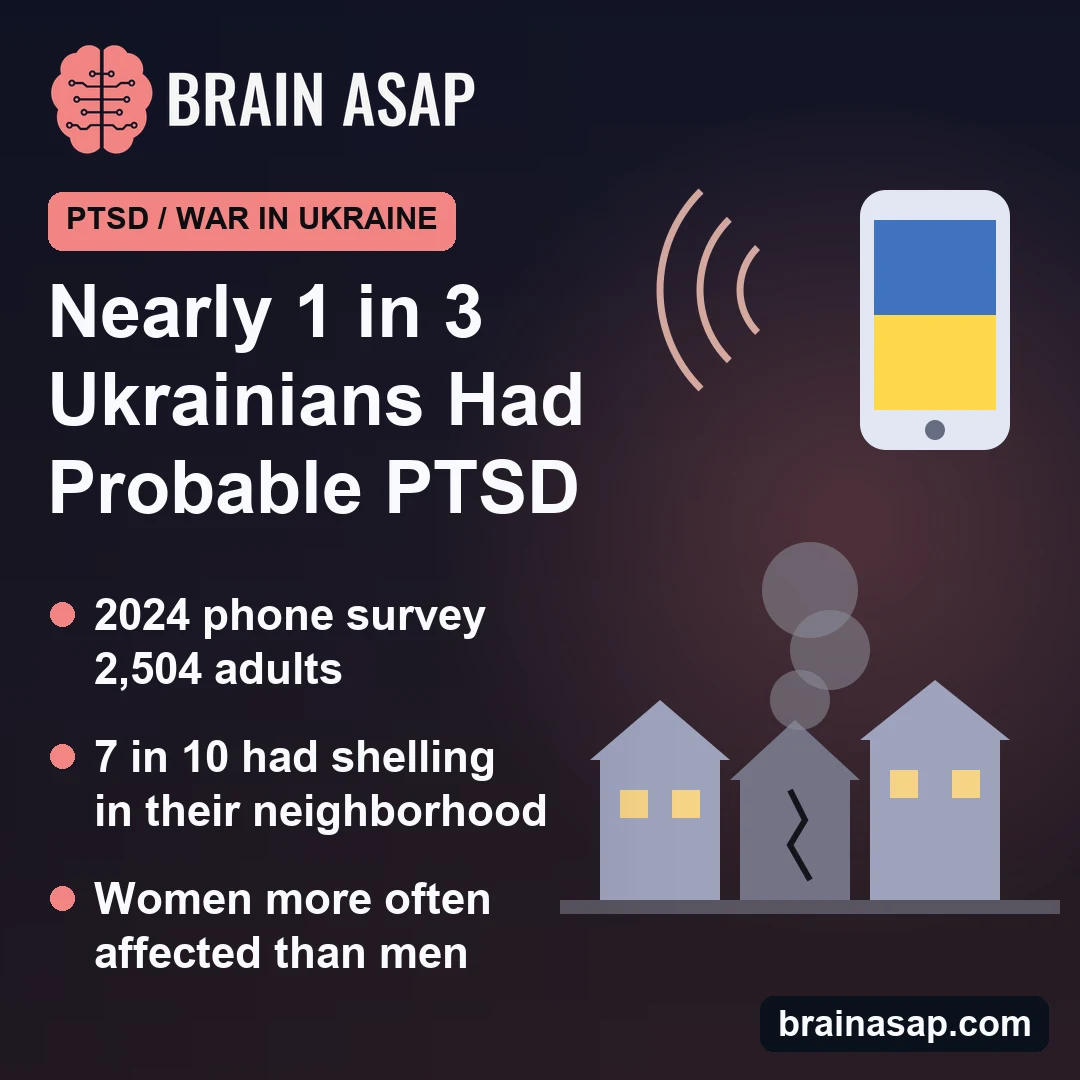
TL;DR: In a 2024 phone survey of 2,504 adults across government-controlled Ukraine, about 7 in 10 said shelling had hit their neighborhood during Russia's war.
Based on their answers to a standard symptom questionnaire, nearly 1 in 3 met thresholds for probable post-traumatic stress disorder (PTSD) or complex PTSD, a related condition with additional symptoms. These were questionnaire results, not clinical diagnoses.
Key Findings
- Probable PTSD was common: An estimated 25% of adults met the questionnaire's threshold for PTSD, and another 6% for complex PTSD, 31% in all.
- War touched nearly everyone: About half had a loved one serving on the front line, and nearly half had a loved one injured or killed in the war.
- Women more affected: About 31% of women vs 19% of men had probable PTSD.
- More war experiences, higher odds: Each additional war-related experience, such as shelling or losing a home, was linked to higher odds of probable PTSD.
Source: European Journal of Psychotraumatology (2026) | Facer-Irwin et al.
More than 2 years into the full-scale Russian invasion, how many people in Ukraine were living with lasting trauma symptoms? Earlier estimates ranged wildly, from about 10% to more than 50%, partly because many studies surveyed narrow groups, such as young parents or people who had fled.
A 2026 study in the European Journal of Psychotraumatology, led by Emma Facer-Irwin and Deirdre MacManus at King's College London with colleagues in Ukraine, Germany and the US, tried to get a nationwide picture.
Calling Random Phone Numbers Across Ukraine
In May 2024, trained interviewers from the Kyiv International Institute of Sociology called randomly generated mobile numbers across every region the Ukrainian government controlled. 2,504 adults completed the 27-minute interview, in Ukrainian or Russian.
- Women: 54%
- Median age: 54
- Displaced from home by the war: 1 in 3
- Ever served in the armed forces or territorial defense: fewer than 1 in 10
People were asked about traumatic events across their lives, a list of 20 war-related experiences, and PTSD symptoms using the International Trauma Questionnaire. Answers were weighted to match Ukraine's adult population by region, age, sex and town or village.
What Had People Lived Through?
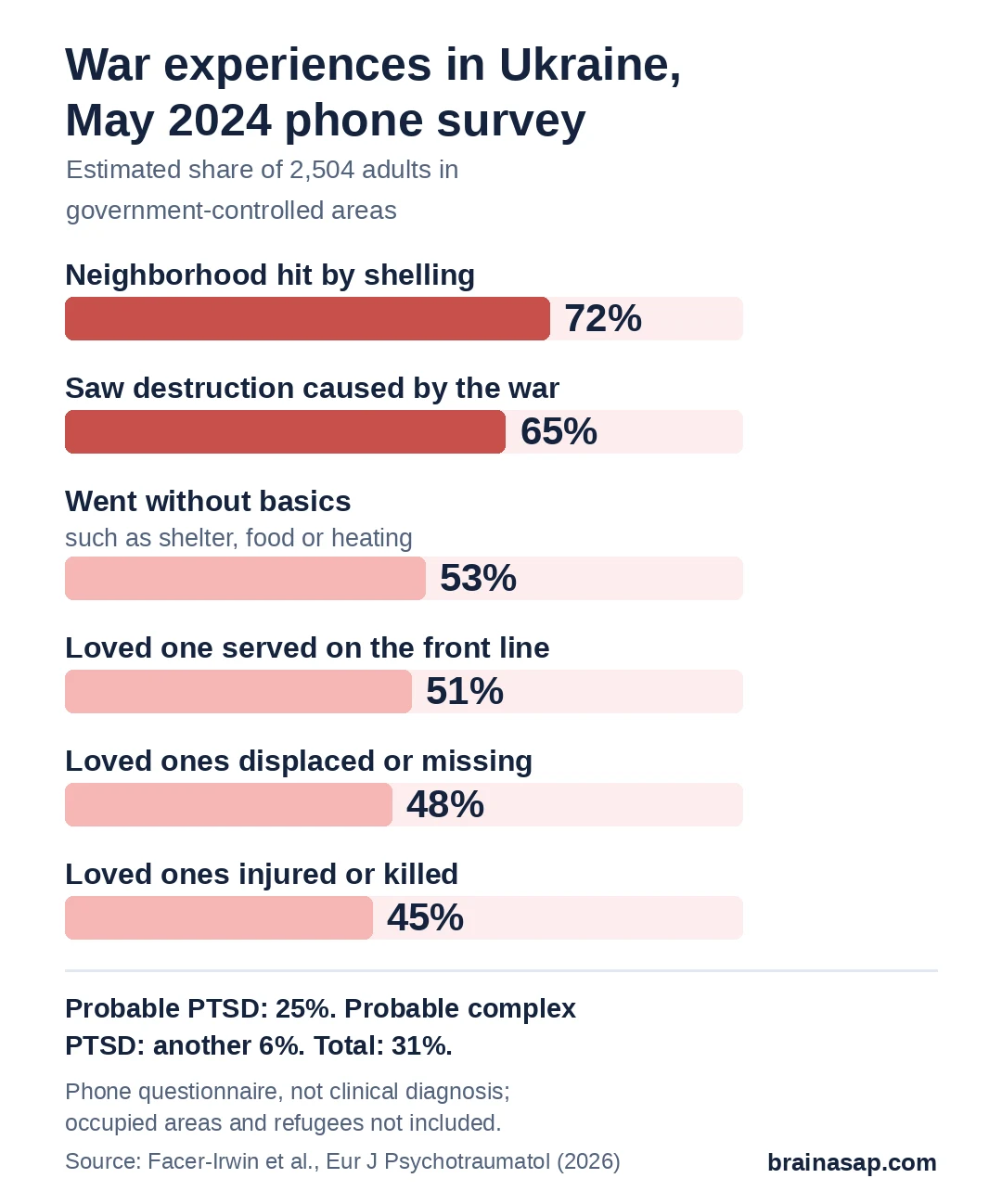
Almost everyone, about 93%, reported at least 1 traumatic event as an adult. Fires or explosions and seeing severe human suffering were each reported by over half.
Direct harm was rarer. Under 4% had been physically injured in the war, and about 3% had been captured or mistreated by Russian forces.
How Many Had Probable PTSD?
The questionnaire assessed reliving a traumatic event, avoiding reminders and a sense of current threat, together with effects on daily life. Complex PTSD adds lasting trouble managing emotions, feeling worthless, and difficulty staying close to others.
- Probable PTSD: 25.2%
- Probable complex PTSD: 6.0%
- Either: 31.2%
That's roughly the same as a 26.5% average reported for war-affected adults worldwide, and well above the 10% or less usually found in general populations.
Who Was More Likely to Have Symptoms?
After accounting for age and sex, higher odds of probable PTSD or complex PTSD were linked to:
- Being a woman: about 1.9 times the odds of men
- Past military or territorial defense service: about 1.8 times the odds
- Being displaced from home: about 1.5 times the odds
- Less education: secondary school or below vs any university
- More war experiences: each extra experience on the list of 20 was linked to about a fifth higher odds
Being older was linked to slightly higher odds, too. Among people with probable PTSD, single people were more likely to have the complex form.
What a Phone Survey Can and Can't Show
- Probable, not diagnosed: A symptom questionnaire by phone isn't a clinical interview.
- Missing groups: People in Russian-occupied areas and refugees abroad weren't included.
- Low response: Only about 11% of people reached completed the survey, which the team noted was typical for Ukraine; weighting helps but can't fix everything.
- Wide uncertainty: Some weighted war-exposure estimates had very wide confidence ranges, so their rounded percentages are approximate point estimates.
- Possible underreporting: About a third of people didn't name a specific traumatic event and weren't asked the PTSD questions, and talking to an interviewer may make people hold back.
- A 2024 snapshot: The war has continued since May 2024, so today's numbers may differ.
Reaching Millions Who May Need Help
Facer-Irwin, MacManus and colleagues argued that, with probable PTSD this common, Ukraine needs support that can reach many people, not only specialist therapy, and that early help aimed at core PTSD symptoms may matter most.
An open question is what happens to these symptoms while the threat is still ongoing. Follow-up waves of the same survey could show whether they ease, persist or turn into the more severe complex form.
Citation: DOI: 10.1080/20008066.2026.2697563 | Facer-Irwin E, Short R, Murphy D, Onuch O, Hale HE, Kulyk V, Biscoe N, Sasse G, MacManus D. Prevalence of exposure to lifetime and war-related traumas, PTSD and complex PTSD in a sample from the Ukrainian general population. European Journal of Psychotraumatology. 2026;17(1):2697563.
Study Design: Cross-sectional national telephone survey (random-digit mobile sampling, CATI) of adults in government-controlled Ukraine, 7–31 May 2024; LEC-5, 20-item war stressor scale, ICD-11 International Trauma Questionnaire; weighted prevalence and age- and gender-adjusted logistic regression.
Sample Size: 2,504 adults (response rate 11.3%); 647 probable PTSD, 146 probable CPTSD, 1,711 no diagnosis (unweighted counts).
Key Statistic: Weighted probable PTSD 25.2% (95% CI 20.4–30.7), CPTSD 6.0% (2.8–12.3), combined 31.2% (26.37–36.46). PTSD/CPTSD vs none: male aOR 0.54 (0.35–0.81); prior service aOR 1.79 (1.32–2.43); displaced aOR 1.51 (1.28–1.78); cumulative war stressors aOR 1.21 (1.18–1.25).
Caveat: Excludes occupied territories and people abroad; self-reported probable diagnoses by phone; 35% screened out without an index trauma; low response rate; cross-sectional associations only.