
TL;DR: In 741 adults with frequent migraine, quality of life rose a bit more on rimegepant than placebo at 12 weeks (18.6 vs 15.0). The next year had no comparison group, so it can't show the drug helped.
Key Findings
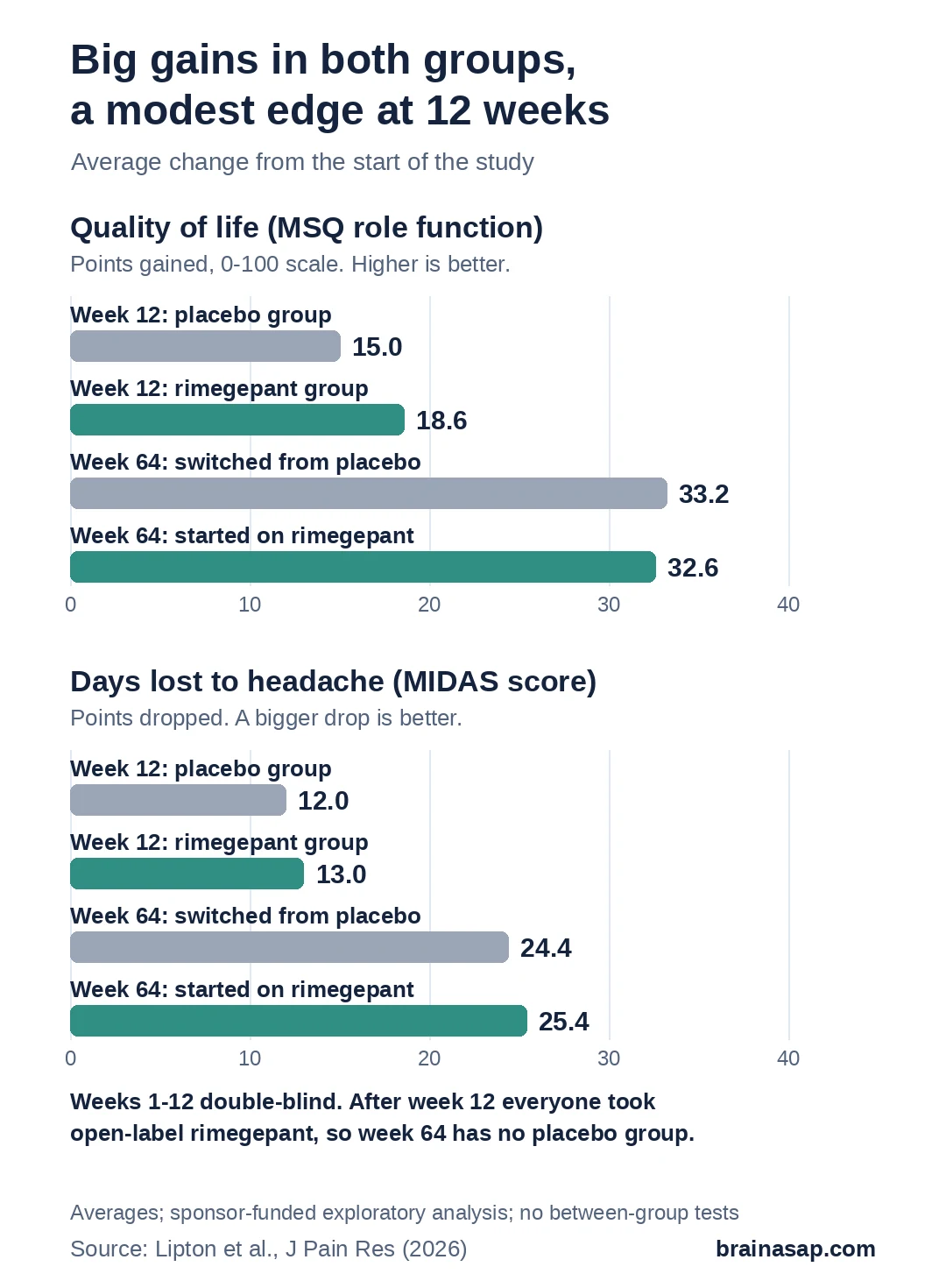
- Quality of life at 12 weeks: 0–100 scale of how much migraine limits daily roles (higher is less limitation): rimegepant group gained 18.6 points, placebo group 15.0.
- Disability at 12 weeks: Days-lost-to-headache score fell 13.0 points with rimegepant, 12.0 with placebo, a gap of just 1.0.
- By week 64: After a year of open-label rimegepant, group that started on the drug gained 32.6 points, group that switched from placebo 33.2. Disability score fell 25.4 and 24.4.
- Satisfaction: 83.7% of the 288 who answered at week 64 were completely or very satisfied.
- Sponsor: Sponsored by Biohaven, now part of Pfizer; several authors are Pfizer employees.
Source: Journal of Pain Research (2026) | Lipton et al.
Does a migraine pill change how people actually live, not just how many attacks they have? In this trial, people taking rimegepant reported big gains in quality of life over more than a year. But in the first 12 weeks, people taking a placebo reported big gains too.
Migraine is more than the attack itself. People cancel plans, miss work, and spend the days in between bracing for the next one, so counting attacks tells only part of the story.
Rimegepant is an oral pill that blocks the CGRP receptor, a pathway involved in migraine pain. The main results of this trial, which focused on migraine days, were published earlier. This paper is a follow-up on the questionnaires patients filled out.
Twelve weeks blinded, then a year with everyone on the drug
The study ran at sites across the United States and enrolled adults with at least a year of migraine, 4 to 18 moderate or severe attacks a month. It had two phases:
- Weeks 1–12, double-blind: 741 people took either rimegepant 75 mg or a matching placebo every other day (370 got rimegepant, 371 got placebo). Neither they nor the researchers knew who got which.
- Weeks 13–64, open-label: 603 people continued. Everyone now took rimegepant every other day, plus an extra dose on off days if a migraine hit, up to one pill a day. Everybody knew they were on the drug. Of these, 302 had started on rimegepant and 301 had started on placebo.
This article calls the first phase’s two arms the rimegepant group and the placebo group. For the second phase, it calls them the group that started on rimegepant and the group that switched from placebo.
One questionnaire for quality of life, one for lost days
Participants filled these out on paper at the start, then at weeks 12, 24, and 64.
- MSQ (Migraine-Specific Quality of Life Questionnaire): asks how much migraine got in the way over the past four weeks. The paper focuses on the “role function restrictive” part, which covers how much migraine limits everyday activities. Scores run from 0 to 100, and higher is better. Both groups started near 50.
- MIDAS (Migraine Disability Assessment): counts days lost to headache over the past three months, from work or school, housework, and leisure. Lower is better. Both groups started near 37.5, which the authors describe as severe disability.
For context, the authors cite earlier work saying a person’s MSQ role function score needs to rise about 5 points for the change to feel meaningful, and a difference of about 3.2 points between groups is considered meaningful. For MIDAS, the cutoff is a drop of roughly 4.5 to 5 points.
At 12 weeks, placebo nearly matched rimegepant on lost days
Both groups improved a lot. On the MSQ, the rimegepant group gained 18.6 points and the placebo group gained 15.0. The 3.6-point gap is just above the 3.2-point threshold the authors use for a meaningful difference, and they call it a “notable numerical benefit.” The other two MSQ parts showed similar gaps: 14.4 vs 11.5 points and 18.9 vs 15.1.
The MIDAS story was different. Disability scores fell 13.0 points with rimegepant and 12.0 with placebo. The authors say this small gap “might indicate no real difference,” and offer some possible explanations: a big placebo response, a lag between fewer migraines and people noticing a change in daily life, and the fact that MIDAS asks people to remember the previous three months.
Satisfaction at week 12 leaned toward rimegepant. Of those who answered, 49.2% of the rimegepant group were completely or very satisfied with their medication, versus 39.3% of the placebo group.
By Week 64, Both Groups Had Gained About the Same
Once everyone was on rimegepant, both groups kept improving, and the placebo group caught up. At week 64, the MSQ role function score had risen 32.6 points in the group that started on rimegepant and 33.2 in the group that switched from placebo. MIDAS fell by 25.4 and 24.4. The other measures looked much the same, including absenteeism (about 13 fewer days lost in both groups).
By week 64, 87.4% of the group that started on rimegepant and 80.0% of the group that switched from placebo were completely or very satisfied. That is 83.7% of the 288 people who answered.
It is tempting to see 32.6 points and think rimegepant delivered that. The design does not allow it. During the open-label year, nobody was on placebo, so there is nothing to compare against. And the first 12 weeks show how large the placebo response can be: an inactive pill went with a 15-point gain on the same scale.
The switching pattern is interesting, though. People who started on placebo ended up in the same place as those on rimegepant from day one. That fits the idea that rimegepant helped them, but it is also consistent with people simply continuing to improve over time, and the study cannot tell those apart.
Limitations and Sponsor Involvement
- No comparison after week 12: Open-label phase had no placebo or other arm. Everyone knew they were on the drug, which can inflate self-reported scores.
- Exploratory analysis: Prespecified but exploratory outcomes; no between-group tests, no correction for multiple comparisons. Paper reports averages and confidence intervals only.
- Who stayed: 428 of 603 (71.0%) finished the open-label phase. People who benefited may have stayed. Post hoc analysis of completers showed similar patterns, the authors say.
- Sponsor involvement: Biohaven, since acquired by Pfizer, sponsored the study. Pfizer employees are co-authors, and Pfizer funded medical writing support. Authors disclosed a generative AI tool drafted the first version, which they then edited.
- Satisfaction was unvalidated: Single unvalidated question, answered by only some participants.
- Participants: 82.7% women, 81.5% white. No head-to-head comparison against other migraine preventives.
A Longer Blinded Comparison Is Needed
For people weighing a migraine preventive, these results add something the migraine-day counts cannot: what people say their lives felt like over more than a year. They report large, sustained gains in daily functioning while taking rimegepant. What they cannot tell us is how much of that came from the drug.
The 12-week comparison points to a modest edge over placebo on these questionnaires, though the paper ran no statistical test of that gap. Only a blinded comparison that runs well past 12 weeks could say how big the pill’s share really is. Whether it is right for any one person is a question for them and their doctor.
Citation: DOI: 10.2147/JPR.S612330. Lipton RB, Buse DC, Martin VT, Semel D, Cappelleri JC, Thiry A, Abraham L, Fullerton T. Improvements in Patient-Reported Outcome Measures Through 64 Weeks’ Rimegepant Treatment for Migraine: Analysis of a Randomized Controlled Trial with Open-Label Extension. Journal of Pain Research. 2026;19:612330.
Study Design: Prespecified exploratory analysis of a phase 2/3 randomized, double-blind, placebo-controlled trial (study 305; NCT03732638) with a 12-week double-blind phase followed by a 52-week open-label extension of rimegepant 75 mg every other day plus as needed on off days.
Sample Size: 741 treated adults in the double-blind phase (370 rimegepant, 371 placebo); 603 treated in the open-label phase, of whom 428 completed.
Key Statistic: Week 12 change in MSQ role function restrictive score: 18.6 (95% CI 16.24–20.94) with rimegepant vs 15.0 (12.60–17.37) with placebo; MIDAS total: −13.0 vs −12.0. Week 64 MSQ role function restrictive: 32.6 vs 33.2 (started on rimegepant vs switched from placebo).
Caveat: No comparison group after week 12; open-label self-reports; exploratory, no between-group tests or multiplicity correction; sponsor-funded with Pfizer-employed authors.