TL;DR: A 42-year-old man lost part of his vision in one eye from a stroke-like event in the optic nerve after losing about 40 kg in two months on semaglutide (Wegovy). One case can't show the drug caused it, and he had several other risk factors.
Key Findings
- About 40 kg in 2 months: On semaglutide for obesity, plus about 2 hours of exercise a day.
- Optic nerve stroke (NAION): Swollen nerve head and a blind patch in the lower field of one eye.
- Several risk factors: Diabetes, high blood pressure, high cholesterol and smoking.
- Six months later: Swelling gone, but the blind patch remained.
- Wider evidence: Individual large studies differ, but EMA's safety committee concluded that NAION is a very rare semaglutide side effect.
Source: Korean Journal of Family Medicine (2026) | Cho & Kim
Semaglutide, sold as Wegovy and Ozempic, is now one of the most widely used drugs for weight loss and diabetes. Since 2024, some studies have raised concern about a rare but serious eye problem: nonarteritic anterior ischemic optic neuropathy, or NAION, a sudden loss of blood flow to the front of the optic nerve. It is sometimes called an eye stroke.
Eye doctors at Yeungnam University Hospital in Daegu, South Korea, describe a patient who developed it after very rapid weight loss on the drug.
Forty Kilograms in Two Months
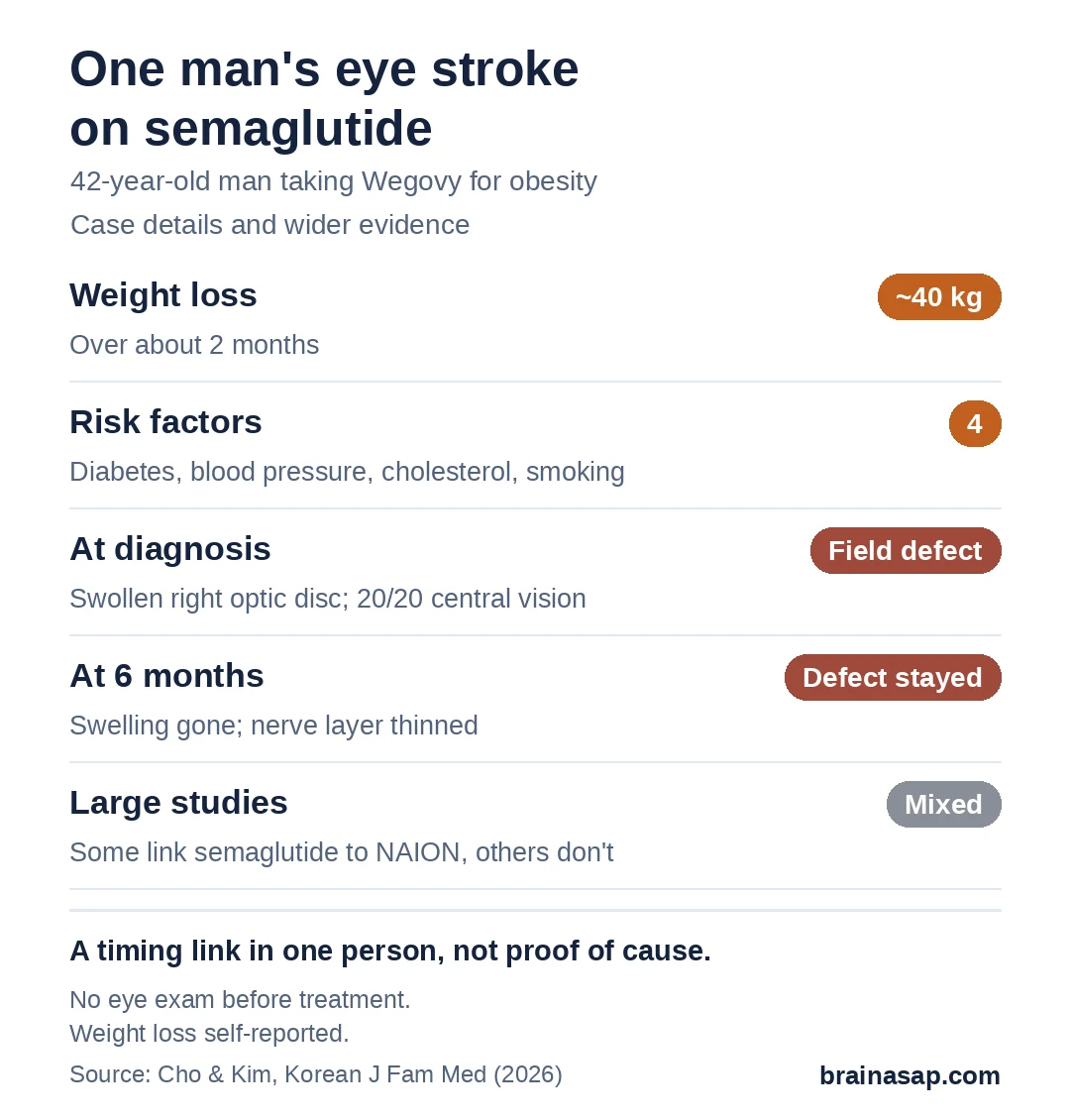
The 42-year-old man had type 2 diabetes and high blood pressure for 10 years, high cholesterol, and a 15-year history of smoking about a pack a day. He started Wegovy injections for obesity, stepping up to 1.7 mg, and exercised around 2 hours a day.
He reported losing about 40 kg in two months. He had no stomach side effects. He then noticed blurry vision in the lower part of the view from his right eye, though he wasn't sure exactly when it began.
A Swollen Optic Nerve and a Blind Patch
- Sharp central vision: 20/20 in both eyes.
- Swollen optic disc: In the right eye only.
- Visual field test: A missing area in the lower half of the right eye's view.
- Other causes ruled out: MRI and blood tests found no inflammation or MS-like disease.
Doctors diagnosed NAION. They stopped semaglutide and gave high-dose IV steroids for three days, though no treatment is proven to help this condition.
Swelling Resolved, Vision Loss Did Not
Six months later the swelling had gone, leaving a slightly pale optic nerve. But the blind patch in the lower field was still there, and a scan showed thinning of the nerve cell layer matching the lost area. This is typical of NAION: the damage usually doesn't reverse.
Drug, Weight Loss or Risk Factors?
NAION usually strikes people over 50, especially those with diabetes, high blood pressure, high cholesterol, smoking or a crowded optic nerve head. This man had four of those risk factors but was younger, and his nerve head did not look especially crowded after the swelling cleared.
The authors suggest semaglutide itself, the very fast weight loss, or both may have tipped him over. Rapid weight loss can lower blood volume and blood pressure, reducing blood flow to the optic nerve.
In June 2025, the European Medicines Agency's safety committee concluded that NAION is a very rare side effect of semaglutide, potentially affecting up to 1 in 10,000 people taking it. That assessment does not establish what caused this man's eye injury.
- One patient: A timing link, not proof of cause.
- No earlier eye exam: His optic nerve before treatment is unknown.
- Self-reported weight loss and uncertain onset date.
- Mixed large studies: Some found higher NAION risk with semaglutide; others didn't.
Speed of Weight Loss May Matter
The authors argue the most useful next question isn't just whether semaglutide is linked to NAION, but whether losing weight very fast raises the risk in people with vascular risk factors. Anyone on semaglutide who notices sudden, painless vision loss in one eye should see an eye doctor promptly.
Citation: DOI: 10.4082/kjfm.26.0135. Cho CH, Kim WJ. Nonarteritic anterior ischemic optic neuropathy after rapid weight loss during semaglutide therapy: a case report. Korean J Fam Med. 2026;47(5):460-464.
Study Design: Single case report.
Sample Size: 1 patient (42-year-old man).
Key Statistic: About 40 kg weight loss over 2 months before onset; field defect persisted at 6 months.
Caveat: One case with multiple vascular risk factors; causation not established.