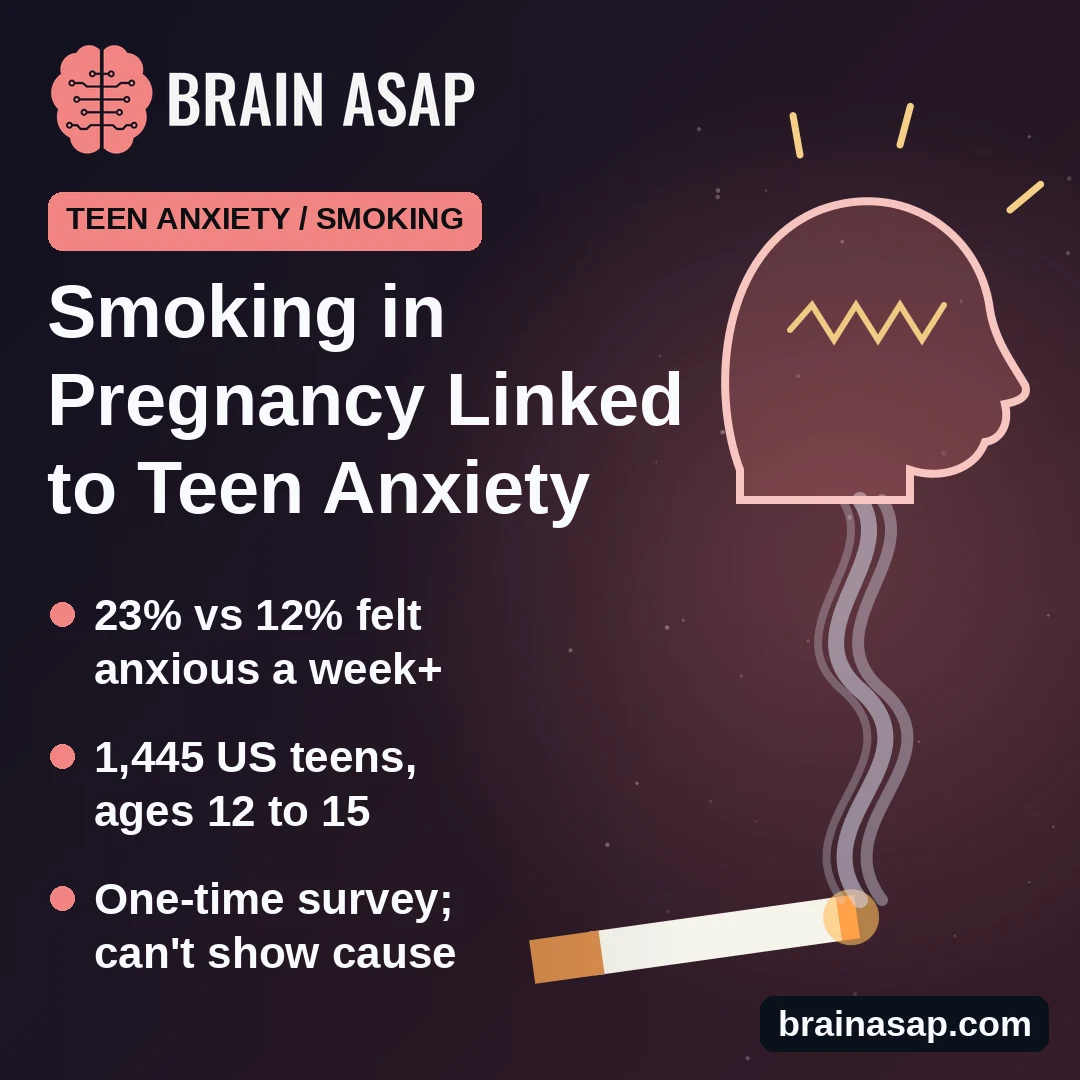
TL;DR: In a 2026 analysis of a national American health survey, 12- to 15-year-olds whose mothers had smoked while pregnant were about twice as likely to say they'd felt anxious, or that their mental health was poor, on at least 7 of the past 30 days.
About 1 in 4 of these teens reported that many anxious days, compared with about 1 in 8 of other teens. A one-time survey can't show that smoking in pregnancy caused the difference.
Key Findings
- More anxious days: 23% of teens whose mothers smoked during pregnancy felt worried, nervous or anxious on 7 or more of the past 30 days, vs 12% of teens whose mothers didn't.
- More poor mental health days: 28% vs 12% said their mental health, including stress and low mood, was poor on 7 or more days.
- Held after adjusting: The gaps stayed statistically clear after accounting for family income, the household head's education, the mother's age and the teen's birth weight.
Source: Tobacco Induced Diseases (2026) | Liu et al.
Smoking during pregnancy is known to raise the risk of low birth weight and other problems for babies. Whether it also affects children's mental health years later is less clear, with past studies disagreeing.
A 2026 study in Tobacco Induced Diseases, by Ya Liu, Jiaqi Deng and Yong Zhang of Xi'an Jiaotong University and Southwest Medical University in China, looked at this question in American teenagers.
A National Survey of US Teens
Data came from the National Health and Nutrition Examination Survey (NHANES), which the US government runs to track the health of a nationally representative sample of Americans. This analysis used survey rounds from 2007 to 2012.
It included 1,445 teens aged 12 to 15. For each one, the survey had asked whether the teen's biological mother smoked at any point while pregnant with them. The survey-weighted proportion exposed was about 15%; the unweighted count was 183 of 1,445 teens.
In private interviews, teens answered 2 questions about the past 30 days:
- On how many days did you feel worried, nervous or anxious?
- On how many days was your mental health, including stress, depression and emotional problems, not good?
How Big Were the Differences?
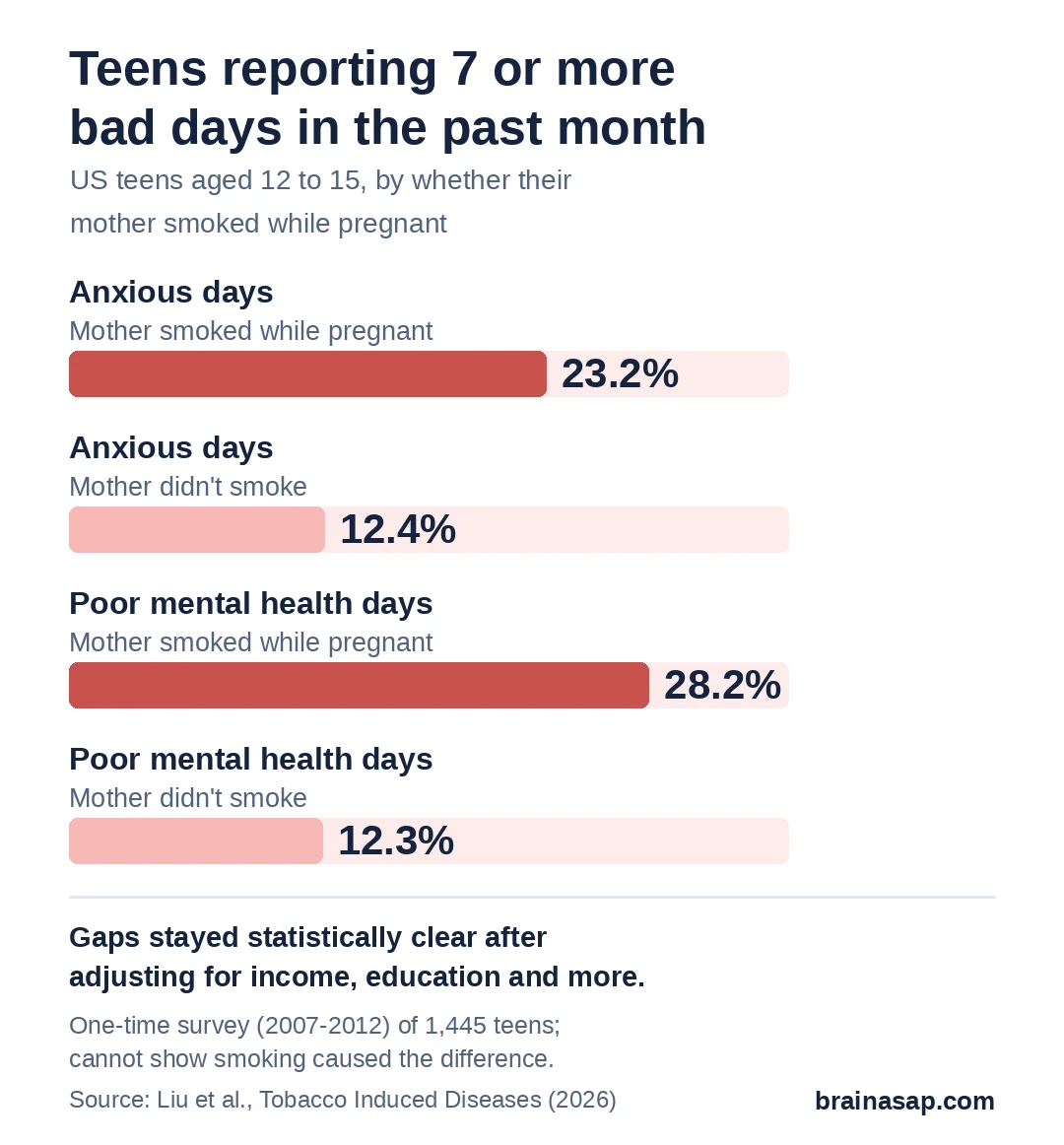
Teens whose mothers smoked during pregnancy reported more bad days on both questions. Gaps widened for teens who reported 15 or more bad days, half the month or more:
- Anxious on 15+ days: 13.6% vs 4.7%
- Poor mental health on 15+ days: 17.7% vs 5.5%
Mothers who smoked were also younger at the birth, had lower incomes and less education on average, and their babies were more often born small.
After accounting for those and other differences, teens whose mothers smoked still reported about 1.7 times as many anxious days and about 2 times as many poor mental health days.
What Could Explain the Link?
Liu and colleagues pointed to animal and lab research suggesting nicotine can reach the developing brain and alter chemical signaling, and that smoking can reduce oxygen to the baby.
Other explanations are just as possible, though. Mothers who smoke during pregnancy often keep smoking at home, may face more stress or have mental health problems of their own, and can pass on genes linked to both smoking and anxiety.
Some earlier studies comparing siblings, where only 1 pregnancy involved smoking, found no clear link, though others did.
Limits of a One-Time Survey
- Snapshot, not follow-up: Pregnancy smoking and teen mood were both reported at the same visit, years after the pregnancy.
- Memory and honesty: Smoking in pregnancy was reported after the fact, and some mothers may not have said they smoked.
- No amount recorded: The survey didn't ask how much mothers smoked.
- Key factors missing: No information on parents' mental health, smoking at home after birth, or the teens' own smoking and drinking.
- Small exposed group: Only 183 teens had mothers who smoked during pregnancy.
- Single questions: Anxiety and mental health were each measured with 1 question, not a diagnosis.
- Older data: Survey rounds were from 2007 to 2012.
Following Children From Pregnancy Onward Is Needed
This survey adds to evidence that teens whose mothers smoked during pregnancy report more anxious and difficult days, but it can't separate the smoking from everything else that comes with it.
Studies that follow children from pregnancy into their teens, record how much mothers smoked, and track parents' own mental health could show how much of this link, if any, comes from smoking itself. Either way, quitting before or early in pregnancy has clear benefits for babies.
Citation: DOI: 10.18332/tid/226577 Liu Y, Deng J, Zhang Y. Maternal smoking during pregnancy in relation to adolescent anxiety and poor mental health: A cross-sectional study based on NHANES 2007–2012. Tobacco Induced Diseases. 2026;24(September):163.
Study Design: Secondary cross-sectional analysis of pooled NHANES 2007–2012; survey-weighted negative binomial and logistic regression with 3 adjustment models; unweighted logistic sensitivity analysis.
Sample Size: 1,445 US adolescents aged 12–15 (183 exposed to maternal smoking during pregnancy; 1,262 unexposed).
Key Statistic: ≥7 anxious days 23.2% vs 12.4%; ≥7 poor mental health days 28.2% vs 12.3%; fully adjusted rate ratio 1.68 (95% CI 1.19–2.37) for anxiety days and 1.97 (1.40–2.77) for poor mental health days; ≥15 days AOR 3.03 and 3.11.
Caveat: Cross-sectional; retrospective report of pregnancy smoking; no dose data; single-item outcomes; no parental mental health, postnatal household smoking or adolescent substance use covariates; small exposed group.