TL;DR: Parents and caregivers of 174 babies and toddlers who had cerebral palsy, or were at high risk of it, filled out a sleep questionnaire at 6 American clinics. Its questions about falling asleep, staying asleep and what the questionnaire calls arousal gave reasonably consistent answers, but its questions about daytime sleepiness and behavior did not.
Key Findings
- Good overall consistency: the questionnaire's items hung together well as a whole.
- 3 parts worked: questions on falling asleep, staying asleep and what the questionnaire calls arousal were reliable, including when answered twice or by different people.
- 2 parts didn't: questions on daytime sleepiness and daytime behavior had poor reliability.
- Sleep problems were common: roughly 28% to 38% of children showed problems in each of the 3 reliable areas.
- Agreed with a standard baby-sleep survey: results matched a widely used infant sleep questionnaire acceptably to strongly.
Source: Pediatric Research (2026) | Maitre and colleagues
Babies and toddlers with cerebral palsy, a lifelong condition affecting movement and posture that starts in early brain development, sleep poorly more often than other children. Poor sleep can affect thinking, behavior and the whole family's well-being.
Spotting sleep problems early needs a good tool, and for children under 2 with cerebral palsy, the best candidate had never been properly tested.
Testing a Sleep Questionnaire Built for Children With Severe Disabilities
A 2026 study in Pediatric Research, led by neonatologist Nathalie Maitre at Emory University and Children's Healthcare of Atlanta, checked a questionnaire called SNAKE, short for the Sleep Questionnaire for Children With Severe Psychomotor Impairment.
It is filled out by a parent or caregiver, and earlier research had rated it the best-supported option for this age group. But no one had checked whether its answers were consistent and measured what they were meant to.
Caregivers of 174 children under 2 years old took part, across 6 US follow-up programs for high-risk infants. All of the children either had cerebral palsy or were at high risk of developing it.
Caregivers completed both SNAKE and a widely used infant sleep survey, the Brief Infant Sleep Questionnaire, so the 2 could be compared.
Which Parts of the Questionnaire Held Up?
Researchers asked 3 questions about each part of SNAKE:
- Do its questions agree with one another?
- Does the same caregiver give similar answers a second time, and do 2 different caregivers agree?
- Do its scores line up with the established infant sleep survey?
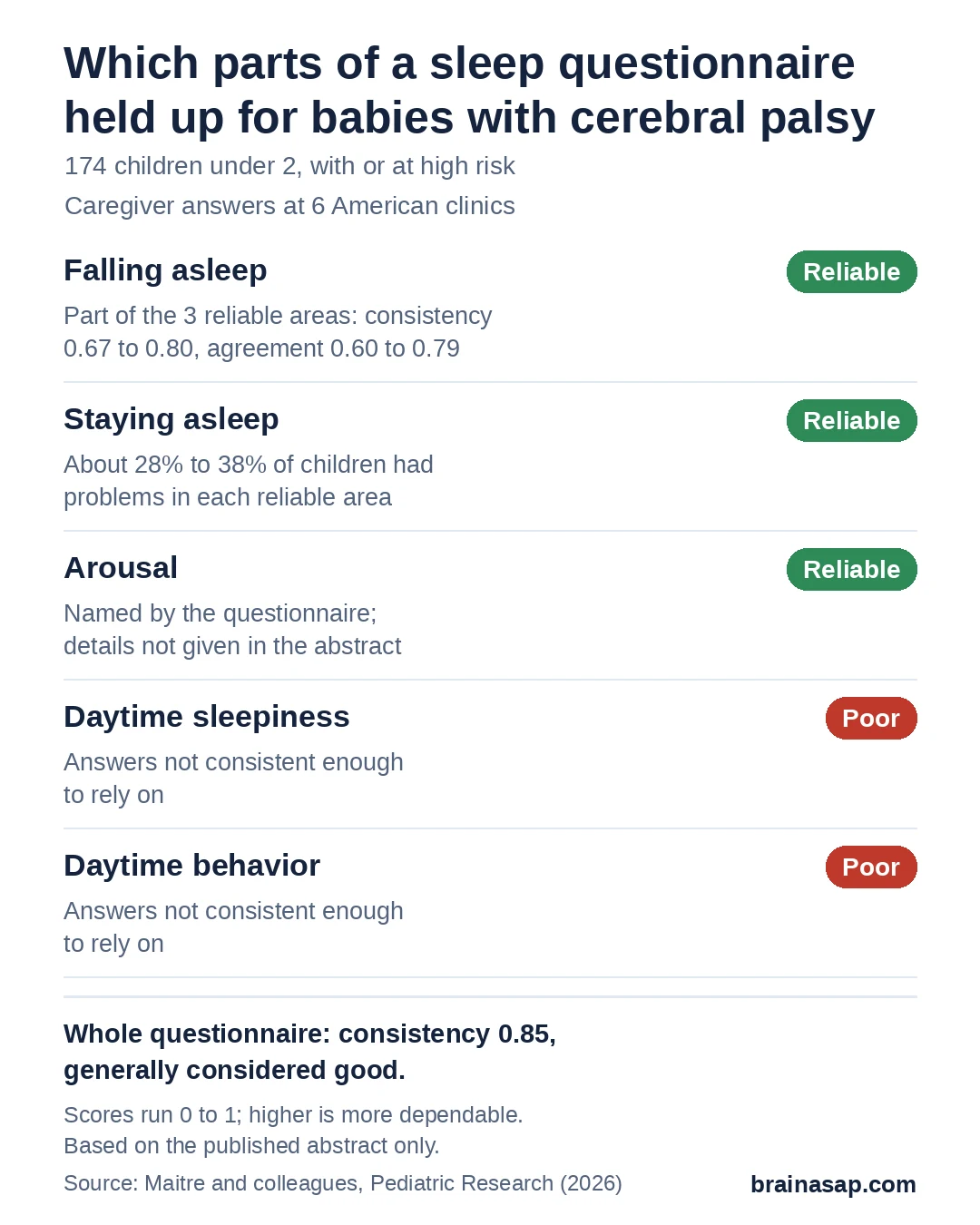
As a whole, the questionnaire scored 0.85 for internal consistency, on a scale where 1 would mean every question moves perfectly together. That is generally considered good.
3 parts held up on their own: falling asleep, staying asleep, and a part the questionnaire calls arousal. Their consistency scores ranged from 0.67 to 0.80. Agreement when the same caregiver answered twice, or when 2 caregivers answered, was moderate to good, at 0.60 to 0.79.
Questions on daytime sleepiness and daytime behavior did not hold up: their reliability was poor.
Sleep Problems Showed Up in About 1 in 3 Children per Area
Using the 3 reliable parts, roughly 28% to 38% of the children showed problems with falling asleep, staying asleep or arousal, depending on the area.
The researchers reported acceptable to substantial agreement with another caregiver sleep survey.
What a Questionnaire Study Can't Show
- Caregiver reports, not sleep studies: the abstract describes comparison with another caregiver questionnaire and gives no accuracy estimate against monitored sleep
- Not a treatment trial: the study checked a tool, not whether any sleep help works
- Specialist clinics only: children came from US high-risk follow-up programs, which may not reflect every family
- Abstract only reviewed: this article is based on the published abstract, so details such as how many children had a cerebral palsy diagnosis versus high risk, and the exact figure for each sleep area, were not available
A Usable Night-Time Sleep Check for Very Young Children
For clinics following babies with or at risk of cerebral palsy, SNAKE looks like a practical way for caregivers to flag trouble falling or staying asleep. Maitre and colleagues described it as feasible for supporting early identification and intervention.
Its daytime questions need rework before anyone relies on them. Whether catching night-time sleep problems this early leads to better sleep, and better development, is the next thing to find out.
Citation: DOI: 10.1038/s41390-026-05613-0. Maitre NL, Ostrander B, Burton VJ, deRegnier RA, Kesavan K, Marra L, He Z, Kjeldsen CP, Byrne R, Duncan AF, et al. A sleep questionnaire's psychometric properties in infants with or high risk of cerebral palsy. Pediatric Research. 2026. PMID: 42998993.
Study Design: Prospective multicenter observational psychometric study at 6 US high-risk infant follow-up programs; caregivers completed SNAKE and the BISQ-R; Cronbach alpha, intraclass correlation coefficients and Cohen kappa.
Sample Size: 174 children under 2 years with or at high risk of cerebral palsy.
Key Statistic: Overall alpha 0.85; initiation, maintenance and arousal domains alpha 0.67 to 0.80, inter- and intrarater ICCs 0.60 to 0.79; daytime sleepiness and behavior domains poor reliability; convergent validity with BISQ-R acceptable to substantial; disturbances in about 28% to 38% across the 3 reliable domains.
Caveat: Based on the PubMed-indexed abstract only; full methods, domain-by-domain values and sample breakdown were not reviewed. Caregiver-report validation, not objective sleep measurement or a treatment trial.