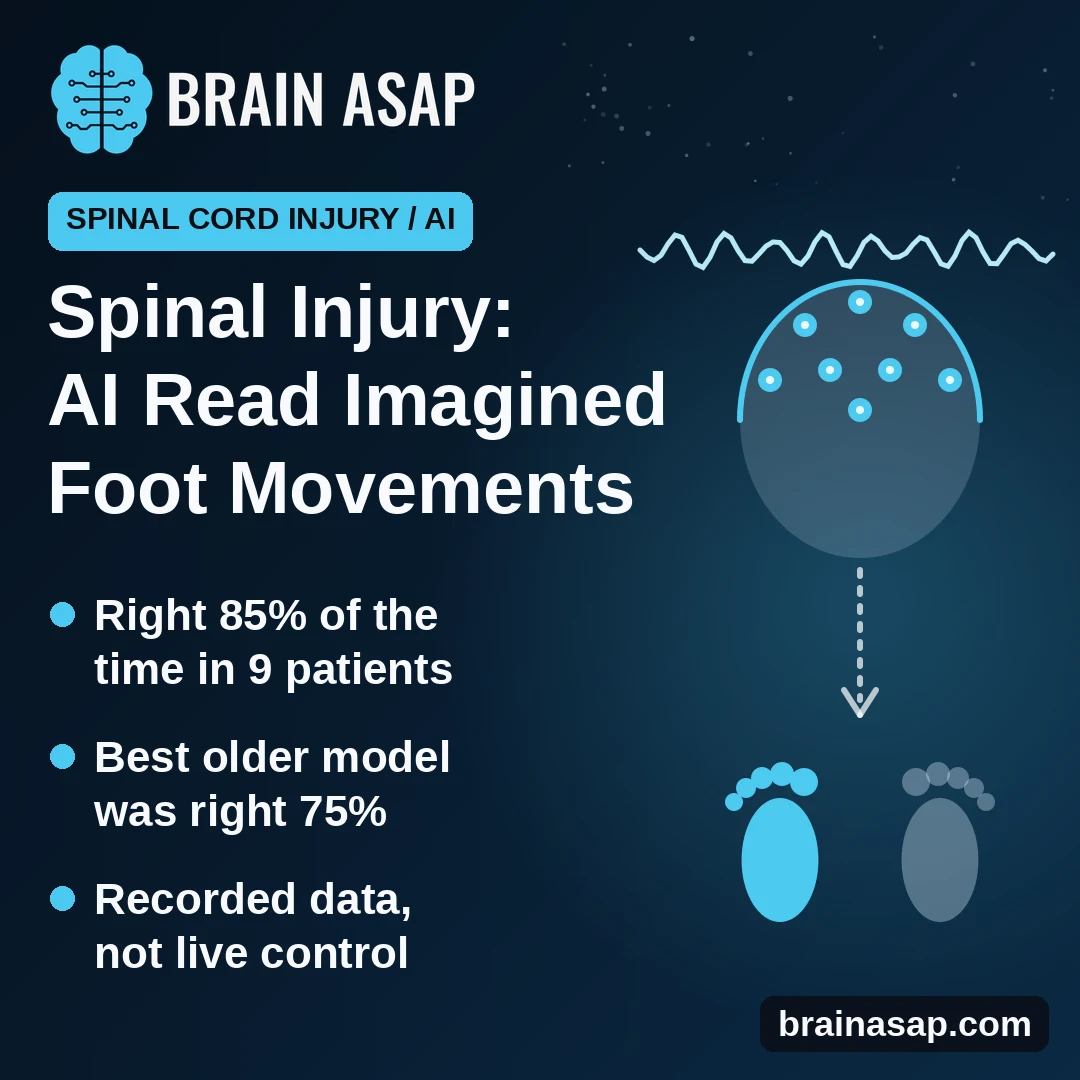
TL;DR: In a 2026 study, 9 people with spinal cord injuries wore a brain-wave cap and imagined moving their left or right foot. A new AI model named the imagined foot correctly 85% of the time, vs 75% for the best older model, but it was tested on recorded data, not live use, and the gain was borderline.
Key Findings
- 85% correct in spinal cord injury: the new model identified which foot 9 patients imagined moving 85% of the time, where guessing would score 50%.
- About 10 points above the best older model: the strongest of 6 older models scored 75% on the same recordings.
- Borderline statistics: one test found the gain just significant (p = 0.048); a second test did not (p = 0.06).
- Stronger lead in healthy volunteers: on a public dataset of 9 healthy people imagining 4 movements, the new model scored 96% vs 81% for the best older model.
- Not yet used live: all tests used recordings after the fact, not a person controlling a device in real time.
Source: Frontiers in Neuroscience (2026) | Cai et al.
Imagining a movement, without making it, changes brain-wave patterns in ways a scalp cap can pick up. Brain-computer interfaces try to turn those patterns into commands, which could help people with paralysis control rehab devices or communicate.
What makes it hard is reading those faint signals reliably, especially in someone the system has never seen before.
A 2026 study in Frontiers in Neuroscience, by engineers and rehabilitation doctors in Jinan, China, built a new AI model for this and gave it an early test in people with spinal cord injuries.
What the Patients Did
The team recorded brain waves (EEG) from 9 patients at the rehabilitation department of a hospital affiliated with Shandong University of Traditional Chinese Medicine.
- Who: 7 men and 2 women, aged 38 to 60.
- Injury severity: 1 had a complete injury, with no feeling or movement below it; 8 had incomplete injuries.
- Task: 80 tries each, 3 seconds per try, imagining moving either the left foot (40 tries) or the right foot (40 tries).
From the brain waves alone, the model had to say which foot each person was imagining.
How the New Model Reads Brain Waves
Brain waves carry information in their timing and in their rhythms, such as the slower alpha and faster beta waves that change when people imagine moving.
Cai and colleagues built a model with 3 parts that each look at the signal a different way: one follows changes over time, one learns which mix of timing and rhythm matters, and one focuses on the known movement-related rhythms.
For every single try, the model then decides how much to trust each of the 3 parts, instead of using a fixed mix.
Did It Work Better Than Older Models?
This test was strict in one important way: the model was trained on 8 patients and tested on the 9th, rotating until every patient had been the test case. That shows how it might do with a new patient it has never seen.
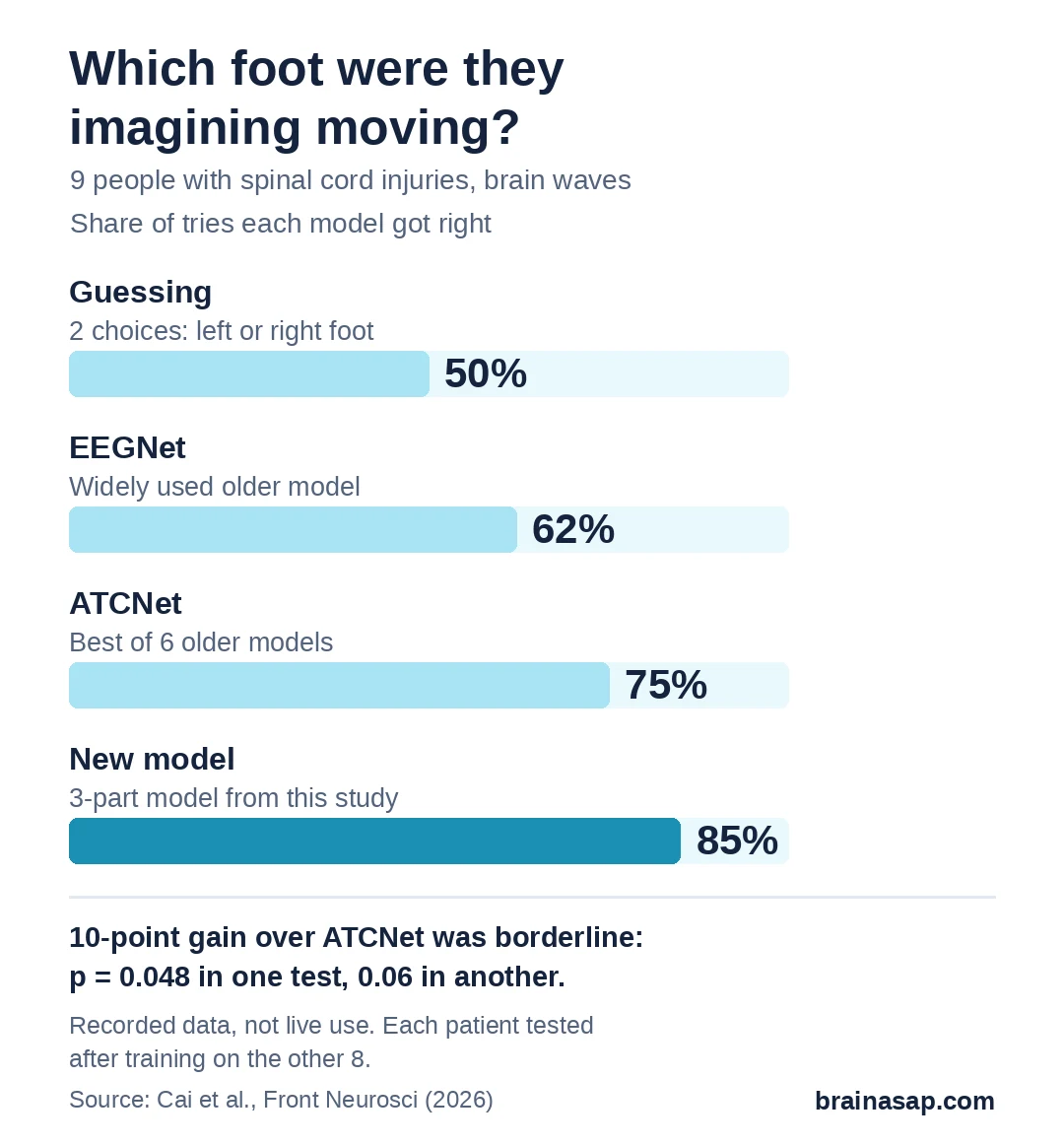
Across the 9 patients, the new model was correct 85% of the time. ATCNet, the best of 6 older models, scored 75%. A widely used older model, EEGNet, scored 62%.
Results varied by patient. Scores for the new model ranged from 65% for one patient to 96% for another, and for 2 of the 9 patients an older model did slightly better.
Whether the 10-point gain is real is not settled. One statistical test found it just significant (p = 0.048), but a second test did not (p = 0.06). Cai and colleagues themselves called it preliminary evidence, not proof of a clinical advantage.
Bigger Gains in Healthy Volunteers
The team also tested the model on 2 public datasets from healthy people, this time training and testing on the same person’s data:
- 9 people imagining 4 movements (left hand, right hand, feet, tongue): new model 96% correct vs 81% for ATCNet, a clear, statistically solid gain.
- 14 people performing 4 tasks (moving the left hand, right hand or feet, or resting): both models scored nearly 100%, with no clear difference.
Why This Is Still an Early Step
- Recorded, not live: the model analyzed brain waves after the fact. No one used it to control a device in real time.
- 9 patients from 1 hospital: results may not hold in other groups, injury levels or recording setups.
- Only 2 choices: left foot vs right foot is a simpler task than the 4-way choice used in healthy volunteers.
- Same team built the model and ran the comparison: the team reprogrammed the older models themselves rather than using results from their original developers.
Can It Work Live, for a New Patient?
That’s the next test: a patient wearing the cap and using the model in real time, for example to trigger a rehab device, with feedback on every try.
Larger trials across several hospitals would also show whether reading imagined foot movements at 85% holds up beyond these 9 patients.
Citation: DOI: 10.3389/fnins.2026.1918072. Cai J, Gao M, Li G, Zhao X, Xu C, Chen L, Xu F, Hu F. A dynamic multi-branch EEG decoding network for motor imagery classification with preliminary clinical validation. Front Neurosci. 2026;20:1918072.
Study Design: Development of a deep-learning EEG decoder (DMB-EDN), compared with 6 reimplemented baselines on 2 public datasets (subject-specific) and a self-collected spinal cord injury dataset (offline leave-one-subject-out).
Sample Size: 9 spinal cord injury patients (80 trials each); public datasets of 9 and 14 healthy volunteers.
Key Statistic: SCI dataset accuracy 85.00% vs 75.13% for ATCNet; paired t-test pHolm = 0.048, permutation test pHolm = 0.0625.
Caveat: Offline analysis only; small single-center patient sample; 2-class task.