TL;DR: In a 2026 survey study, 537 high school students in eastern China filled out questionnaires about their mood and sleep over the past week or month. Over half scored in the range that suggests depression, and nearly half reported poor sleep.
Students with moderate or severe depression symptoms slept a bit worse than the rest, but that difference was small and faded in a second analysis.
Key Findings
- Depression signs were common: 57% of students scored at or above the questionnaire's cutoff for depression symptoms, most of them in the mild range.
- Poor sleep for nearly half: 47.5% scored above the usual cutoff for poor sleep on a standard sleep questionnaire.
- Worse sleep with more depression, but only slightly: Students with moderate or severe depression symptoms averaged a sleep score about 1 point worse, on a 21-point scale, than students with mild or no symptoms.
- Link didn't hold up: When students were sorted into good and poor sleepers and accounted for age, sex and body size, depression level no longer clearly predicted poor sleep.
Source: Medicine (2026) | Han, Zhou and colleagues
Low mood and sleep problems often occur together in adolescence.
A survey from one Chinese city looked at how common low mood and poor sleep were, and whether the 2 rose together.
Who Was Surveyed?
A 2026 study in Medicine, by Herun Han, Xiao Zhou and colleagues at Huazhong University of Science and Technology, surveyed high school students in Huaibei, a city in China's Anhui province, in 2023.
Of 619 students aged 15 to 18 who were invited, 537 were included. Students who didn't finish the forms, had recently misused alcohol, or were taking hormone, antidepressant or sleep medicines were left out. Students averaged 16 years old, and 55% were girls.
Each student filled out 2 standard paper questionnaires:
- Self-Rating Depression Scale: 20 questions about mood and related symptoms over the past week. A standard score of 50 or more counts as mild depression symptoms, 60 or more as moderate, and 70 or more as severe.
- Pittsburgh Sleep Quality Index: 19 questions about sleep over the past month, scored from 0 to 21. A score above 5 counts as poor sleep.
These are screening tools, not a doctor's diagnosis.
How Many Students Showed Signs of Depression?
More than half. Of the 537 students:
- No depression symptoms: 231 students (43%)
- Mild symptoms: 247 (46%)
- Moderate symptoms: 55 (10%)
- Severe symptoms: 4 (under 1%)
That 57% is well above the roughly 20% to 44% found in earlier surveys of Chinese students cited in the paper. Heavy academic pressure is one possible reason the team suggested, though the survey didn't measure it.
Boys scored slightly higher on the depression scale than girls on average (55.2 vs 53.8), a small but statistically clear difference that runs against most research, where girls usually score higher.
Did Depression Go Along With Worse Sleep?
A little. Here are the average sleep scores, where higher means worse sleep:
- No depression symptoms: 5.2
- Mild symptoms: 5.3
- Moderate or severe symptoms: 6.2
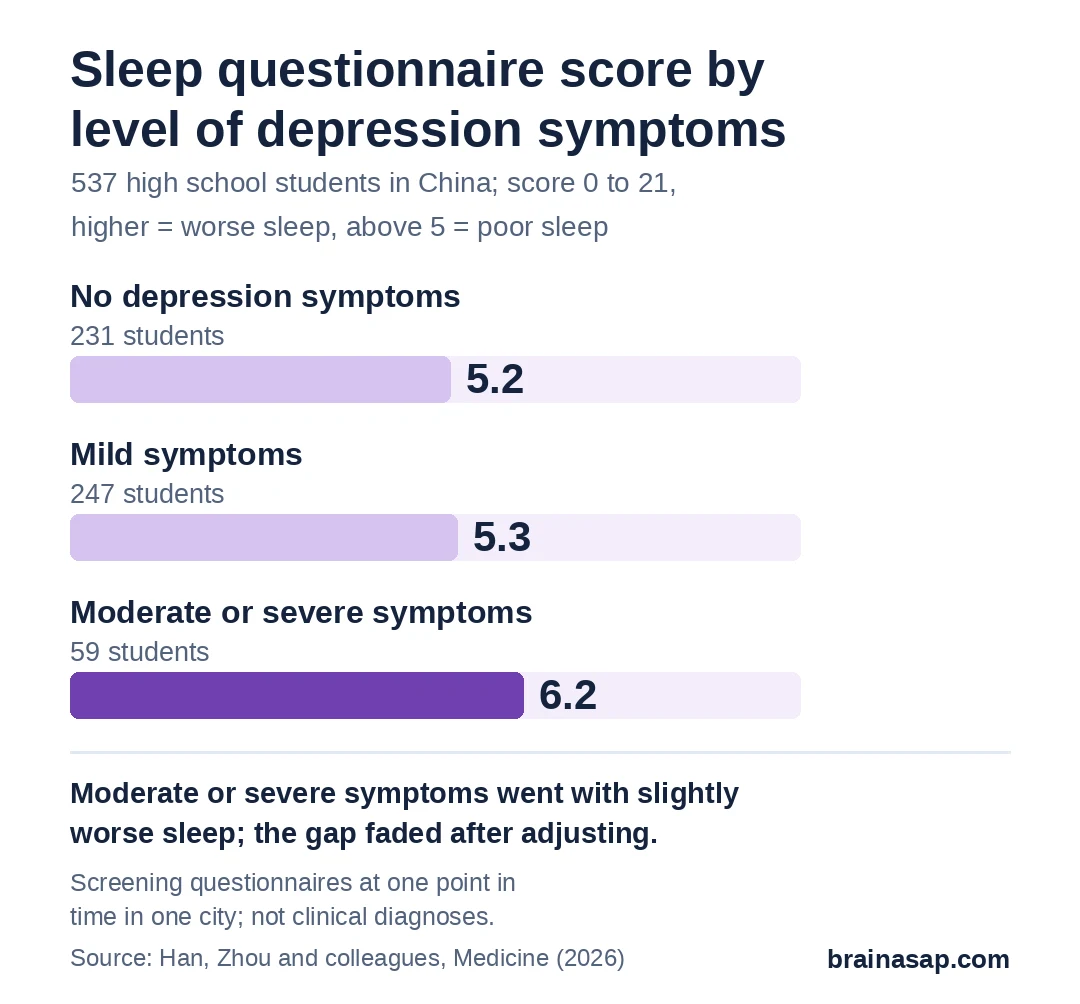
Average sleep questionnaire scores were about one point worse in the moderate-to-severe group than in either of the other two groups. Students with mild symptoms scored close to those with no symptoms.
A second analysis asked who crossed the poor-sleep cutoff. When students were sorted simply into good and poor sleepers, and age, sex, height, weight and body mass index were taken into account, depression level was no longer a clear predictor.
Students with moderate or severe symptoms had about 1.5 times the odds of poor sleep, but the range (0.8 to 2.7) included no difference at all.
Han, Zhou and colleagues offered several reasons, including the small number of students with moderate or severe symptoms (59) and the information lost when a sleep score is split into just 2 groups. They concluded the link is weak and not robust, rather than absent.
What Are the Limits?
- Screening forms, not diagnoses: a score in the depression range is a warning sign, not a confirmed illness
- One point in time: it can't show whether poor sleep feeds low mood, or the other way around
- One city: results may not apply to students elsewhere in China or in other countries
- Few severe cases: only 4 students scored in the severe range
- Missing factors: study load, anxiety and screen time weren't measured
- Reporting errors: the paper's discussion lists different depression scores for boys and girls (44.1 vs 43.0) than its own table and summary (55.2 vs 53.8)
Should Schools Screen for Both?
In this group of high school students, signs of depression and poor sleep were both common, even though the 2 weren't tightly linked. Their paper called for yearly mood and sleep screening in schools.
Whether that would help depends on what follows a positive screen. Studies that follow the same students through the school year, with interviews by clinicians, could show how sleep and mood shape each other under exam pressure.
Citation: DOI: 10.1097/MD.0000000000051117. Han H, Mu Z, Li Q, Zeng H, Ma Y, Liu Z, Li C, Zhou Y, Guo Z, Lv M, Zhou X. The characteristics of depression and sleep among Chinese high school students: A cross-sectional study. Medicine. 2026;105(42):e51117. PMID: 42888633. Full text: PMC13681095.
Study Design: Cross-sectional paper questionnaire survey in Huaibei, Anhui, 2023; Self-Rating Depression Scale (index 50 or more = depression symptoms) and Pittsburgh Sleep Quality Index (above 5 = poor sleep); one-way ANOVA with Tukey tests; logistic regression adjusted for age, sex, height, weight and BMI.
Sample Size: 537 of 619 invited high school students aged 15 to 18 (243 boys, 294 girls).
Key Statistic: Depression symptoms 57.0%; poor sleep 47.5%. Mean sleep score 5.2 (none), 5.3 (mild), 6.2 (moderate to severe); F = 3.5, p = .032, partial eta squared 0.013. Adjusted odds ratio for poor sleep, moderate to severe vs none, 1.49 (95% CI 0.82 to 2.71).
Caveat: Cross-sectional; self-report screening tools; single city; small moderate-to-severe group; inconsistent sex-difference figures in the paper's discussion. Full published text reviewed.