TL;DR: In a 2026 study of 41 children newly diagnosed with tic disorders in China, those with fewer helper T cells, a type of white blood cell that coordinates the immune system, in a routine blood test tended to score higher on a scale that combines tic severity and how much tics disrupt daily life.
Low vitamin D also looked linked at first, but that link did not hold up, and with no healthy children for comparison, this is an early clue rather than a test doctors can use.
Key Findings
- Fewer helper T cells, worse tics: Children with lower helper T-cell counts had higher scores on a standard 100-point tic severity scale, the only one of 15 blood measures to hold up statistically.
- Modest size: Every 100 more helper T cells per microliter of blood went with about 1.8 points lower tic severity, after accounting for age, sex and how long tics had lasted.
- Vitamin D unclear: Children low in vitamin D had the highest average tic scores, but there was no steady pattern of more vitamin D going with milder tics.
- Other vitamins: Vitamins A, E and K showed no link with tic severity.
Source: Frontiers in Psychiatry (2026) | Zhu, Zhang and colleagues
Tics are sudden, repeated movements or sounds, like blinking, shrugging or throat clearing, that a child does not fully control. Tic disorders, including Tourette syndrome, usually start in childhood.
Their causes are not fully understood. One long-standing idea is that the immune system plays a part, and some studies have linked low vitamin D, which also affects immune cells, to tics.
Which Children Were Studied?
A 2026 study in Frontiers in Psychiatry by doctors at the First People's Hospital of Zhangjiagang, affiliated with Soochow University in China, looked at records of 41 children seen between January 2022 and August 2025.
- Age: under 14, about 8 and a half on average
- Sex: 29 boys and 12 girls
- Stage: newly diagnosed, with no tic medicine yet; half had had tics for a month or less
Children with recent infections, immune or chronic diseases, or recent use of vitamin supplements or medicines were left out.
What Was Measured?
Each child was rated on the Yale Global Tic Severity Scale, which scores how many tics a child has, how often and how strongly they occur, and how much they disrupt daily life. Scores run from 0 to 100; the children averaged about 31.
From routine blood tests, the team checked 15 measures:
- Vitamins: vitamin D, plus vitamins A, E and K
- Immune cells: overall lymphocyte count (a family of white blood cells) and its subtypes, including helper T cells and killer T cells
Which Blood Measures Went With Worse Tics?
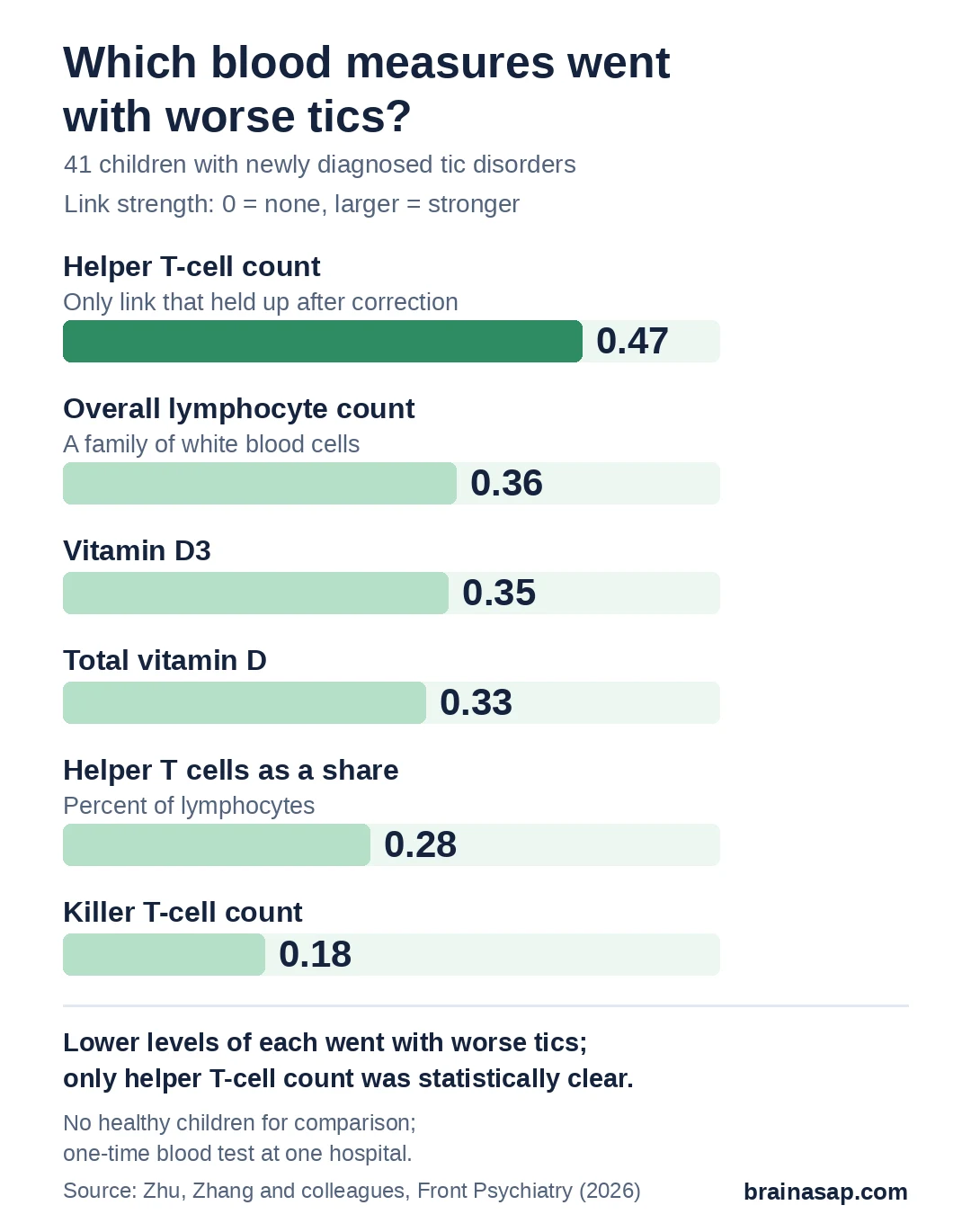
Helper T cells, also called CD4+ T cells, stood out. Children with fewer of them in their blood had worse tic scores, a moderate link that held up after correcting for the 15 measures tested and after accounting for age, sex and how long the tics had lasted.
On the 100-point scale, each extra 100 helper T cells per microliter went with about 1.8 points lower severity.
Overall lymphocyte count and vitamin D first looked linked to worse tics too, but neither link survived the correction for testing many measures.
What About Vitamin D?
When children were grouped by vitamin D level, the pattern was uneven:
- Low (below 20 ng/mL, 23 children): average tic score 34
- Middle (20 to below 30 ng/mL, 10 children): average 23
- Highest (30 ng/mL or more, 8 children): average 30
Only the low and middle groups differed clearly. Because the highest group did not have the mildest tics, more vitamin D did not steadily go with milder tics, and Zhu, Zhang and colleagues called these results exploratory.
Why to Hold This Lightly
- No healthy children: without a comparison group, the study cannot say whether these children's helper T-cell counts were actually low
- Small, one hospital: 41 children, and only 8 in the highest vitamin D group
- One snapshot: the study cannot tell whether immune changes affect tics, tics affect the immune system, or something else drives both
- Missing factors: body weight, season of the blood draw, sun exposure, diet and allergies were not recorded
- Hidden inflammation possible: a standard inflammation marker was available for only 24 of the 41 children
- Count, not share: the share of lymphocytes that were helper T cells was not clearly linked. The result for the helper T-cell count persisted in an added analysis that accounted for total lymphocytes, but that estimate was less precise
Zhu, Zhang and colleagues were clear that these results have no current role in diagnosing or treating tics.
Whether helper T cells really run low in children with tics, compared with children without tics, is the next question a larger study with healthy children could answer.
Citation: DOI: 10.3389/fpsyt.2026.1903047. Zhu F, Gao Y, Zhang Z, Kang S, Xu W, Zhang J. Associations of vitamin status and T-lymphocyte subsets with tic severity in children: a cross-sectional study using the Yale Global Tic Severity Scale. Frontiers in Psychiatry. 2026;17:1903047. PMID: 42952789. Full text: PMC13713763.
Study Design: Single-center cross-sectional study of newly diagnosed, treatment-naive children with tic disorders; Spearman correlations with Benjamini-Hochberg FDR correction across 15 laboratory variables; linear regression adjusted for age, sex and disease duration with HC3 robust standard errors; vitamin D group comparison.
Sample Size: 41 children under 14 (29 boys, 12 girls; mean age 8.6).
Key Statistic: CD4+ T-cell count and YGTSS global severity: ρ = -0.474, P = 0.0017 (FDR-adjusted P = 0.026); adjusted B = -0.018 per cell/µL (about -1.8 points per 100 cells/µL; 95% CI -3.07 to -0.53), P = 0.0069. Vitamin D groups: Kruskal-Wallis P = 0.0073; only <20 vs 20 to <30 ng/mL differed.
Caveat: Small single-center sample; no healthy control group; cross-sectional; vitamin D findings exploratory with no dose-response; several possible confounders not recorded.