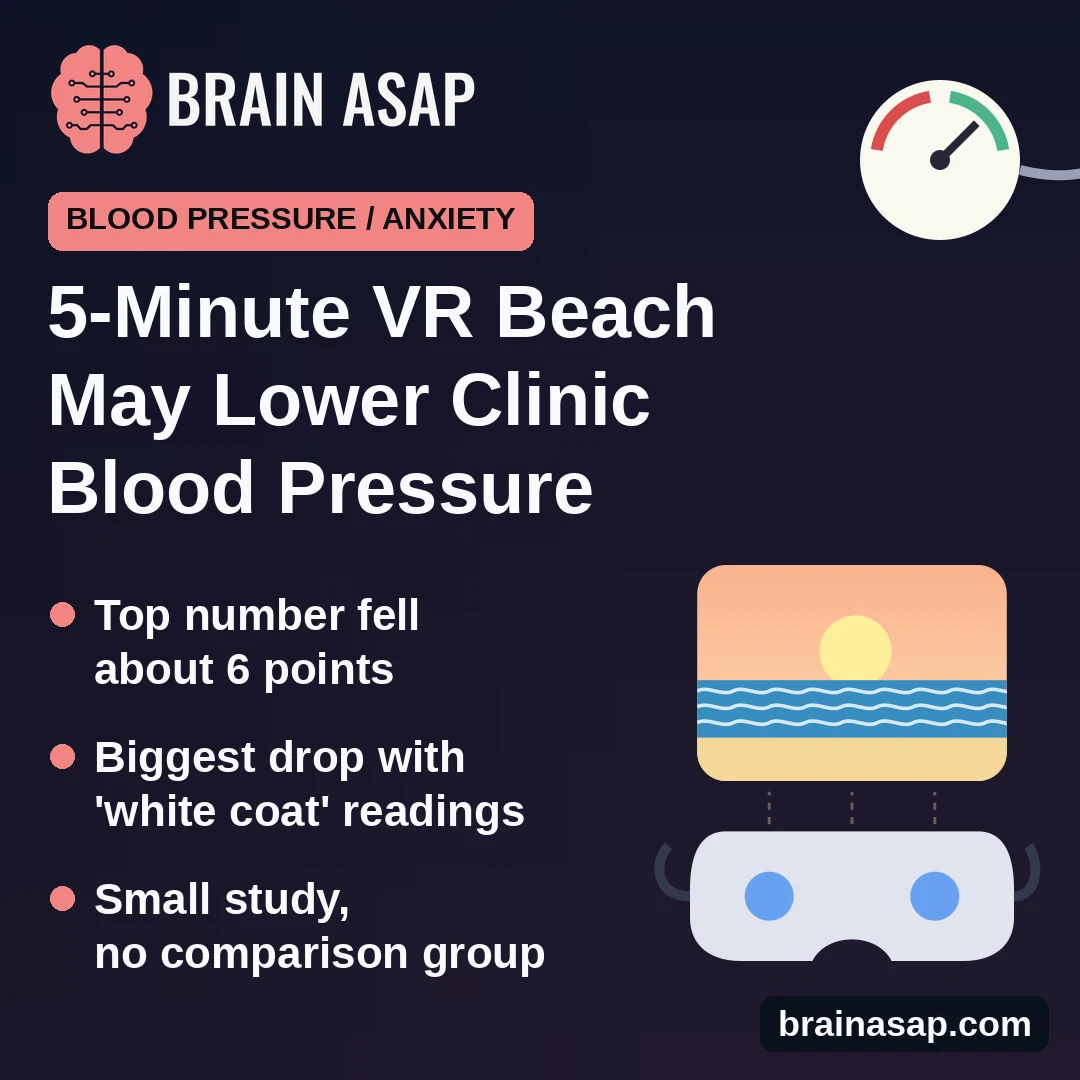
TL;DR: In a study published in 2026 at a Mayo Clinic blood pressure clinic, 78 adults spent 5 minutes watching a calm beach scene through a virtual reality headset. Their top blood pressure number, measured by the clinic's machine, was about 6 points lower afterward, and they felt a little less anxious.
People whose earlier office readings were much higher than their average daytime monitor readings saw the biggest drop, about 12 points. There was no comparison group, so quiet rest alone may explain part of it.
Key Findings
- Lower clinic readings: Systolic blood pressure, the top number, fell from an average of 131 to 125 after the 5-minute headset session.
- Biggest drop with "white coat" readings: In 11 people whose office readings ran at least 15 points above their average daytime readings from an ambulatory monitor, the top number fell about 12 points.
- Different category: 1 in 3 people moved into a lower blood pressure category, such as from stage 2 high blood pressure to stage 1.
- Less anxious: About 6 in 10 said they felt less anxious afterward, and nobody reported dizziness or nausea.
Source: The Journal of Clinical Hypertension (2026) | Baker et al.
For some people, just sitting in a doctor's office pushes blood pressure up. Doctors call it the "white coat" effect, and it can make blood pressure look worse than it really is day to day.
That matters, because a high office reading can lead to a diagnosis or more medication someone may not need. Could a few minutes of relaxation before the cuff goes on help?
A 2026 study in The Journal of Clinical Hypertension, led by Lyle Wesley Baker at Mayo Clinic in Jacksonville, Florida, tried it with virtual reality.
A Virtual Beach Before the Cuff
The study included 78 adults, average age 62, who had come to the clinic to wear an ambulatory blood pressure monitor, a cuff that takes readings during daily life. The clinic used either a 24-hour recording or a shorter 6-hour daytime recording. That monitor shows what someone's blood pressure looks like outside the office.
When they came back to return the monitor, each person:
- Rested quietly for 5 minutes, then had 3 automatic office readings, averaged
- Rated how anxious they felt on 2 short questionnaires
- Wore a VR headset for 5 minutes showing a beach with ocean sounds
- Had 3 more readings and repeated the anxiety questions right afterward
The whole visit took about 30 minutes.
How Much Did Blood Pressure Drop?
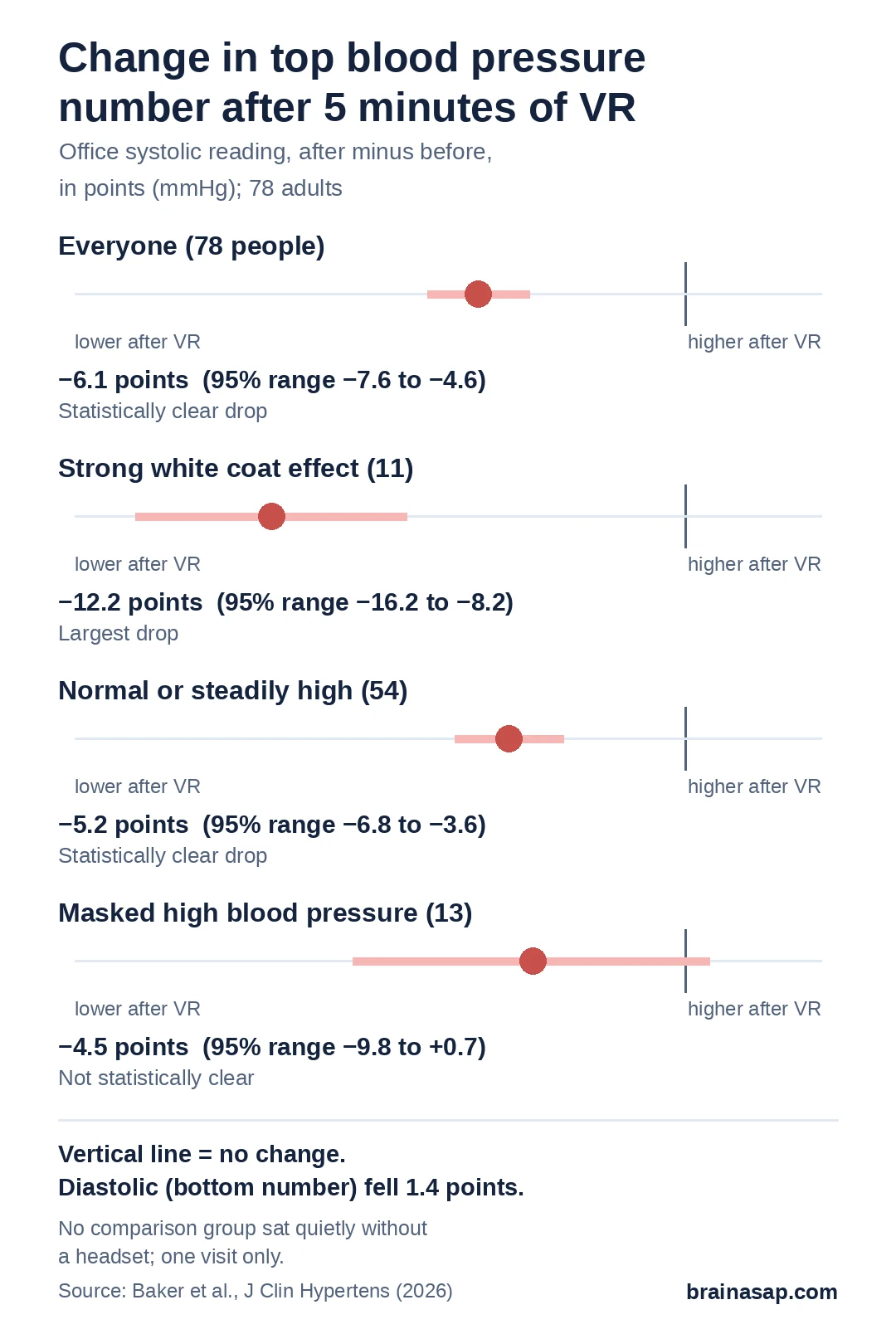
On average, readings went from 131/75 before the headset to 125/74 after. Most of the change was in the top number. Heart rate barely moved.
- Dropped at least 5 points: 55% of people
- Dropped at least 10 points: 28%
- Dropped at least 15 points: 10%
That shift changed labels for some. Before the headset, 22 people had readings in the stage 2 high blood pressure range; afterward, 13 did. In total, 25 of 78 moved to a lower category, and 2 moved higher.
Who Benefited Most?
The earlier office reading taken when the monitor was fitted, together with average daytime monitor readings, let the team sort people into 3 groups:
- Strong white coat effect (11 people): office top number at least 15 points higher than their average daytime reading outside the clinic
- Masked high blood pressure (13 people): office top number below 130, but average daytime monitor reading 130 or higher
- Everyone else (54 people): did not meet either of those two study definitions; this group included normal and sustained high readings
The result? People with a strong white coat effect dropped about 12 points, more than twice the drop in everyone else (about 5 points). In the masked group, a 4.5-point drop wasn't statistically clear.
Baker and colleagues noted that a bigger drop in the white coat group was partly expected, because those people started with the most room to come down.
Did People Feel Calmer?
Anxiety was low to begin with, but it fell on both questionnaires. On a 0-to-10 rating of how anxious people felt, the average went from 2.6 to 1.4.
- Felt less anxious: 62%
- Found it very relaxing: 59%
- Found the headset comfortable: 71%
- Side effects: none reported
Changes in anxiety and changes in blood pressure weren't clearly linked person by person, so feeling calmer may not be the whole explanation.
Why a Comparison Group Matters Here
- No control group: Nobody sat quietly for 5 minutes without a headset, so the extra rest, getting used to the room, or a second set of readings may explain some of the drop.
- Small groups: Only 11 people had a strong white coat effect.
- One visit only: Whether the effect lasts, or works again on later visits, is unknown.
- Unusual clinic mix: About 4 in 10 were kidney transplant recipients; results held when they were left out.
- Not a treatment: Only immediate office readings were assessed after VR; the study did not establish a change in daylong blood pressure.
Could a VR Break Become Part of Clinic Visits?
A brief period of calm before the cuff might give a reading closer to someone's everyday blood pressure, but this study did not establish that VR adds benefit beyond quiet rest.
A fair test would be a trial that randomly gives some patients the headset and others the same 5 minutes of plain quiet rest, then checks which office readings line up better with 24-hour monitoring.
Citation: DOI: 10.1111/jch.70360 | Baker LW, Karthik R, Munlapudi VR, Balog J, Mao MA, Trautman CL, Ma Y, Fang ZJ, Porter IE II. Virtual Reality Reduces Office Blood Pressure and Anxiety in Patients Undergoing Ambulatory Blood Pressure Monitoring: Enhanced Response among Those With a Pronounced White Coat Response. The Journal of Clinical Hypertension. 2026;28:e70360.
Study Design: Prospective single-arm pre-post study (NCT06960057), Mayo Clinic Florida, June–August 2025; office BP and anxiety (VAS, STAI-6) before and after a 5-minute immersive VR beach relaxation; subgroups defined by ambulatory BP monitoring.
Sample Size: 78 adults (mean age 62; 47% female): 11 pronounced white coat response, 13 masked hypertension, 54 normotension/sustained hypertension.
Key Statistic: Office SBP 131.3 to 125.2 mmHg (−6.1; 95% CI −7.6 to −4.6); DBP −1.4 (−2.3 to −0.5). White coat subgroup SBP −12.2 (−16.2 to −8.2) vs −4.5 masked and −5.2 normotension/sustained (between-group p = 0.005). STAI-6 −2.1 (−2.8 to −1.4); 32.1% reclassified to a lower office BP category.
Caveat: No control condition; single brief exposure; small subgroups; exploratory analyses not adjusted for multiple comparisons; 38.5% kidney transplant recipients.