TL;DR: A review of 16 reviews found the strongest evidence for medicines in smoking and opioid addiction, and smaller effects for alcohol. Varenicline made people 2.3 times as likely to quit smoking as a dummy pill.
Key Findings
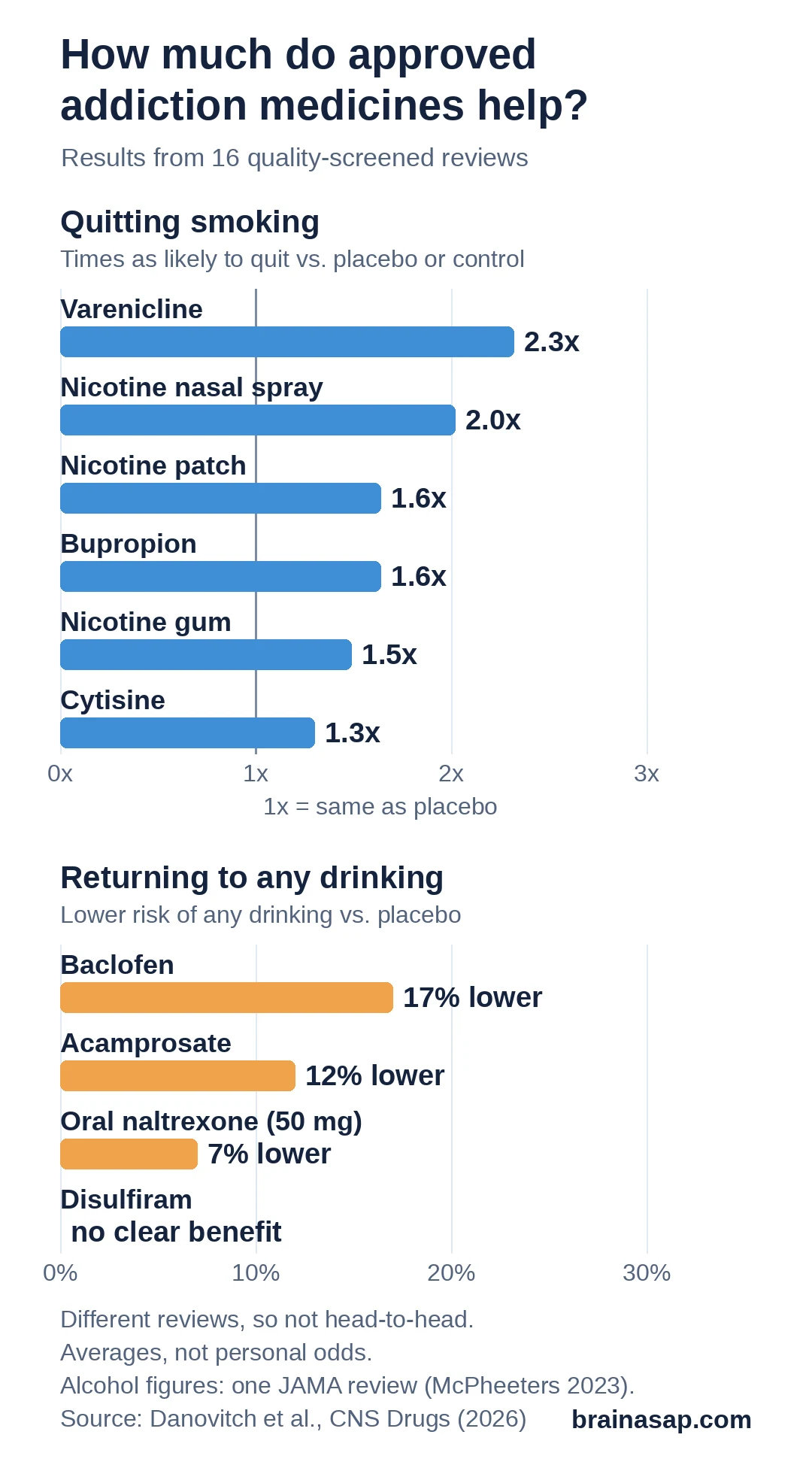
- Smoking: Varenicline strongest (2.3 times as likely to quit as with placebo). Nicotine replacement (1.55 times) and bupropion (1.6 times) also helped; cytisine a little less (1.3 times).
- Alcohol: Acamprosate, baclofen, and oral naltrexone each cut chance of returning to any drinking by 7 to 17%. Disulfiram: no clear benefit in pooled trials.
- Opioids: Methadone kept people in treatment longer than buprenorphine. In one review of 4 trials, monthly buprenorphine injection produced mean abstinence percentages of about 41 to 43% at higher doses, versus 5% on placebo. These percentages describe negative drug-use assessments, not the share of people who stayed abstinent.
- Gaps: Nothing approved for cannabis, stimulant (including cocaine and methamphetamine), hallucinogen, or inhalant use disorder.
- Pipeline: Four phase 3 trials (1026 people in all) hint at future options. Each is a single trial, so none is proven.
Source: CNS Drugs (2026) | Danovitch et al.
Is there a medicine for addiction? It depends heavily on the substance. For smoking, there are several with solid evidence. For cannabis or cocaine, nothing is approved at all.
This review pulled together the last ten years of research to lay out what exists, what the evidence says about each option, and where nothing exists yet.
How the Review of Reviews Was Done
This is an umbrella review, a review of reviews. Instead of running a new trial, the authors searched for systematic reviews (studies that gather and combine all the trials on a question) published between 2016 and 2026. Their search of 959 records left 110 full-text reviews to assess. They then rated the reviews for bias and quality and kept only the 16 that met their bar. Eight others were dropped for high bias or low quality.
Those 16 reviews covered 371 randomized trials (about 132,000 people) and 62 observational studies (about 229,000 people). Together they evaluated 41 approved medications built from 25 distinct molecules. The reviews barely repeated each other’s trials: overlap was 0.34%, which the authors classed as slight.
The authors did not combine the numbers themselves, because the reviews were too different from one another. What follows are the individual reviews’ own results, side by side.
What a risk ratio of 2.0 means
Most results here are risk ratios, which compare two groups. For quitting smoking, a ratio of 2.0 means people on the medicine were twice as likely to quit as people given a dummy pill (placebo) or no treatment. For drinking, a ratio below 1.0 is good: 0.88 means 12% lower risk of returning to any drinking than with placebo. When a result is called “not significant,” the study could not rule out no effect at all.
Smoking: Varenicline Made Quitting 2.3 Times as Likely
Tobacco has the deepest evidence, with 223 trials of 8 medications and more than 100,000 participants.
- Varenicline (41 trials, 17,395 people): 2.32 times as likely to quit as placebo. This was the largest effect of any single medicine.
- Nicotine replacement (133 trials, 64,640 people): 1.55 times as likely to quit overall. The patch (1.64), gum (1.49), lozenges (1.52), inhaler (1.90), and nasal spray (2.02) all helped. The inhaler and spray each rested on only 4 trials.
- Bupropion (45 trials, 17,866 people): 1.64 times as likely to quit as placebo, with results similar to nicotine replacement. Head to head, it did worse than varenicline (ratio 0.71).
- Cytisine (4 trials, 4,623 people): 1.30 times as likely to quit. That is a smaller effect, though the authors point out its low cost could matter for access.
Alcohol: Modest Effects
Alcohol medicines showed smaller and less consistent effects. Across 86 trials of seven medications, the risk of returning to any drinking fell by 7 to 17% compared with placebo.
- Acamprosate: 12% lower risk of returning to any drinking (20 trials, 6,380 people). It did not reduce heavy drinking.
- Baclofen: 17% lower risk in one review (8 trials) and 13% in a Cochrane review of 17 trials. Effects on heavy drinking were mostly not significant.
- Oral naltrexone (50 mg): 7% lower risk of any drinking, plus 19% lower risk of returning to heavy drinking. The authors say it had the most consistent evidence across several measures. A 100 mg dose did not add benefit.
- Naltrexone injection: About 2 fewer drinking days and 1 fewer heavy-drinking day per month.
- Disulfiram: No significant benefit in pooled trials. The authors note it works by making drinking unpleasant, so it depends on supervised use, which pooled trials capture poorly.
Nalmefene and sodium oxybate showed some signal, but the evidence was too thin for firm conclusions.
Opioids: Methadone, Buprenorphine, and Injections
The two workhorse medicines, methadone and buprenorphine, each have a strength. Methadone kept people in treatment longer: after 6 months, retention on buprenorphine was 24% lower across 16 trials of 3,151 people, and 23% lower in 21 observational studies. The reviews found no significant difference between the two on urine-confirmed opioid use.
Monthly injectable buprenorphine looked promising. In that review of 4 trials (1,365 people), the mean percentage of negative urine tests and negative self-reports of illicit opioid use during weeks 5 to 24 was 41.3% (at the 300/300 mg dose) and 42.7% (300/100 mg), versus 5.0% on placebo. The authors say replication in broader populations is needed. Oral naltrexone did not clearly improve retention, likely because people struggled to take it daily. Injectable naltrexone did.
Naloxone: High Survival, No Comparison Group
For naloxone, the reversal drug, the review pooled 41 observational studies (74,114 participants). Survival after community naloxone use was 98.3% in drug treatment programs, 95.0% in family and community programs, and 92.4% when police gave it. These studies had no comparison group, so they show high survival among people who got naloxone, not how much naloxone changed the outcome.
Limits of an Umbrella Review
- Summary, not a new trial: Results reflect quality and choices of underlying reviews. Comparisons across medicines use different trials, populations, and comparison groups.
- Narrow filters: Low-quality reviews excluded; 10-year window leaves out older foundational trials. Some approved medicines (cyanamide, metadoxine, heroin-assisted therapy) had no qualifying review, which does not mean they do not work.
- Effect sizes are averages: 12% lower risk of drinking does not mean an individual will drink 12% less. Medicines are usually paired with counseling.
- Pipeline trials are early: Each candidate rests on one trial; authors call results hypothesis-generating.
- No personal guidance: General evidence, not medical advice. Choice depends on history, other conditions, and clinician judgment.
No Approved Medicines for Cannabis, Stimulants, or Hallucinogens
The starkest finding is the gap. Alcohol, opioids, and tobacco account for nearly all approved medicines. Nothing is approved for cannabis, stimulant (including cocaine and methamphetamine), hallucinogen, inhalant, or caffeine use disorder. The only approved drug for a sedative-type problem is flumazenil, which reverses benzodiazepine overdose and carried nearly three times as many adverse events as placebo (ratio 2.85).
The review also looked at completed phase 3 trials that posted results. Only four qualified, all single trials:
- Naltrexone injection plus bupropion for stimulant use disorder (403 people): 13.6% responded, versus 2.5% on placebo. A win over placebo, but most people still did not respond.
- Dutasteride, ondansetron, and zonisamide for alcohol (623 people across three trials): each reduced drinking on at least some measures. Ondansetron's benefit was limited to people with particular gene variants, and it did not reach full significance in the unselected group.
The authors also point to GLP-1 drugs, the class that includes semaglutide, as a promising direction now in trials for alcohol, opioid, and tobacco use disorders. That is a research lead, not an approved use.
The authors argue that funders and researchers should focus on these gaps. None of the single-trial leads changes what a clinician can prescribe today until it is replicated in more people.
Citation: DOI: 10.1007/s40263-026-01334-4. Danovitch I, Truman K, Brown H, Miller M, Shah S, Totlani J, Kaidbay DN, Tessema KK, Minasyan Z, IsHak WW, Miles S, Pechnick RN. Approved medications for substance use disorders: an umbrella review of systematic reviews and completed phase 3 randomized controlled trials. CNS Drugs. 2026.
Study Design: PROSPERO-registered (CRD420251036330) umbrella review following PRISMA. Systematic reviews from 2016 to 2026 rated with ROBIS and AMSTAR-2, plus completed phase 3 trials with posted results (RoB 2). Narrative synthesis, no new meta-analysis.
Sample Size: 16 systematic reviews covering 371 randomized trials (n = 131,965) and 62 observational studies (n = 229,225); plus 4 phase 3 trials (n = 1,026).
Key Statistic: Varenicline versus placebo for quitting smoking: risk ratio 2.32 (95% CI 2.15 to 2.51; 41 trials). Acamprosate versus placebo for returning to any drinking: risk ratio 0.88 (95% CI 0.83 to 0.93; 20 trials).
Caveat: Review of reviews with no pooled analysis; different comparators across reviews; pipeline findings come from single trials; overdose survival data are observational without a comparison group.