TL;DR: A 2026 Dutch study filmed 212 children aged 5 to 12 with attention-deficit/hyperactivity disorder (ADHD) during a 1-hour clinic visit with tasks built to test their patience, once alongside a parent and once with a researcher. Trained coders who watched the videos scored restless, impulsive and angry behavior very consistently, but those scores only loosely matched what parents and teachers reported.
Key Findings
- Coders agreed closely: when 2 coders scored the same 20 videos, their scores agreed very closely (agreement of 0.89 to 0.93 on a 0-to-1 scale).
- 2 kinds of behavior stood out: restless, impulsive behavior, such as talking nonstop or not waiting a turn, and angry behavior, such as defiance or verbal aggression.
- More outbursts with a parent: children showed more of both kinds of behavior during tasks with their parent than during tasks with a researcher.
- Only loose links to parent and teacher reports: clinic scores matched parent and teacher questionnaires weakly to moderately.
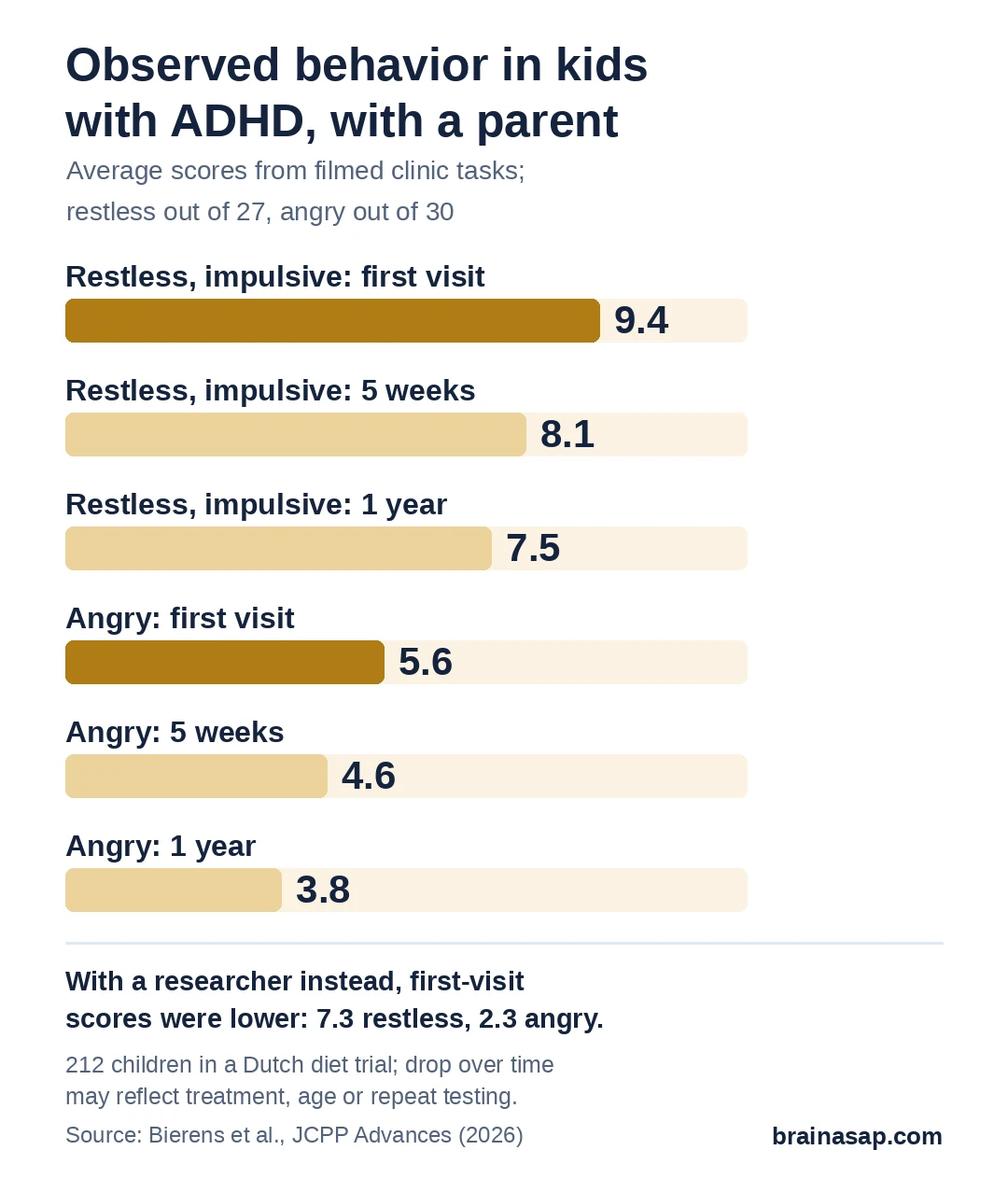
- Scores fell over a year: during the parent tasks, scores for angry behavior dropped from 5.6 at the start to 3.8 a year later, but it's unclear why.
Source: JCPP Advances (2026) | Bierens et al.
When a child is evaluated for ADHD, most of what doctors hear comes from parents and teachers. Those reports matter, but they can differ from each other, and they can be colored by hopes about a treatment.
For autism, clinicians often add a structured observation, where a trained person watches the child in a set situation. For ADHD, no such clinic-based observation is routinely recommended.
A 2026 study in JCPP Advances, by researchers at Karakter Child and Adolescent Psychiatry and several Dutch universities, tested whether a structured observation first built for preschoolers could work for school-age children with ADHD.
What Happened During the 1-Hour Clinic Visit?
Children took part between 2015 and 2021, as part of a Dutch trial testing diet changes for ADHD. Each child had a confirmed ADHD diagnosis, and about 3 in 4 were boys. Average age was 8.5.
In a quiet room with a one-way mirror and a hidden camera, each child did a set of tasks designed to press on patience and self-control. Tasks were done in 2 settings:
- With a parent: the parent led the activities
- With a researcher: a trained staff member led them instead
Later, psychologists who didn't know the child, the diet group or the time point watched the videos. They rated 19 behaviors from 0 (typical) to 3 (clearly unusual).
Children came back after 5 weeks (206 children) and after 1 year (160 children) to do it again.
Which Behaviors Did the Coders Pick Up?
Those 19 behaviors fell into 2 kinds:
- Restless, impulsive behavior: talking too much, blurting out answers, trouble waiting, trouble staying seated
- Angry behavior: defiance, refusing to follow directions, provoking others, threats or cursing, getting upset quickly and staying upset
Coders scored these consistently. When 2 coders rated the same 20 videos, their agreement was 0.89 to 0.93, where 1 means perfect agreement. Most items also hung together well as a scale, though restless behavior during the parent tasks was less consistent.
Most items about inattention were dropped. They proved hard to bring out and score reliably in a 1-hour visit, so this observation mainly captures overt, visible behavior, not daydreaming.
Did Kids Act Differently With a Parent Than With a Researcher?
Yes. At the first visit, average scores were higher with a parent:
- Restless, impulsive behavior: 9.4 with a parent vs 7.3 with a researcher (out of 27)
- Angry behavior: 5.6 with a parent vs 2.3 with a researcher (out of 30)
This fits earlier research in younger children. Kids often save their hardest moments for the people they're closest to.
How Well Did Clinic Scores Match Parent and Teacher Reports?
Only loosely. Links between clinic scores and parent or teacher questionnaires about hyperactivity, conduct problems and emotional control were mostly small, with correlations up to about 0.3 (where 1 would be a perfect match).
Bierens and colleagues saw this as expected. A clinic visit, a parent at home and a teacher in a classroom each see a different slice of a child's behavior.
Over time, though, the observation tracked change somewhat better. Changes in clinic scores lined up with changes parents or teachers reported more often than parent and teacher reports lined up with each other.
What This Observation Can't Do Yet
- Not a diagnosis tool: authors stressed it should not be used alone to diagnose ADHD or other behavior disorders.
- No comparison group: only children with ADHD were tested, so there's no way yet to say what score is unusual.
- Change has many possible causes: children were in a diet trial, and scores can also fall with age, repeat visits or chance. No untreated group was available for comparison.
- Mostly boys, all Dutch families in a trial: results may differ for girls, older children or families who don't join trials.
- Reliability checked on few videos: coder agreement came from 20 children at the first visit.
Next: A Benchmark From Children Without ADHD
For parents, the takeaway is modest. A standard, video-coded clinic visit can measure restless and angry behavior consistently, and it adds a view that doesn't depend on any one adult's report.
Before clinics could use it routinely, the Dutch team plans to test children without ADHD to set cutoff scores that separate typical from clinically concerning behavior.
Citation: DOI: 10.1002/jcv2.70149. Bierens M, Huberts-Bosch A, Ly V, Matthys W, Buitelaar J, Hartman CA, Rommelse N. Reliability, validity, and change over time in disinhibited and disruptive behaviors assessed with the age-adapted disruptive behavior diagnostic observation schedule in children aged 5–12 years with ADHD. JCPP Advances. 2026;e70149.
Study Design: Psychometric analysis of the age-adapted Disruptive Behavior Diagnostic Observation Schedule (DB-DOS) within a Dutch randomized nutritional-intervention trial (NTR5434); blinded video coding at baseline, 5 weeks and 1 year; principal component analysis, Cronbach's alpha, intraclass correlations, Pearson correlations with SWAN, SDQ, BRIEF and CSBQ.
Sample Size: 212 children aged 5–12 with ADHD at baseline (208 complete observations; 206 at 5 weeks, 160 at 1 year); interrater subsample 20.
Key Statistic: 19 items, 2 components (behavioral regulation, anger modulation); interrater ICC 0.89–0.93; internal consistency 0.66–0.81; baseline parent-context vs examiner-context means: behavioral regulation 9.4 vs 7.3, anger modulation 5.6 vs 2.3.
Caveat: ADHD-only clinical trial sample, 76% boys; no typically developing comparison or cutoffs; change confounded by treatment, development and repeated testing; convergent validity partial.