TL;DR: In a 2026 Danish study of 83 children aged 7 to 11, kids with attention deficit hyperactivity disorder whose parents described them as often daydreaming, low on energy or unmotivated also had more trouble with conversation skills, according to the same parents.
That link was strong, but it shrank and was no longer statistically clear once the researchers accounted for how inattentive each child was, so the 2 may be hard to pull apart.
Key Findings
- Conversation skills in kids with ADHD: Children with ADHD who were rated as more dreamy and sluggish had weaker everyday conversation skills, a strong link.
- Not storytelling or grammar: In kids with ADHD, dreaminess was not clearly linked to how well they told a story or to their scores on standard language tests.
- Different pattern in kids without ADHD: Dreamier children without ADHD scored somewhat lower on standard language tests, but not on conversation skills.
- The links weakened: After accounting for how inattentive each child was, neither link was statistically clear.
Source: Frontiers in Psychiatry (2026) | Jepsen, Lambek and colleagues
Some children with ADHD are not bouncing off the walls. They drift off, look tired, move slowly and seem lost in thought.
This pattern has a name: cognitive disengagement syndrome, or CDS, formerly called sluggish cognitive tempo. Previous studies cited by the authors have estimated that this pattern occurs in about 25% to 40% of children with ADHD.
Children with ADHD also have language problems more often than other kids. Could a dreamy, low-energy style be part of the reason?
Who Took Part?
A 2026 study in Frontiers in Psychiatry by researchers at Aarhus University, Denmark, included 83 children aged 7 to 11, all native Danish speakers:
- Kids with ADHD (45): diagnosed at a specialist hospital clinic; those taking ADHD medicine stopped it at least 24 hours before testing
- Kids without ADHD (38): recruited from local schools
Children with autism, epilepsy, brain injury or an IQ below 70 were not included.
How Were Dreaminess and Language Measured?
Parents rated their child against other children on 3 traits: daydreaming or being lost in thought, drowsiness or low energy, and seeming unmotivated. Each child's CDS score was the average of those 3 ratings.
Language was checked 3 ways:
- Telling a story: each child told the story in a wordless picture book, and trained raters scored whether it had a clear beginning, middle and end
- Standard language tests: tasks such as following spoken directions and building sentences, which test vocabulary and grammar
- Conversation skills: parents filled in a questionnaire about how their child starts and keeps up conversations, uses context and reads nonverbal cues
As expected, kids with ADHD scored lower on average across all 3 measures, with the biggest gap in conversation skills (an average of 24 vs 45 on the parent questionnaire, where higher is better).
Was Dreaminess Linked to Weaker Language?
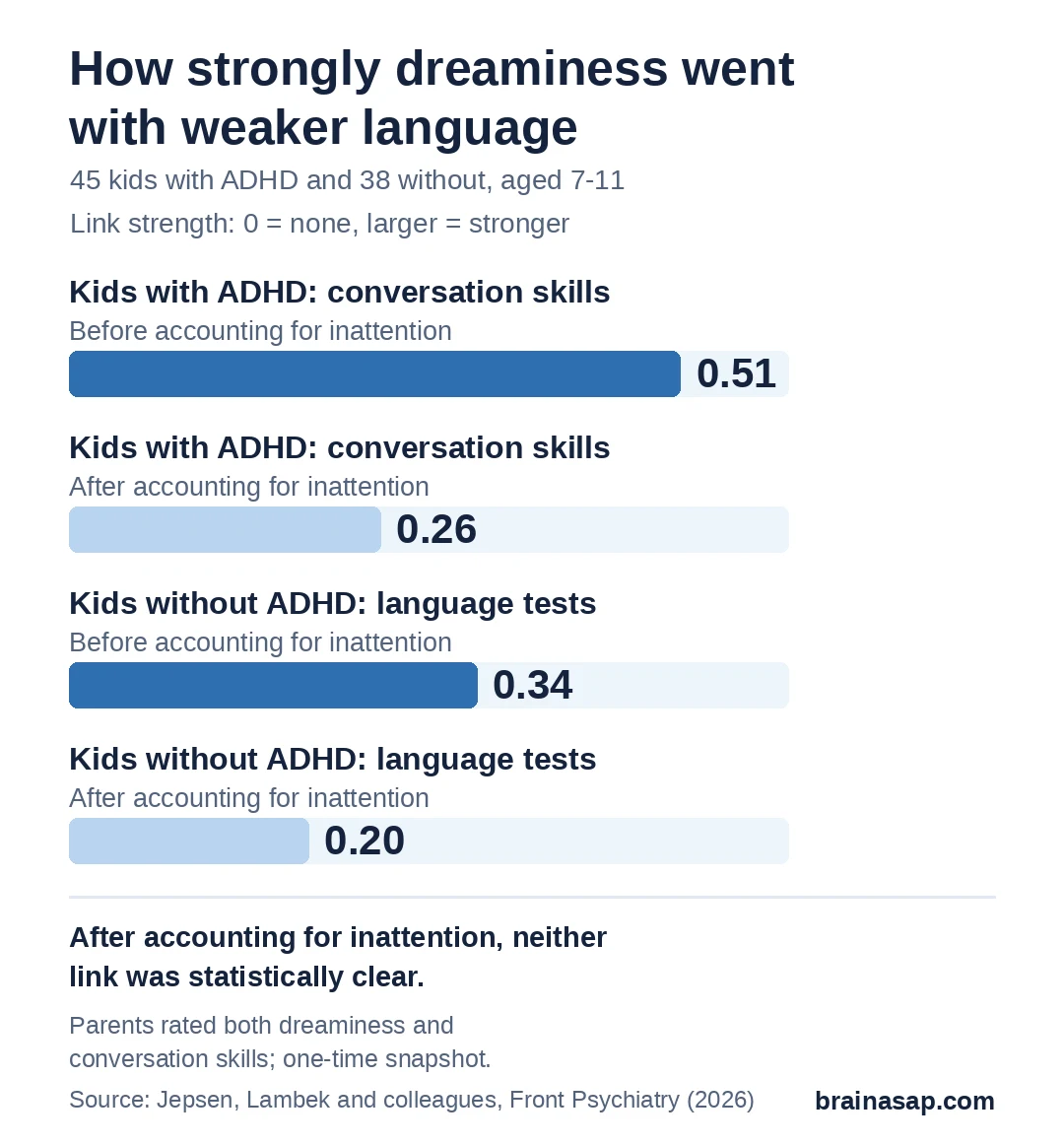
In kids with ADHD, a dreamier, more sluggish style went with weaker conversation skills, and the link was large. It was not clearly linked to storytelling or to standard language test scores.
Kids without ADHD showed a different pattern. Dreamier children scored somewhat lower on standard language tests, a medium-sized link, but their conversation skills did not track their dreaminess.
Statistically, the link with conversation skills was clearly stronger in kids with ADHD than in kids without ADHD.
What Happened When Inattention Was Counted?
Dreaminess and classic ADHD inattention, such as losing focus or not following through, overlap a lot. So the team ran the analysis again, this time accounting for how inattentive parents said each child was.
The result? Both links shrank and were no longer statistically clear, and the group difference in the conversation-skills link was no longer statistically clear.
Jepsen, Lambek and colleagues suggested 2 readings. Perhaps the link with conversation skills largely comes from inattention rather than dreaminess itself. Or perhaps, because the 2 traits overlap so much, accounting for inattention may have removed part of what makes up CDS.
What This Study Can't Tell Us
- Small groups: 45 kids with ADHD and 38 without, which limits the power to detect smaller links
- Same raters for both: parents rated both dreaminess and conversation skills, which could make the 2 look more related than they are
- Only 3 questions on dreaminess: CDS was measured with a short 3-item rating
- One snapshot: the study cannot show whether dreaminess leads to conversation problems or the reverse
- Uneven groups: 37 of the 45 kids with ADHD were boys, compared with 16 of the 38 kids without ADHD
For now, the practical point is modest. When a child with ADHD seems dreamy and low on energy, it may be worth checking conversation skills too, since language problems in ADHD often go unnoticed.
Whether dreaminess itself makes conversation harder, or simply rides along with inattention, needs larger studies to settle.
Citation: DOI: 10.3389/fpsyt.2026.1965712. Jepsen I, Brynskov C, Rask CU, de López KJ, Thomsen PH, Lambek R. The association between cognitive disengagement syndrome and language in children with attention-deficit/hyperactivity disorder. Frontiers in Psychiatry. 2026;17:1965712. PMID: 42973942. Full text: PMC13725549.
Study Design: Cross-sectional study; parent-rated CDS (3 SWAN items), narrative coherence ("Frog, where are you?"), CELF-4 core language, parent-rated CCC-2 pragmatic language; multiple-group multivariate regression adjusted for age and sex, with a sensitivity analysis adding inattention.
Sample Size: 45 children with ADHD and 38 neurotypical children aged 7 to 11 years.
Key Statistic: ADHD group, CDS and pragmatic language: β = -0.51, p = .001; neurotypical group, CDS and core language: β = -0.34, p = .04; group difference for pragmatic language p = .04. With inattention added: β = -0.26 (p = .08) and β = -0.20 (p = .44); group difference p = .15.
Caveat: Small exploratory sample; cross-sectional; CDS and pragmatic language both parent-rated; links not significant after accounting for inattention.