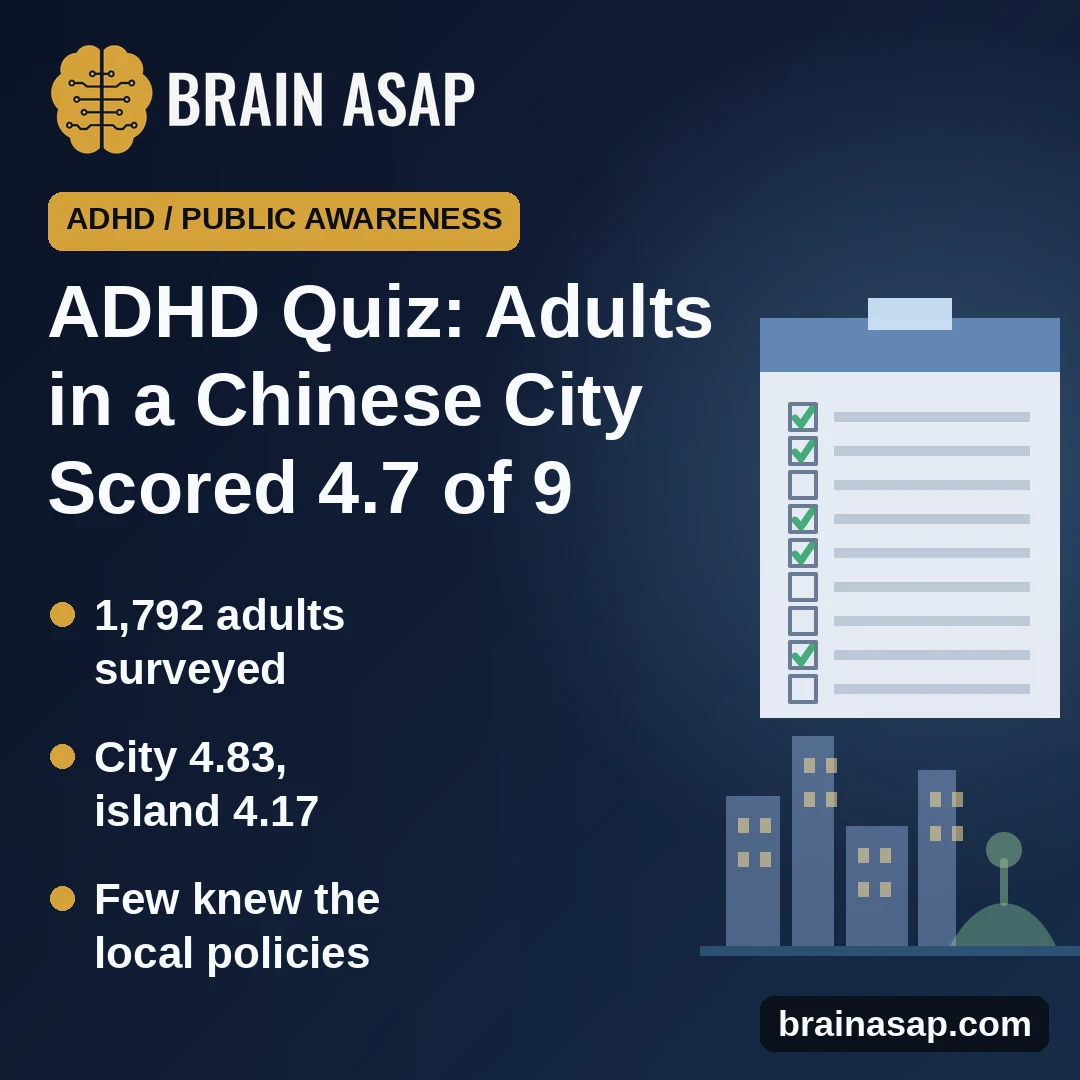
TL;DR: Researchers in Wenzhou, a city in eastern China, gave 1,792 adults a 9-question quiz about attention-deficit/hyperactivity disorder (ADHD), a condition that can affect both children and adults. Each correct answer scored 1 point.
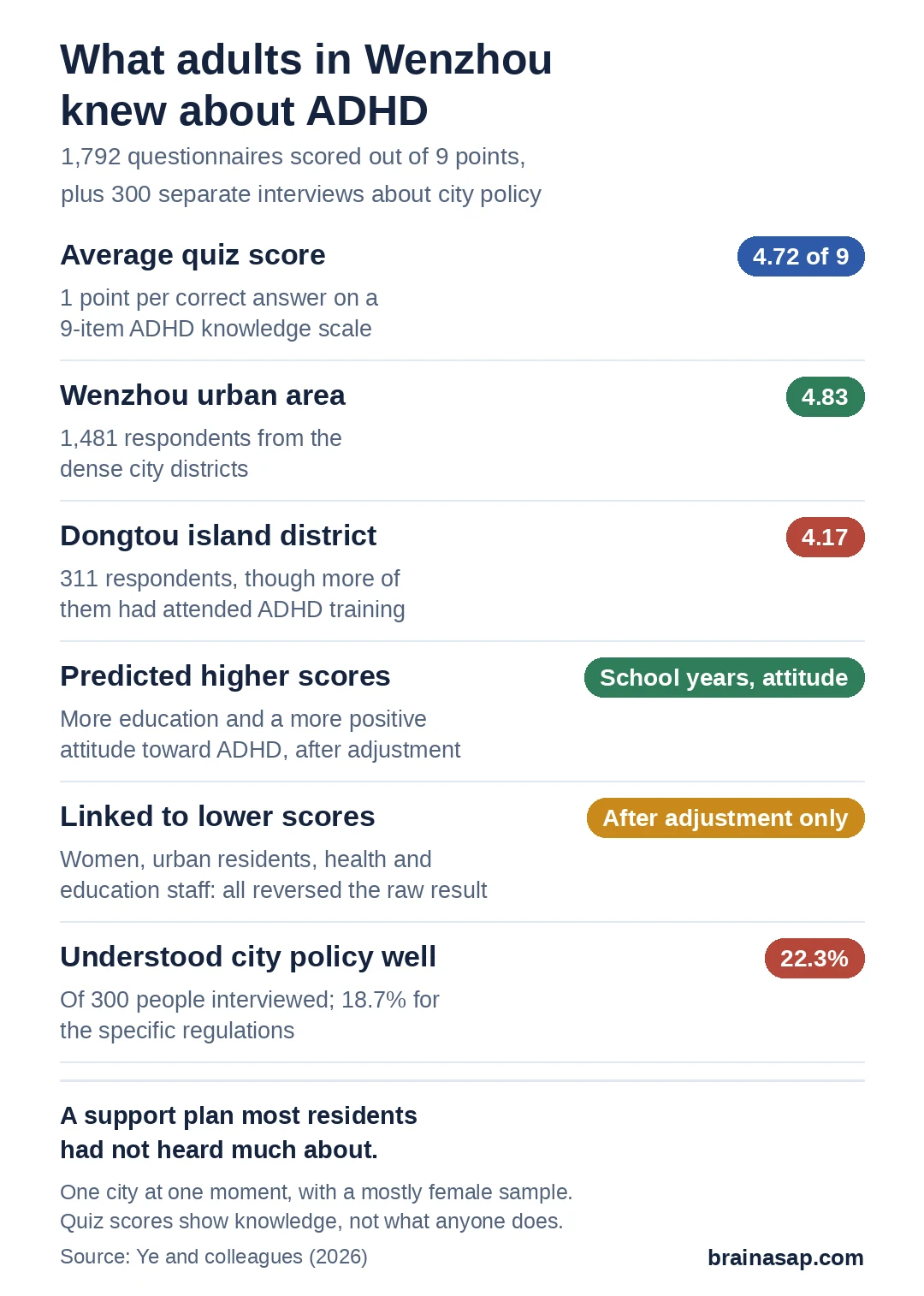
Average score: 4.72 out of 9. In 300 separate interviews, fewer than one in four respondents said they understood the city's child-friendly plan very well.
Key Findings
- About half the questions right: adults averaged 4.72 of 9 points on the ADHD knowledge quiz.
- City scored above island: residents of the Wenzhou urban area averaged 4.83, residents of Dongtou, an island district, 4.17.
- Education and attitude predicted knowing more: higher educational attainment and a more positive attitude toward ADHD were linked to higher scores after adjustment.
- Several patterns flipped after adjustment: teachers, healthcare workers and urban residents scored higher in the simple comparison but lower once schooling, region and attitude were held constant.
- Policy awareness was thin: of 300 people interviewed, 22.3% said they understood the child-friendly city idea well, and 18.7% said the same about its specific regulations.
Source: Neuropsychiatric Disease and Treatment (2026) | Jingwei Ye, Dan Wang and colleagues
A policy for children only works if the adults around them know it exists. Wenzhou launched a 3-year Child-Friendly City plan in 2022, covering services that children with ADHD and their families would use, and nobody had measured what residents actually knew.
A 2026 study in Neuropsychiatric Disease and Treatment set out to collect that baseline, on 2 fronts: how much adults know about ADHD itself, and how much they know about the city's policies.
Who Answered, and What They Were Asked
Questionnaires went out to adults aged 18 and over in 2 contrasting parts of the city: the dense urban area and Dongtou, an island district. Of 2,060 handed out, 1,792 came back usable, 1,481 from the urban area and 311 from the island.
Knowledge was measured with a 9-item scale adapted from an existing Chinese ADHD questionnaire, covering things like what causes ADHD and how it is recognized and treated. One point per correct answer, 9 points maximum.
How Much Did People Know?
An average of 4.72 out of 9 puts the typical adult a little above half the questions, which the research team describes as low-to-moderate literacy rather than a comfortable grasp.
Urban residents outscored island residents, 4.83 against 4.17 (P < 0.001). That gap of roughly two-thirds of a point sits alongside a practical difference: island residents reported roughly double the rate of attending any ADHD-related training.
Which Adults Knew More?
In the simple group-by-group comparison, the expected pattern appeared. People with more schooling, people working in healthcare or education, and urban residents all scored higher.
Then the team ran a regression that holds the other characteristics constant, and 3 of those patterns reversed. After adjustment, being female, living in the urban area and working in healthcare or education were each linked to lower scores.
Two predictors survived in the expected direction: higher educational attainment and a more positive attitude toward ADHD. A third was odd enough to be flagged in the paper itself: respondents who said they did not know whether any relative or friend had ADHD scored higher in the adjusted model than those who answered yes.
Why Those Reversals Need Care
A reversal like this usually means the groups differ in several ways at once, and the adjustment is separating effects that travel together in real life.
Ye and colleagues give an example: women in the urban sample scored higher in the unadjusted comparison, whereas the adjusted model for both districts found lower scores associated with female gender. The two analyses cover different comparisons.
Whatever the explanation, these adjusted coefficients are not a reason to conclude that nurses and teachers know less about ADHD than other people. That raw comparison said the opposite.
Did Anyone Know About the Child-Friendly City Policies?
A separate set of 300 interviews, with a different group of residents that included some under 18, asked about the city plan rather than about ADHD.
Just 22.3% reported understanding the concept well, and 18.7% said the same about the actual regulations. Healthcare and education workers, and people aged 41 to 50, were the most informed groups.
What This Can and Cannot Support
- One city, one moment: a snapshot in Wenzhou says nothing about awareness elsewhere in China, and nothing about how it changes over time
- Who filled it in: around 61% of urban and 64% of island respondents were women, and the authors describe the sample as not fully representative of the population it came from
- Knowledge, not behavior: quiz scores do not show whether anyone noticed symptoms in a child, sought an assessment, or followed advice
- The interviews stayed descriptive: the 300 interview records were summarized as percentages, with no deeper analysis of why awareness was low
- Adjusted effects are small and unstable: several of them reversed direction between the 2 analyses, which is a reason to treat each one as a lead rather than a result
The Useful Part
Baseline numbers are unglamorous and they are what makes a later comparison possible. If Wenzhou runs the same quiz after an awareness campaign, 4.72 out of 9 is the figure to beat.
The study gives the city a baseline for these interviewees. It did not track whether families heard about the plan or used its services.
Citation: DOI: 10.2147/NDT.S639923. Ye J, Wen Y, Zhang T, Zeng Y, Jin X, Lin J, Du S, Yang X, Zhan J, Hla KWY, Shu X, Wang D. Determinants of ADHD Health Literacy and Public Awareness of Child-Friendly City Policies in Wenzhou: A Cross-Sectional Survey. Neuropsychiatric Disease and Treatment 2026;22.
Study Design: Mixed-methods cross-sectional survey in Wenzhou, China, reported following STROBE. A validated 9-item ADHD knowledge scale (Cronbach's alpha 0.753) scored 1 point per correct answer; group differences tested with t-tests, one-way and factorial ANOVA and chi-square, and independent predictors with Poisson regression. A separate qualitative strand used 300 semi-structured interviews about child-friendly city policy awareness, analyzed thematically and reported as proportions.
Sample Size: 2,060 questionnaires distributed and 1,792 valid responses analyzed (1,481 Wenzhou urban area, 311 Dongtou District), an effective response rate of 86.99%; plus 300 separate interview records, including some participants under 18.
Key Statistic: Mean ADHD knowledge score 4.72 of 9 overall; 4.83 in the urban area versus 4.17 in Dongtou District (P < 0.001). In Poisson regression, educational level (beta = 0.0624), positive attitude toward ADHD (beta = 0.0758) and being unsure whether relatives or friends have ADHD compared with answering yes (beta = 0.1002) predicted higher scores, while female gender, urban residence and healthcare or education employment were associated with lower scores after adjustment (all P < 0.05). Of 300 interviewees, 22.33% reported understanding the child-friendly city concept well and 18.67% its regulations.
Caveat: Cross-sectional and from a single city, so no result here shows cause and effect or applies automatically elsewhere. The sample skewed female (around 61% urban, 64% island) and the authors state it does not fully reflect the underlying population. Several associations reversed direction between the unadjusted and adjusted analyses, which the authors attribute to confounding, so individual adjusted predictors should be read as leads rather than conclusions. The quiz measures knowledge only, not whether anyone acts on it, and the 300 interviews were reported as descriptive proportions without deeper mechanistic analysis.