TL;DR: When people were told which of two remembered sounds would be tested, they recalled its pitch more accurately, but not where it came from. Both features were judged faster, suggesting attention does not sharpen every detail of a sound memory equally.
Key Findings
- 40 young adults: Remembered two spoken syllables that differed in pitch and location.
- A hint sped things up: Being told which syllable mattered made judgments of both pitch and location faster.
- Only pitch got sharper: Accuracy and precision rose for pitch, not location.
- Knowing the question helped more: Speed gains were larger when people knew which feature would be tested.
Source: Psychonomic Bulletin & Review (2026) | Peita and Lim
In a noisy room, you hear a voice, then another. Seconds later you need to recall who said what, and from where. Attention can help: shifting focus to a sound already held in memory is known to make it clearer.
But a sound has several features at once. Researchers at Binghamton University asked whether focusing on a remembered sound sharpens all of them, or just some.
Two Syllables, Two Features, One Hint
Forty young adults (aged 18 to 34) wore headphones and heard two short syllables, "da" and "ge." Each had its own pitch and seemed to come from a different side.
During a short pause, a screen showed either:
- A helpful hint: The written syllable ("da" or "ge") that would be tested.
- A neutral hint: "xx," which gave nothing away.
Then they heard one syllable again and judged whether its pitch went up or down, or whether it moved left or right. Changes were tuned to each person's own hearing thresholds.
Half the participants always knew which feature, pitch or location, would be asked in a block. The other half had to keep both in mind.
Faster on Both, More Accurate on One
The helpful hint made people faster at judging both pitch and location, with a bigger speed boost for the group that knew which feature was coming.
Accuracy was a different story:
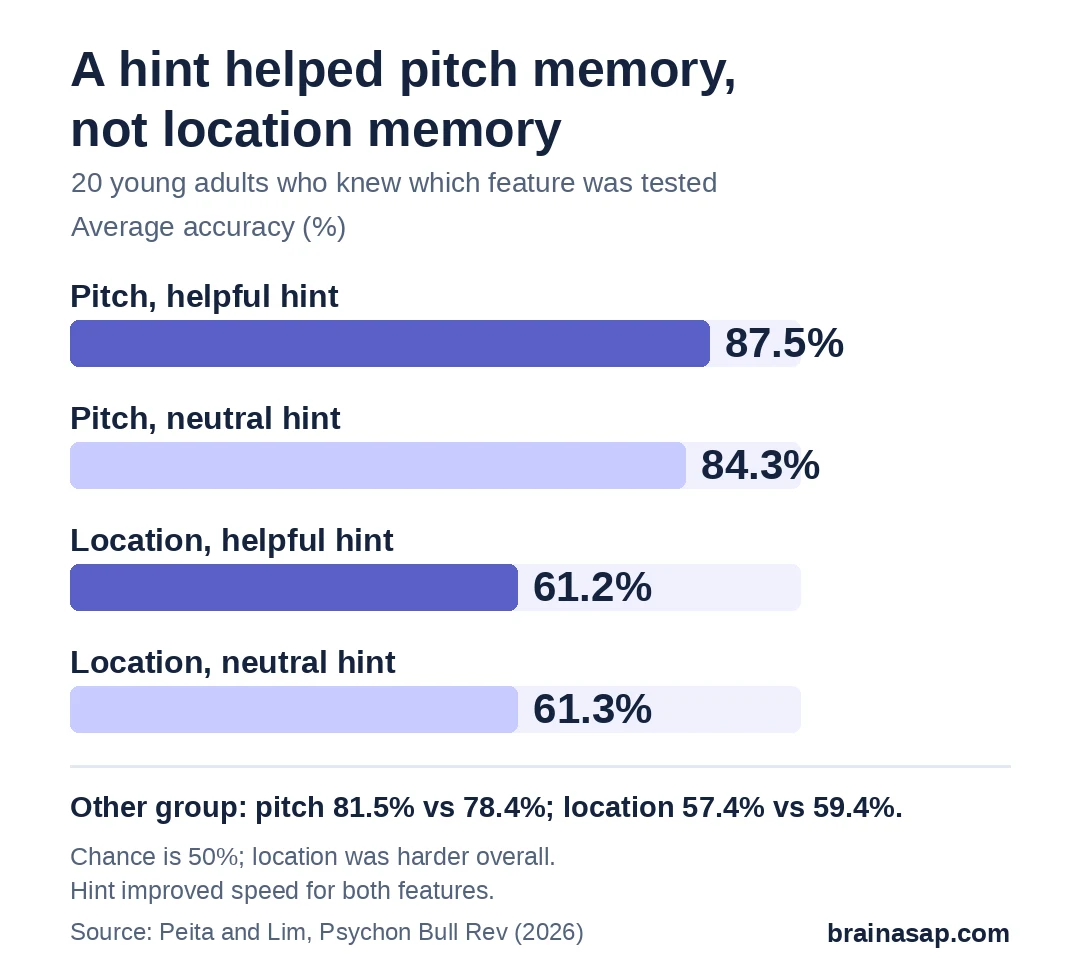
The hint improved pitch accuracy, a difference that held up statistically, but did nothing for location. A finer measure of memory precision showed the same pattern. The pitch-only boost remained after accounting for the fact that pitch was easier to judge to begin with.
Why Pitch Might Win
The authors suggest that hearing is built mainly to identify what a sound is, with pitch central to that, while location is handled more by vision in everyday life. So when attention reaches into a sound memory, it may favor identity over place.
What the Study Cannot Settle
- Uneven difficulty: Location was harder overall (about 60% correct vs about 80% for pitch).
- Location depended on angle: Spatial judgments varied with where the sound started.
- Young, healthy listeners: Mostly college students; no older adults or people with hearing loss.
- Lab task: Two syllables over headphones, not real conversation.
- Not preregistered.
Attention Shapes Some Sound Details More Than Others
The takeaway is that a sound held in memory is not one tidy package. Paying attention to it helps you answer faster, but only some details, like pitch, get clearer.
The next question is whether location memory can be sharpened if cues point to place rather than identity, and whether this pattern changes in older adults or people with hearing loss.
Citation: DOI: 10.3758/s13423-026-02991-8. Peita D, Lim SJ. Attention to memory: asymmetric enhancement of mnemonic features in auditory working memory. Psychon Bull Rev. 2026;33:234.
Study Design: Laboratory experiment with retro-cues (valid vs neutral) in an auditory working memory task; two between-subject groups (feature predictable vs unpredictable).
Sample Size: 40 young adults (20 per group).
Key Statistic: Retro-cue by feature interaction on accuracy, p = 0.013; pitch benefit p = 0.0085, location p = 0.55.
Caveat: Young lab volunteers; unequal feature difficulty; not preregistered.