TL;DR: A computer model scored rare genetic changes found in children with autism and in their siblings without autism. It predicted how each change would alter the way the genome folds, which can affect whether a gene comes close to its distant regulatory regions.
Changes from the children with autism came out slightly more disruptive, and growing neurons in a dish with one of those deletions confirmed what the model predicted for that spot.
Key Findings
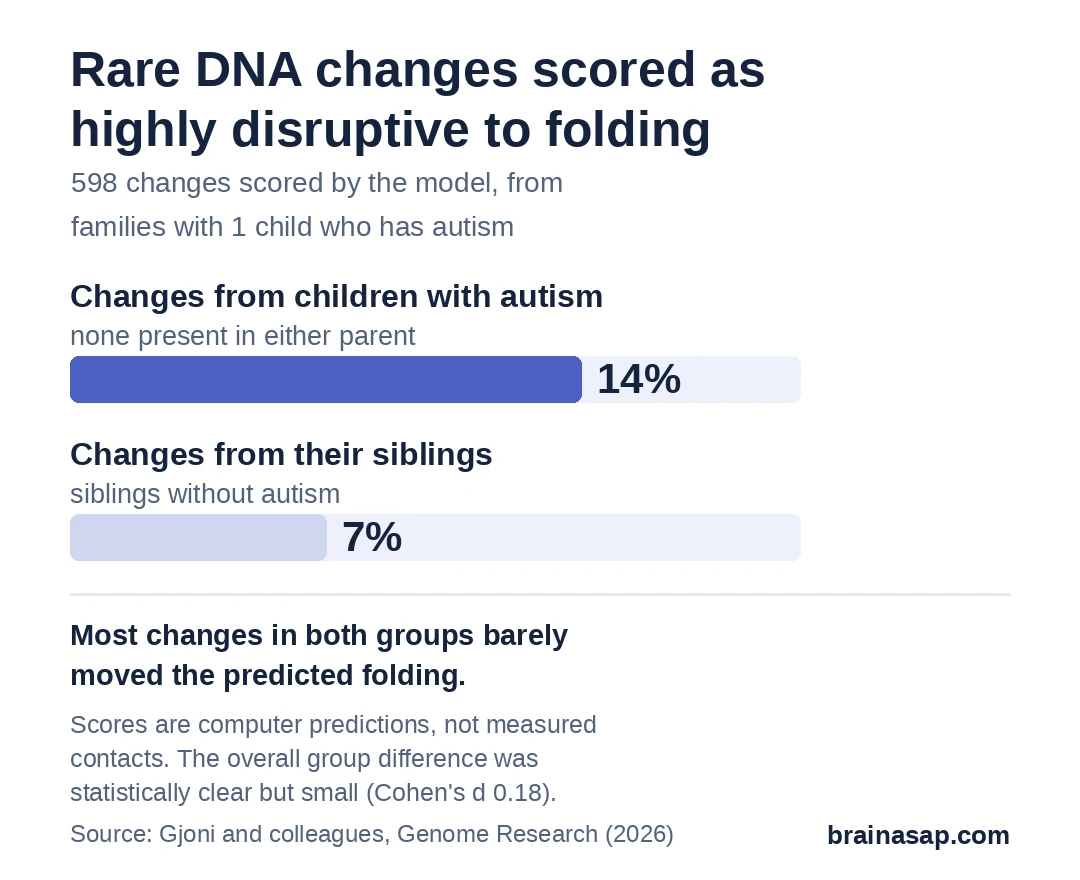
- Small gap, driven by a few changes: across 598 scored DNA changes, those from children with autism disrupted predicted folding slightly more than their siblings' (14% of scored variants from children with autism versus 7% of scored variants from siblings without autism crossed the study’s disruption threshold). Most changes in both groups barely moved the prediction.
- Disruption landed on gene control points: scoring only the contacts between genes and their regulatory elements widened the gap, suggesting the changes hit spots where folding matters for switching genes on and off.
- One prediction held up in cells: a 23,000-letter deletion on chromosome 10, cut into stem cells that were then grown into neurons, changed DNA contacts the way the model said it would.
- Many genes shifted in those neurons: 1,102 genes were turned up or down, and the list was unusually rich in genes for neuron development and in genes already linked to autism.
Source: Genome Research (2026) | Ketrin Gjoni, Yin Shen, Katherine S. Pollard and colleagues, Gladstone Institutes and UCSF
A genetic cause remains unidentified for many autistic people. Gene hunting has mostly searched the small slice of DNA that spells out proteins, where a damaging change is easy to recognize.
A 2026 paper in Genome Research went after a different suspect: DNA changes that break nothing in a gene itself, but move the furniture around it.
Why DNA Folding Matters for Genes
Stretched out, the DNA in one cell would run about 2 meters. Packed into a nucleus, it folds into loops and neighborhoods that decide which stretches touch each other.
Those contacts do real work. A switch sitting a million letters away from a gene can turn it on, but only if folding brings the 2 together. Boundaries between neighborhoods keep the wrong switches away from the wrong genes.
Delete, duplicate or flip a chunk of DNA, and the folding can change even when no gene is touched. Researchers already know this kind of rewiring causes limb malformations and other developmental conditions.
Scoring Rare DNA Changes With a Model
Gjoni and colleagues used variants from the Simons Simplex Collection, families in which one child has autism and a sibling does not. These are de novo changes: present in the child but not in either parent.
Testing each one in the lab would take years. Instead the team fed the DNA sequence, with and without each change, to Akita, a neural network trained to predict contact maps from sequence alone, then measured how far the 2 predicted maps diverged.
A score near zero means folding barely changed. A high score means the predicted contacts around that spot rearranged.
A Small but Consistent Edge
Across the 598 changes the model could score, those from children with autism came out more disruptive than their siblings'. That gap was small, and a handful of highly disruptive changes drove it rather than a shift across the board.
Narrowing the scoring to contacts between genes active in excitatory neurons, a cell type implicated in prior autism research, and their distant control elements widened the gap between the 2 groups.
Longer changes that removed a CTCF site, a short sequence that acts as an anchor for folding, were especially disruptive in children with autism but not in their siblings.
Testing One Deletion in Living Neurons
Predictions are hypotheses. To check one, the team picked a 23,000-letter deletion found in a single child with autism, in a stretch of chromosome 10 crowded with neurodevelopmental genes.
Using CRISPR, Gjoni and colleagues cut the same deletion into stem cells and grew them into excitatory neurons, then measured the real contact map. It matched the model's prediction, though the real effect was somewhat larger than predicted.
Deleting only the CTCF anchor inside that region produced a similar but weaker change, so the anchor explains part of the effect and other sequence in the deletion explains the rest.
Gene activity shifted too: 1,102 genes changed their activity level in the edited neurons, and that list was enriched for genes involved in neuron development and for genes already on autism risk lists.
What This Does and Doesn't Show
- Prediction, not diagnosis: the scores rank variants worth testing; they do not identify a cause of autism in any child
- One locus tested: only 1 of the hundreds of scored changes was checked in cells, so how well the rankings hold up elsewhere is unknown
- Edited cells differ from the child: the engineered neurons carried the deletion on both chromosome copies, while the child has it on one, so the gene activity changes may be larger than what happens in the child
- Model trained on other cells: Akita was trained on non-neuronal cell types, and public neuron folding data were too coarse to train on
- Small effect: the overall difference between the 2 groups was statistically clear but modest, and the model could not score every variant
Where This Line of Work Goes Next
The open question is whether disrupted folding contributes to autism in other families or mainly helps researchers prioritize variants to test. Answering it means testing many more of these ranked variants in neurons, which is becoming possible as genome editing scales up.
What stands on its own is narrow: rare DNA changes in children with autism were slightly more likely than their siblings' to disturb the contacts between neuronal genes and their distant switches, and one such deletion did exactly that when it was built into neurons in a dish.
Citation: DOI: 10.1101/gr.280394.124. Gjoni K, Ren X, Everitt A, Shen Y, Pollard KS. De novo structural variants in autism spectrum disorder disrupt distal regulatory interactions of neuronal genes. Genome Research. 2026;36:1825-1835. PubMed record.
Study Design: Computational scoring of de novo structural variants with the SuPreMo-Akita pipeline and a new weighted scoring method focused on putative cis-regulatory element interactions from excitatory neuron PLAC-seq data, followed by CRISPR-Cas9 deletion in WTC11 iPSC-derived excitatory neurons with Hi-C and RNA sequencing.
Sample Size: 869 de novo structural variants from Simons Simplex Collection families (521 from children with autism, 348 from unaffected siblings); 598 scored by the model; 319 near a regulatory interaction; 1 variant tested in cells.
Key Statistic: Mean disruption score higher for variants from children with autism (Mann-Whitney U p = 0.039, Cohen's d = 0.18; 14% vs 7% classified as highly disruptive). Weighted scoring at regulatory interactions: p = 0.006 when upweighting those contacts 10-fold, p = 0.008 when scoring only those contacts. Full deletion in neurons: 1,102 differentially expressed genes.
Caveat: Predictions come from a model trained on non-neuronal cell types; experimental validation covers a single locus with homozygous deletions in cultured neurons, which may overstate the effect of the child's single-copy variant. The group difference is small and does not establish that disrupted folding causes autism.