TL;DR: In a small trial in Egypt, 70 family members caring for someone with bipolar disorder either joined 8 weekly online group sessions led by a psychiatric nurse or got the hospital's usual care.
Right after the program, people who took part rated their caregiving as much less of a strain, felt more resilient and found more reward in the role. Nobody checked whether those gains lasted.
Key Findings
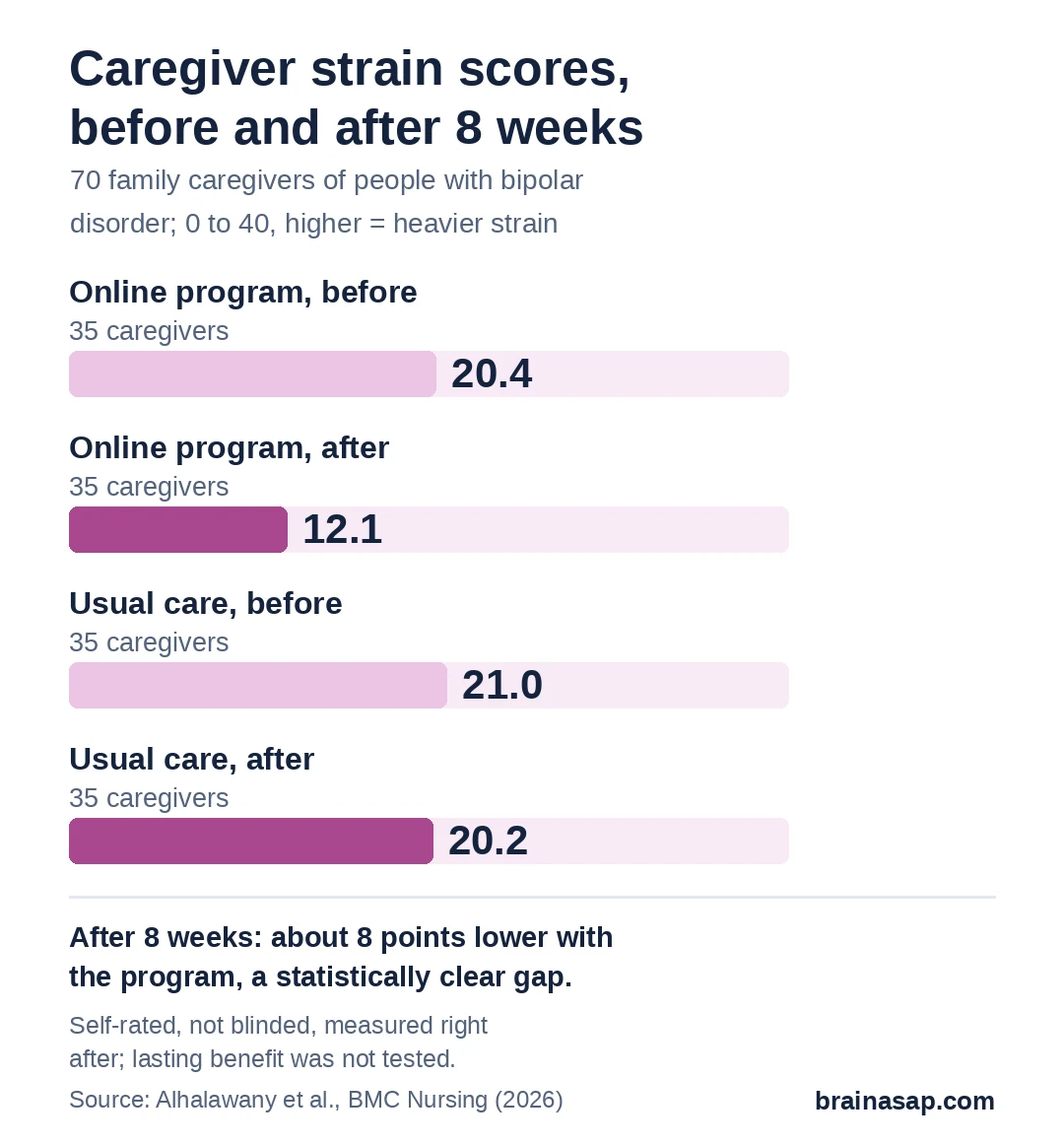
- Caregiving felt lighter: On a 0 to 40 caregiver strain questionnaire, scores in the program group fell from 20.4 to 12.1. Caregivers with usual care barely changed, from 21.0 to 20.2.
- Resilience rose sharply: On a 0 to 100 resilience questionnaire, program caregivers went from 39 to 68, while usual-care caregivers went from 39 to 41.
- More reward in the role: Scores for the positive side of caregiving nearly doubled with the program (16 to 30 out of 40), compared with 16 to 19 with usual care.
- Everyone stayed: All 70 caregivers finished, but answers were self-reported and the nurse who ran the sessions was also on the research team.
Source: BMC Nursing (2026) | Alhalawany and colleagues
When someone has bipolar disorder, a spouse, parent or sibling often carries much of the day-to-day load. They watch for warning signs, help with medicines and ride out the swings between mania and depression.
That load can wear people down. Can a few weeks of structured support from a nurse, delivered over video calls, make it feel lighter?
Who Took Part
A 2026 study in BMC Nursing, by Rania Maher Alhalawany and colleagues, recruited 70 family caregivers at a public psychiatric hospital in Menoufia, Egypt, between September and December 2025.
Each was the main caregiver for a relative with bipolar disorder and had been caring for at least 6 months. About 70% were women, 73% were ages 41 to 60, and most were spouses or parents of the patient. More than half had been caregiving for over 5 years.
A computer randomly split them into 2 groups of 35:
- Program group: 8 weekly group sessions over Zoom, plus phone check-ins and WhatsApp reminders
- Usual-care group: the hospital's normal outpatient follow-up for the patient, with no extra caregiver sessions
What the 8 Weeks Covered
Each session ran 60 to 90 minutes and was led by a psychiatric nursing researcher, in Arabic, with examples drawn from Egyptian family life. Topics built week by week:
- Understanding bipolar disorder and the caregiver's role
- Spotting and managing caregiver strain
- Finding the rewarding side of caregiving
- Building resilience
- Communication and support networks
- Stress management
- Relaxation and mindfulness
- Pulling it together into a personal wellness plan
How Much Caregiving Strain Changed
Caregivers rated their strain on a 10-question version of the Zarit Burden Interview, scored 0 to 40, where higher means heavier.
Both groups started near 21. After 8 weeks, the program group averaged 12.1 and the usual-care group 20.2.
That is about 8 points lower for caregivers who took the program, a statistically clear gap that held after accounting for starting scores.
Resilience and Reward Moved Even More
Resilience, meaning how well people felt they could bounce back from stress, was measured on the 25-question Connor-Davidson scale, scored 0 to 100.
Program caregivers rose from 38.5 to 68.2. Usual-care caregivers went from 39.1 to 41.0.
A third questionnaire asked about the positive side of caregiving, such as feeling closer to the patient or proud of coping. Program scores rose from 15.8 to 30.4 out of 40; usual-care scores from 16.2 to 18.5.
Caregivers who felt more resilient and found more reward in caregiving also tended to report less strain afterward. That link is a correlation, though, and doesn't show one caused the other.
Reasons to Be Careful With These Numbers
A 30-point jump in resilience after 8 weeks is unusually large, and several features of the trial could inflate it:
- Self-report only: caregivers rated themselves, and those who got the program knew it
- Not blinded: the same researcher led the sessions, and outcome assessment was not blinded
- No comparison program: usual-care caregivers got no extra attention, so simply having regular contact may explain part of the gain
- Measured once, right after: there was no follow-up to see whether the benefits lasted
- One hospital, small sample: 70 caregivers recruited by convenience
- Registered late: the trial record was first posted in April 2026, after its listed completion in December 2025. The registry lists an earlier study start than the September 2025 window described in the paper.
A Longer Trial With an Attention Control Is Needed
The sessions took place online, with follow-up by phone and WhatsApp. For caregivers who can't easily travel to a clinic, that format may help. The study did not measure what it would cost to run.
What this trial can't say is how much of the improvement came from the program's content rather than from weekly contact and a sense of being looked after, or whether it held up after the last session.
A larger trial comparing it with a simpler support group, at several hospitals and with follow-up months later, would answer both.
Citation: DOI: 10.1186/s12912-026-05326-z. Alhalawany RM, Khatatbeh YM, Mansour OZ, Hashem SR. From caregiver burden to psychological resilience and positive emotional outcomes: the effectiveness of innovative psychiatric nursing intervention among family caregivers of patients with bipolar disorder. BMC Nursing. 2026;25:996. PMID: 42902289. Full text: PMC13685295. Trial registration: ClinicalTrials.gov NCT07548359 (retrospective).
Study Design: Two-arm randomized controlled pre-test/post-test trial, single psychiatric hospital in Menoufia, Egypt (September to December 2025); 8-week nurse-led telenursing program vs usual care; repeated-measures ANOVA (primary), independent t-tests and ANCOVA adjusted for baseline, correlation and multiple regression.
Sample Size: 70 primary family caregivers of patients with bipolar disorder (35 per group); no withdrawals.
Key Statistic: Post-test caregiver burden (Modified Zarit, 0 to 40) 12.1 ± 4.9 vs 20.2 ± 5.7, an 8.1-point difference. Reported post-test means were 68.2 versus 41.0 for resilience (0 to 100) and 30.4 versus 18.5 for positive aspects of caregiving (0 to 40).
Caveat: Single-center convenience sample; self-reported outcomes; intervention delivered by the principal investigator and assessment not blinded; usual-care control without attention control; outcomes only immediately post-intervention; retrospective trial registration and undocumented effect-size assumption for sample size. Full published text reviewed.