TL;DR: At a Montreal psychiatric hospital, adults with borderline personality disorder reported long-term physical illnesses such as migraines, back problems and asthma more often than people from the same neighborhood without a psychiatric emergency visit. About half had 2 or more such illnesses, a higher share than adults with schizophrenia, even though people with borderline personality disorder were younger on average.
Key Findings
- Half had 2 or more illnesses: 49% of adults with borderline personality disorder reported at least 2 long-term physical conditions, compared with 36% of adults with schizophrenia and 20% of community volunteers.
- About 7 times the odds: After accounting for age and sex, adults with borderline personality disorder had about 7 times the odds of having 2 or more conditions as community volunteers.
- Migraine stood out: Migraine was the only individual condition with a clear difference between adults with borderline personality disorder and community volunteers after accounting for multiple tests.
- Linked habits: Taking longer to fall asleep, acting rashly when upset and smoking were each linked to more physical illness across all groups.
Source: Frontiers in Psychiatry (2026) | Dias Ribeiro Junior, Giguère and Cailhol
Borderline personality disorder is known for intense emotions, unstable relationships and impulsive actions.
It is less known for its toll on the body. Yet people with the condition die younger on average, and not only from suicide. Physical illness plays a part too.
Who Was Compared?
A 2026 study in Frontiers in Psychiatry, by researchers at the University of Montreal and Université Laval, used data from a research biobank at a large Montreal psychiatric hospital. Patients were enrolled after visits to the hospital's psychiatric emergency room between 2012 and 2020.
Researchers compared 590 adults in 3 groups:
- Borderline personality disorder: 158 patients diagnosed by a psychiatrist, mostly women (71%), about 32 years old on average
- Schizophrenia: 283 patients, mostly men (78%), about 39 years old on average
- Community volunteers: 149 people from the neighborhood around the hospital with no psychiatric emergency visit in the past 5 years, about 41 years old on average
Each person answered yes or no to a list of long-term physical conditions that a health professional had diagnosed, from asthma and migraine to diabetes, heart disease and stroke. Mental health conditions were left out of the count.
How Common Were Multiple Illnesses?
Researchers focused on having 2 or more long-term physical conditions at once, often called multimorbidity.
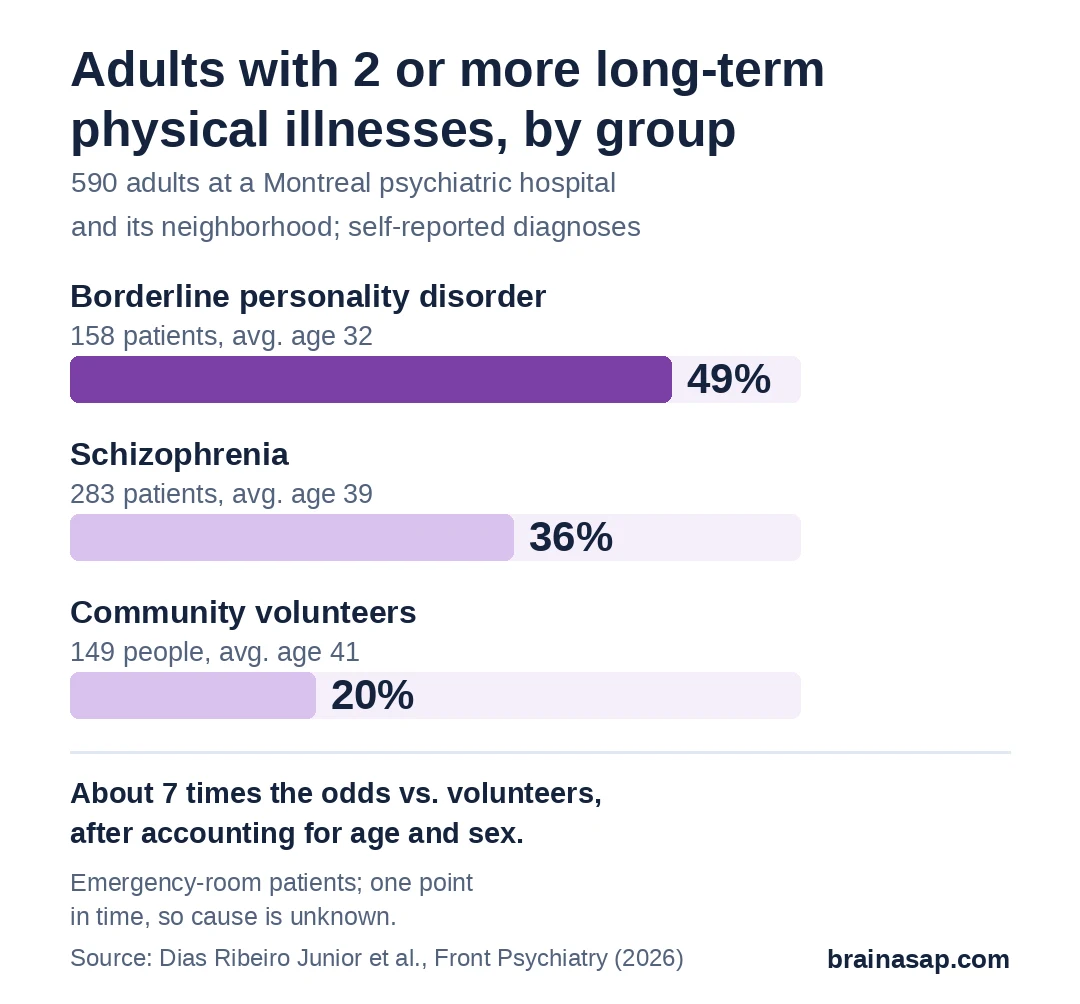
Adults with borderline personality disorder had the highest share, at 49%, despite being the youngest group.
After taking age and sex into account, that worked out to about 7 times the odds of having 2 or more conditions compared with community volunteers. For adults with schizophrenia, the odds were about 3.5 times those of community volunteers.
On average, adults with borderline personality disorder reported about 1.9 conditions, adults with schizophrenia 1.5 and community volunteers 0.9. Both patient groups differed clearly from community volunteers but not clearly from each other.
Which Illnesses Were Most Common?
Migraine, back problems and asthma were among the most commonly reported conditions in the borderline personality disorder group. The paper’s counts and percentages for individual conditions are inconsistent, which makes exact rates uncertain.
Once researchers corrected for testing many conditions at once, migraine was the only single illness that clearly differed between adults with borderline personality disorder and community volunteers.
Adults with schizophrenia more often reported diabetes, emphysema and other long-term lung disease.
What Habits Went With More Illness?
A further analysis looked at which personal factors went with a higher number of conditions, while also accounting for group, age, sex, education, work and income. Several stood out:
- Older age: the strongest link
- Taking longer to fall asleep: linked to more conditions
- Acting rashly when upset: about 7% more conditions per point on a 4-to-16 survey scale
- Never having smoked regularly: about 26% fewer conditions than people who had
- Alcohol use: not linked
Even after all of these, adults with borderline personality disorder still had about 70% more conditions than community volunteers, and adults with schizophrenia about 63% more.
What Are the Limits?
- Emergency patients only: people seen in a psychiatric emergency room are likely sicker than most people with these diagnoses
- Self-reported illnesses: conditions were reported by participants, not checked in medical records
- One point in time: it can't show whether poor sleep, smoking or impulsive behavior led to illness, or the other way around
- Uneven groups: most people with borderline personality disorder were women and most with schizophrenia were men, which may affect comparisons even after adjustment
- No symptom severity: how severe each person's borderline symptoms were was not recorded
What Could Change in Care?
This study suggests that physical health deserves as much attention in borderline personality disorder as it already gets in schizophrenia. Dias Ribeiro Junior and colleagues suggested that help with sleep, smoking and acting on impulse under stress could be built into mental health care.
Whether doing so would actually reduce physical illness in people with borderline personality disorder remains to be tested.
Citation: DOI: 10.3389/fpsyt.2026.1726738. Dias Ribeiro Junior M, Giguère CÉ, Cailhol L. Prevalence of physical comorbidities and multimorbidity in Borderline Personality Disorder: risk factors and comparisons with schizophrenia and healthy controls. Frontiers in Psychiatry. 2026;17:1726738. PMID: 42757226. Full text: PMC13584916.
Study Design: Cross-sectional analysis of the Signature biobank (IUSMM, Montreal); self-reported chronic conditions (ESCC-2008 list); logistic regression adjusted for age and sex; negative binomial regression with behavioral and socioeconomic covariates.
Sample Size: 590 adults (158 borderline personality disorder, 283 schizophrenia, 149 community controls); 571 in main analyses, 509 in the adjusted burden model.
Key Statistic: Multimorbidity 49.4% vs 36.4% vs 20.1%; borderline personality disorder vs controls OR 7.21 (95% CI 4.03 to 13.3), adjusted for age and sex.
Caveat: Emergency-room patient sample; self-reported conditions; cross-sectional; sex imbalance between groups; no symptom-severity data. The indexed abstract and original journal methods and tables were reviewed.