TL;DR: A review of 10 years of research found no consistent evidence that radio waves from cell phones or phone towers harm children or pregnancies. Some studies did find links to sleep, behavior or birth size, but most relied on self-reported phone use and couldn't rule out other explanations.
Key Findings
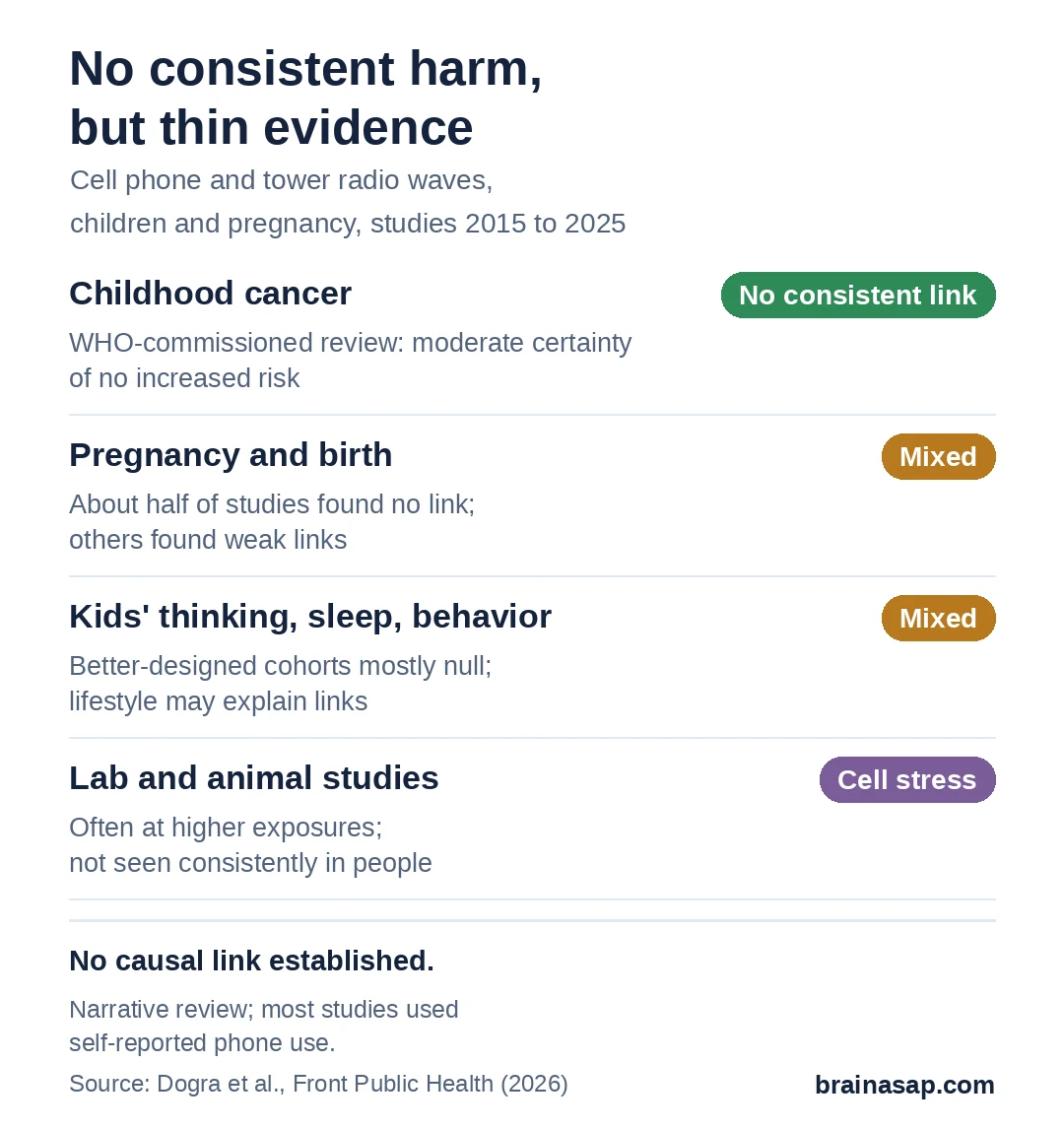
- Cancer: No consistent link to childhood brain tumors or leukemia.
- Pregnancy: About half the studies found no link; the rest found weak ones.
- Kids' thinking and behavior: Mixed, and better-designed studies mostly found nothing.
- Lab studies: Signs of cell stress, often at higher exposures.
- Not proof of safety: Long-term studies are scarce.
Source: Frontiers in Public Health (2026) | Dogra et al.
Kids get phones younger every year, and pregnant women carry them close to the body all day. So it's a fair question whether the radio waves they give off are safe for a developing brain or baby.
Researchers at the Indian Council of Medical Research pulled together studies from 2015 to 2025 to see where the evidence stands.
Phones Up Close, Towers Far Away
Cell phones and the towers that connect them both send out radiofrequency waves. These don't carry enough energy to break DNA directly, unlike X-rays. The authors separate two kinds of exposure:
- Near-field: A phone held against your head or body. Stronger, but short.
- Far-field: Towers and Wi-Fi in the background. Weak, but constant.
Typical indoor and city levels sit below international safety limits. Those limits are set to prevent tissue heating, the one effect that's well established.
No Consistent Cancer Link in Children
The biggest study, MOBI-Kids, compared 899 young people aged 10 to 24 with brain tumors against 1,910 without. Heavier phone use wasn't linked to higher risk. A WHO-commissioned review found moderate-certainty evidence that mobile phone use likely does not raise brain-tumor risk in children and young people.
Pregnancy Studies Point in Different Directions
The review looked at six human studies on phone use during pregnancy. The large Norwegian cohort found no link to low birth weight, early birth or small babies. A Korean study found no direct effect on toddlers' development.
Others found small signals:
- Fetal growth: Over 30 minutes of calls a day vs under 5 was linked to about 1.5 times the odds of a small baby in one cohort.
- Miscarriage and birth size: Tiny risk increases in an Iranian cohort.
- Kidney and urinary defects: Linked to longer call times in one small case-control study.
Sleep and Behavior Links Are Hard to Untangle
Across 17 studies on children's brains and behavior, results were all over the map. Some linked phone use to shorter sleep, headaches, tiredness or behavior problems. One large cohort of about 84,000 children linked 4 or more calls a day in pregnancy to about 1.3 times the odds of hyperactivity later.
But several careful cohorts found nothing. One even found slightly better language and motor scores. The authors conclude the links are more likely due to how kids use phones, like late-night screen time, than to the radio waves.
Why the Evidence Is Still Murky
- Self-reported use: Most studies asked people how much they used their phones.
- Few long-term studies: Not many follow kids from pregnancy to adolescence.
- Lab findings don't carry over: Cell stress in animals often used higher exposures than daily life.
- Narrative review: No formal quality scoring or pooled numbers.
- Tech keeps changing: 5G studies are still limited.
Simple Steps While the Science Catches Up
The authors stress that no clear harm isn't the same as proven safety. They suggest low-cost habits for kids and pregnant women: shorter calls, speaker mode or headphones, texting when practical, and not keeping an active phone against the body. They add that "anti-radiation" shields haven't been shown to work.
The open question is whether large birth cohorts that measure exposure directly, instead of asking about it, will find any effect at all.
Citation: DOI: 10.3389/fpubh.2026.1915745. Dogra S, Rajput S, Rathi A, Gautam R, Mazumder P, Sinha A, Sahoo RK, Pati S, Mukherjee A, Arora T. A review of potential health risks of radiofrequency electromagnetic field exposure from mobile phones and base stations in children and pregnant women. Front Public Health. 2026;14:1915745.
Study Design: Narrative review of human, animal and lab studies published 2015 to 2025.
Sample Size: 3 systematic reviews on childhood cancer, 6 pregnancy studies, 17 child neurological studies tabulated.
Key Statistic: MOBI-Kids (899 cases, 1,910 controls): no increased brain tumor risk with heavier use; maternal calls >30 vs <5 min/day and reduced fetal growth aOR 1.54 (95% CI 1.03 to 2.31).
Caveat: Narrative review without formal risk-of-bias scoring; most included studies used self-reported exposure.