TL;DR: In a two-week trial of 30 adults with chronic insomnia, nightly sleep rose about 82 minutes with real brain stimulation and 6 with fake. The groups started far apart, so this is an early signal.
Key Findings
- Sleep time: Real-stimulation group gained about 82 minutes a night on the wrist tracker; fake-stimulation group about 6. Adjusted for starting point, the difference was 34 minutes (95% CI 1.6 to 66.9).
- Sleep quality score: Real group's questionnaire score fell 4.9 points; fake group's fell 0.1.
- Other tracker measures: None, such as time awake at night, held up after the authors' statistical corrections.
- Side effects: None serious. Mild skin symptoms or headache in 4 of 15 in real group, 1 of 15 in fake group.
- Mood (exploratory): Anxiety and depression scores also dropped more in real group; not a main trial goal.
Source: Research Square preprint (2026) | Hao et al.
Could a couple of weeks of gentle electrical pulses to the back of the head help people with chronic insomnia sleep longer? In this small trial, the group that got real stimulation gained about 82 minutes a night. The group that got fake stimulation gained about 6.
The twist is in the chart further down: by the end, both groups were sleeping almost exactly the same amount.
Guidelines say sleep medications are meant for short-term use, yet many people with insomnia stay on them far longer, and many still report being unhappy with their sleep. Researchers are looking for treatments that work on the brain directly, without another pill.
This trial tried one of the odder targets: the cerebellum, the structure at the back of the head better known for balance and coordination. It also has wiring into brain regions that control sleep and waking.
Twelve half-hour sessions of weak pulses
The stimulation method is called transcranial pulsed current stimulation (tPCS). Two soft electrode pads sit on the scalp, one over each side of the cerebellum, near the base of the skull. A small device sends very weak electrical pulses through them, 400 times per second. The current is low, an average of 0.6 milliamps.
Thirty adults from a sleep clinic in Chongqing, China, took part. All had insomnia for at least 3 months with a high score on a standard sleep questionnaire, and all stayed on their usual sleep or mood medications, which were not allowed to change during the trial. Over 2 weeks, each person came in for 12 sessions of 30 minutes.
Two groups were compared, with 15 people in each:
- The real-stimulation group received the full current for the whole session.
- The fake-stimulation group (called a sham group) got the same setup, but the current ramped up over 10 seconds, ramped back down over 5, and then nothing more was delivered. The aim is that people cannot easily tell which group they are in.
Assignment was random, and both the participants and the staff running the sessions and assessments did not know who got what.
How Sleep Was Measured
The main outcome was total sleep time from a wrist-worn movement tracker (an actigraph), averaged over three nights. This is more objective than asking people how they slept, though it has a known weakness: sedating medications can make a still, awake person look asleep. The second outcome was the Pittsburgh Sleep Quality Index (PSQI), a questionnaire where higher scores mean worse sleep. Anxiety and depression were tracked with two other self-rating questionnaires.
Real stimulation added about 82 minutes of sleep
The real-stimulation group's average sleep time rose by about 82 minutes a night, from roughly 291 to 373 minutes. The fake-stimulation group's rose by about 6 minutes, from roughly 366 to 372. When the authors compared the groups using an analysis that accounts for the different starting points, the real group came out ahead by 34 minutes. Because that analysis works on ranks, treat "34 minutes" as a rough size. The range of plausible values was wide, from barely more than zero to about an hour.
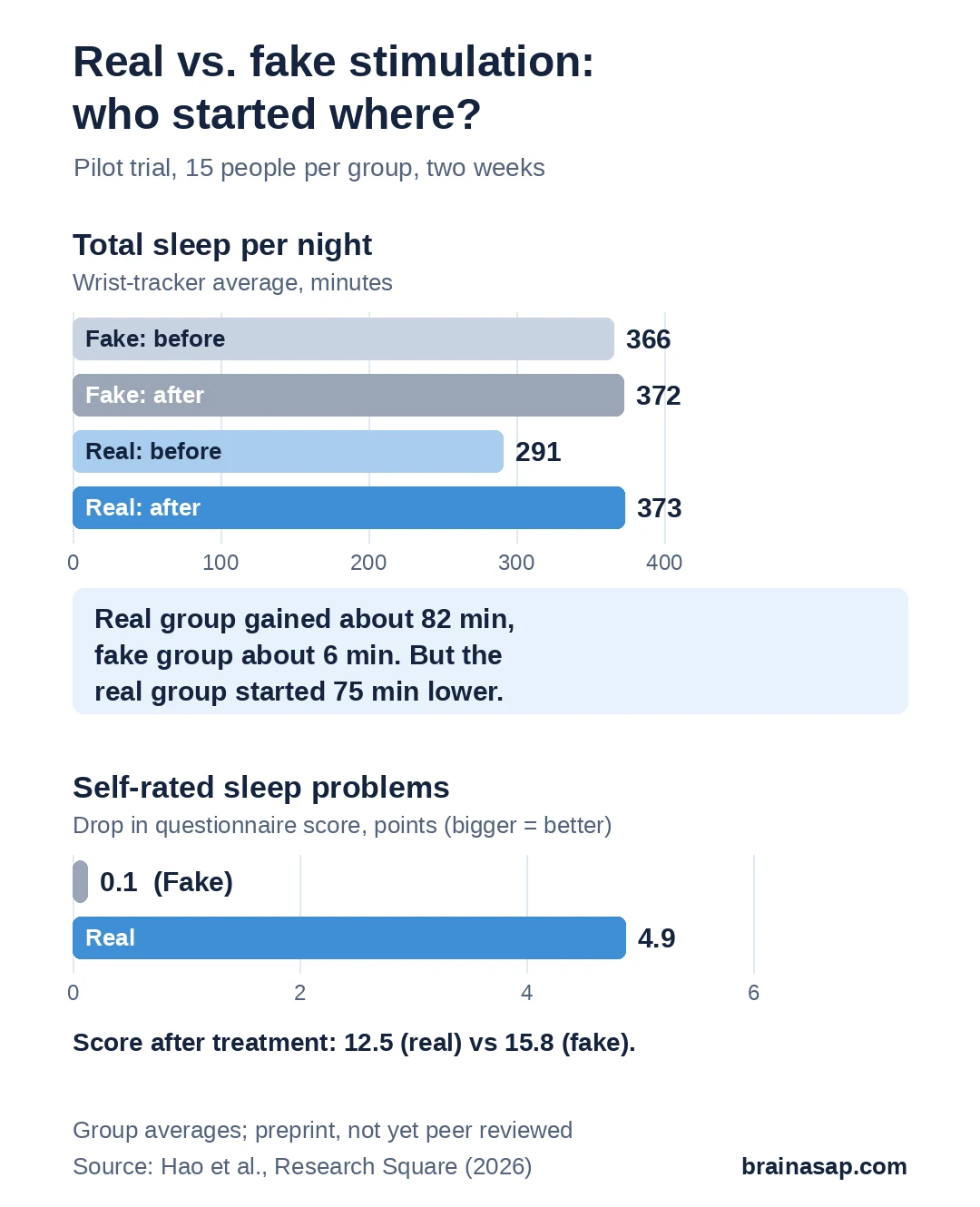
The questionnaire told a matching story. The real group's PSQI score fell 4.9 points, from a very poor baseline, to about 12.5. The fake group barely moved and ended near 15.8. The improvement was concentrated in two items: how people rated their sleep quality and how long they said they slept. That lines up with the tracker, which matters because what people feel and what a tracker records often disagree in insomnia.
Mood questionnaires also improved more in the real group, with anxiety scores dropping about 7 points versus under 1, and depression scores about 7 versus 2. The authors label this exploratory, so it is best read as a hint.
Both groups ended at about 6 hours
Look at the top bars. By the end, both groups averaged nearly identical sleep time, about 372 minutes, or a little over 6 hours. The difference in gains exists mostly because the real group began about 75 minutes lower.
Randomization with only 30 people does not always balance groups, and here it did not. The real group was older (about 49 versus 38 years on average), started with less tracker-measured sleep, and spent less time in bed. Someone starting low has more room to improve, and unusually low measurements tend to drift back toward normal on their own. The authors adjusted for baseline values and tested other imbalances, and none changed the result. Still, adjusting cannot fully rule out this kind of pattern in a trial this small.
Limitations of a Small, Short Preprint
- It is a preprint: Posted publicly, not peer reviewed; details could change.
- It is tiny: Plan was 130 people; recruitment problems cut it to a pilot of 30 analyzed. Dropout account is a little muddled, so check against the final version.
- Only two weeks: No follow-up after treatment ended, so unknown if effect lasts.
- Sleep stages are unknown: No lab sleep study, so unclear whether people got more deep sleep or just more time asleep.
- Main result was borderline: Confidence interval for the sleep-time gain nearly touched zero (1.6 minutes at low end).
- Add-on, not replacement: Everyone stayed on medication, so nothing about replacing pills.
- Possible bias: Two co-authors are co-inventors on related patents; authors say this did not influence the study. Team also did not formally test whether participants could guess their group.
A Larger Trial With Matched Starting Points Is Warranted
Nobody should hunt down a cerebellar stimulator on the strength of this paper. What a reader can reasonably take from it is modest: for people whose insomnia persists despite medication, this is a lead worth watching. It had no serious side effects in this small trial, and it seemed to help on both the tracker and the questionnaire.
The question for the next trial is a plain one. If both groups start at the same level, sleep is measured in a lab, and people are followed after the sessions end, does the real group still sleep longer than the fake group?
Citation: DOI: 10.21203/rs.3.rs-10564909/v1. Hao F, Zhong S, Ho RCM, Neufeld E, Kuster N, Karimi F, Li J, Wu X, Pascual-Leone A, Jiang X. Cerebellar High Frequency Transcranial Pulsed Current Stimulation Increases Total Sleep Time in Chronic Insomnia: A Pilot Study. Research Square (preprint, not peer reviewed). Posted September 18, 2026.
Study Design: Single-center, double-blind, randomized, sham-controlled pilot trial (ChiCTR2300072403). Twelve 30-minute sessions of bilateral cerebellar 400 Hz tPCS at 0.6 mA versus sham over 2 weeks, added to stable medication.
Sample Size: 30 adults with chronic insomnia analyzed (15 per group; per-protocol), from 38 randomized.
Key Statistic: Actigraphy total sleep time rose 81.63 minutes with real stimulation versus 6.25 minutes with sham (baseline-adjusted rank difference 34.25 minutes; 95% CI 1.60 to 66.89; P = 0.022). PSQI global score fell 4.87 versus 0.13 points (P < 0.001).
Caveat: Preprint, not peer reviewed; very small pilot; baseline imbalance in age and sleep time (both groups ended near 372 minutes); 2-week duration with no follow-up; no polysomnography; participants stayed on medication; some authors hold related patents.