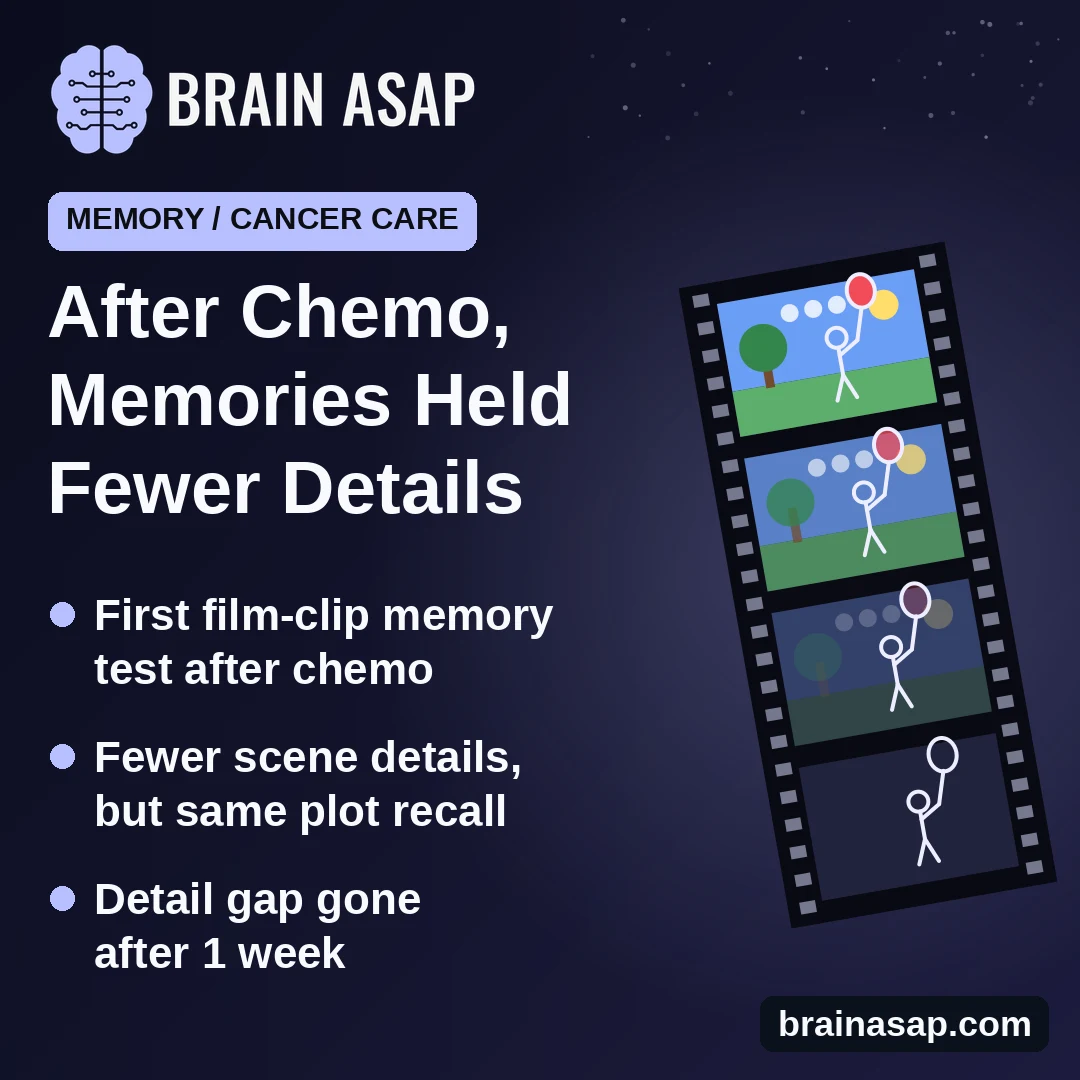
TL;DR: In a 2026 study, women who had chemotherapy for breast cancer and women who never had cancer watched dozens of short film clips, then described them from memory. Right after watching, the chemo survivors recalled somewhat fewer small details, like colors, sounds and objects, but remembered what happened about as well. A week later, the 2 groups no longer differed in how many details they recalled.
Key Findings
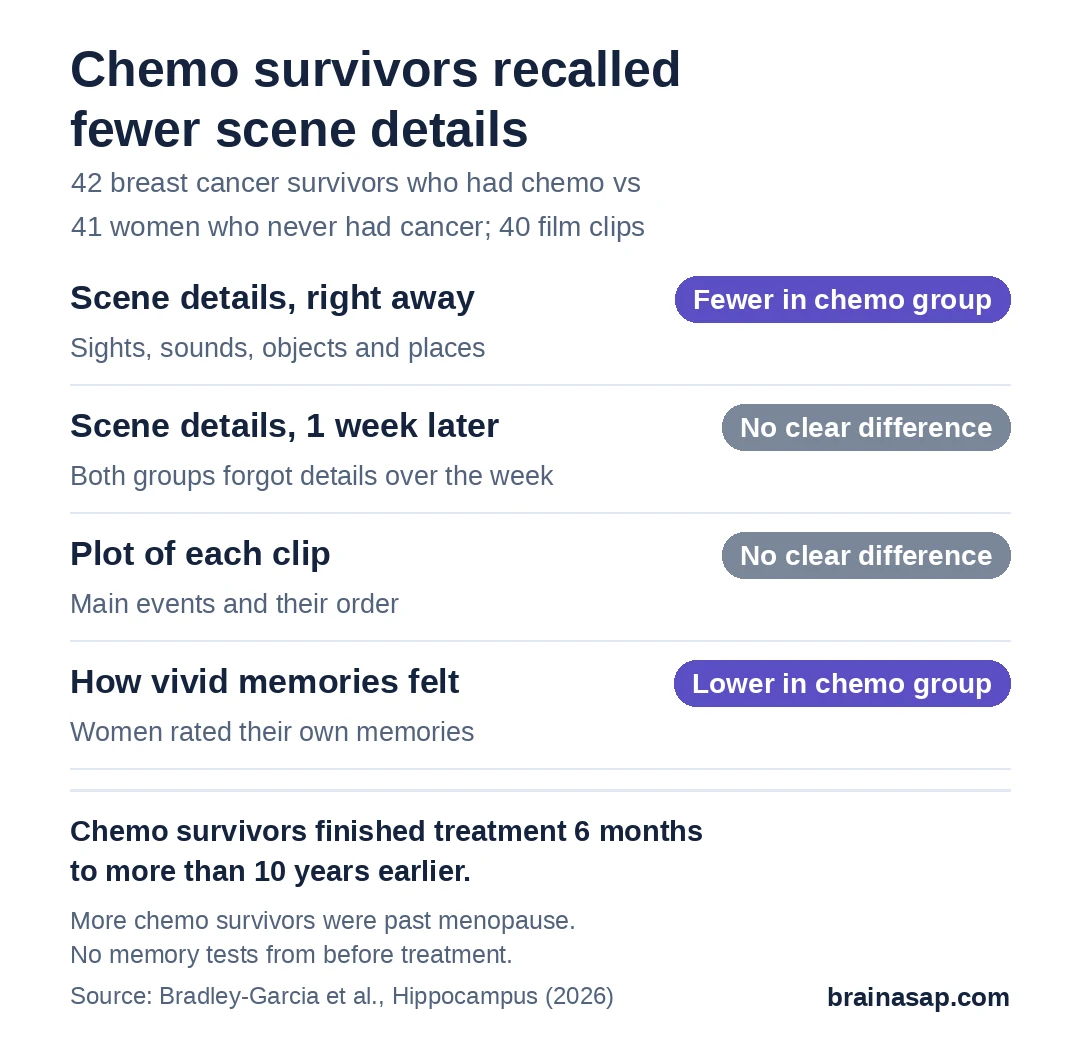
- Fewer small details right after watching: When describing clips straight away, 42 breast cancer survivors who had chemo mentioned fewer sights, sounds and other small details than 41 women who never had cancer, a modest but statistically clear difference.
- Plot recalled about as well: Chemo survivors recalled the main events of each clip about as well as women without cancer. A slight dip did not hold up after correcting for the many comparisons made.
- Detail gap gone after a week: On clips tested 7 days later, both groups remembered less, and the 2 groups no longer differed in how many small details they recalled.
- Order of events and forgotten clips matched: Chemo survivors put events in the right order and forgot about as many whole clips as women without cancer.
- Memories felt less vivid: Chemo survivors rated their memories of the clips as less vivid, but rated how much of each plot they remembered about the same as women without cancer.
Source: Hippocampus (2026) | Bradley-Garcia et al.
Many people who go through chemotherapy say their memory isn’t what it used to be, a problem often called “chemo brain.”
Standard memory tests, like recalling a list of words, don’t capture much of what everyday memory involves. So psychologists at the University of Ottawa tried something closer to real life.
In a 2026 study in Hippocampus, women watched short film clips and later described them out loud. The result? Breast cancer survivors who had chemo remembered what happened in each clip but described fewer of the details around it.
A Memory Test Built From 40 Short Film Clips
Participants came from across Canada, in 2 groups of women aged 30 to 65:
- Chemo survivors: 42 women who had finished breast cancer treatment, including chemotherapy and surgery, at least 6 months earlier. For 31 of them, chemotherapy had ended 1 to 10 years before.
- Women without cancer: 41 women of similar age who had never had cancer.
Average ages were about 51 and 50. Women with a recent mental health diagnosis, a past brain injury or a low score on a quick thinking screen were left out.
Each woman watched 40 clips, each 23 seconds long, over Zoom with a researcher present. Clips came from foreign films with little dialogue, so no one would recognize them, and each had a short title, such as “Boy, Girl and Balloon.”
Memory was then tested twice:
- Right away: for 20 of the clips.
- 7 days later: for the other 20.
For each clip, its title appeared on screen. Each woman then replayed the clip in her mind and rated how much of its plot she remembered and how vivid the memory felt.
She then spent up to a minute saying what happened, and up to another minute describing what she saw and heard.
Two Kinds of Detail: What Happened and What It Looked Like
Scorers who didn’t know which group each woman was in sorted everything she said into 2 kinds of detail:
- Story details: the main events that carry the plot, like a family having dinner at a restaurant. Each clip had 5 to 8.
- Small details: everything around those events, like the color of the walls, where the table sat or the sound of the server’s voice.
That split matters because earlier research suggests the two rely on different brain systems. Rich, sensory details depend heavily on the hippocampus, a memory region that some chemotherapy drugs may harm, according to animal and human studies cited in the paper.
Up to 75% of patients report thinking problems linked to chemotherapy, according to that earlier work.
Did Chemo Survivors Remember Less?
Right after watching, yes, but mainly the small details.
On the immediate test, chemo survivors described fewer small details than women without cancer. This difference was modest in size but statistically clear, and it held up after subtracting details people added that weren’t in the clip.
For story details, chemo survivors scored slightly lower, but that gap didn’t hold up after a statistical correction for running many comparisons. Nor did the 2 groups differ on:
- Order of events: recalling the main events in the right sequence.
- Forgotten clips: clips where a woman couldn’t recall anything.
- Made-up events: story details described that never happened in the clip.
A Week Later, the Detail Gap Was Gone
On the 20 clips tested 7 days later, both groups remembered less, as expected. But chemo survivors no longer recalled fewer small details than women without cancer.
That doesn’t mean their memories got better. Bradley-Garcia and colleagues suggested that chemo survivors took in fewer details in the first place, so they had less to lose over the week. Women without cancer started with more details and forgot more of them.
By the 7-day test, women without cancer also added more small details that weren’t in the clips than chemo survivors did.
Small details were also sorted into 7 types, including objects, sounds, places and where things were in the scene. Chemo survivors trended lower on several, but no single type differed reliably after correction. Each type may have had too few examples to show a difference, the authors noted.
Chemo Survivors’ Memories Felt Less Vivid, Too
Women’s own ratings matched their recall. Chemo survivors rated their memories of the clips as less vivid than women without cancer did, at both tests.
Yet both groups rated how much of each plot they remembered about the same. Both also found the task similarly demanding.
Was Chemotherapy the Cause?
This study can’t say. It compared 2 groups at a single point in time, with no memory tests from before treatment, and the groups differed in other ways:
- Menopause: 79% of chemo survivors were past menopause vs 51% of women without cancer. Menopause on its own has been linked to poorer memory for events, and cancer treatment can bring it on early.
- Other treatments: Every chemo survivor also had surgery, 79% had radiation and 57% had hormone therapy. Half were still on hormone therapy.
- Medications: 81% of chemo survivors reported taking medications vs 49% of women without cancer.
- Unknown chemo details: Each woman’s drug type and dose weren’t available.
- Who took part: Mostly white, well-educated women from higher-income households, tested online.
Detail-Rich Memory Tests May Pick Up Subtle Changes
For cancer survivors who feel their memory has lost some sharpness, these findings fit a specific pattern of complaint: the gist of events stays, but the texture around it is thinner.
Whether chemotherapy itself causes that remains open. Answering it will take studies that test women before and after treatment and track each drug and dose, as the authors proposed.
Citation: DOI: 10.1002/hipo.70120. Bradley-Garcia M, Neveu Karimpour H, Oksit D, Lilley M, Cateaux C, Tanguay AF, Sekeres MJ. Cancer Treatment and Memory in Breast Cancer Survivors: Differential Effects on Detailed Episodic and Gist-Like Memory Recall Over Time. Hippocampus. 2026;36:e70120.
Study Design: Cross-sectional comparison of breast cancer survivors and women without cancer on an online film-clip memory task, with recall tested immediately and after 7 days.
Sample Size: 83 analyzed (42 chemo survivors, 41 women without cancer) of 93 eligible; 5 chemo survivors dropped out and 5 women were excluded for audio recording failures.
Key Statistic: Small (peripheral) details: group × time interaction F(1,81) = 6.63, p = 0.012; chemo survivors recalled fewer at immediate recall (p = 0.003), with no difference after 7 days. Story (central) details: group difference p = 0.041, not significant after Bonferroni correction.
Caveat: No pre-treatment testing; chemo survivors more often postmenopausal and had other treatments; chemotherapy regimens and doses unknown.