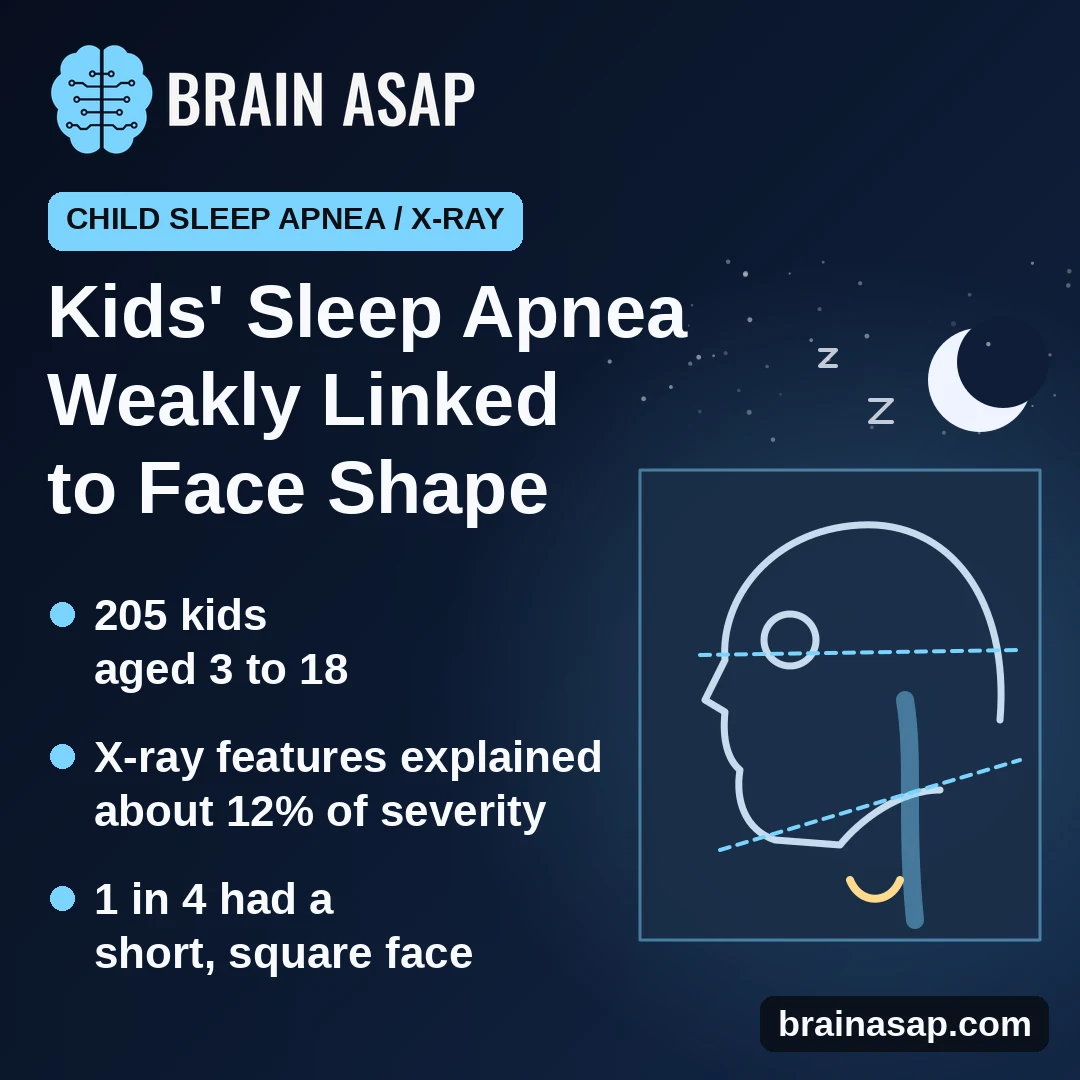
TL;DR: In 205 children with moderate to severe sleep apnea, two features on a side X-ray of the face, the jaw angle and the position of a small neck bone, were linked to how bad their apnea was, but together they explained only about 12% of the difference between kids. About 1 in 4 children had a short, square face rather than the long face often linked to childhood sleep apnea.
Key Findings
- 205 kids aged 3 to 18: All had sleep apnea serious enough for treatment.
- Two X-ray features mattered: Flatter jaw angle and a lower-sitting neck bone went with worse apnea.
- Weak link overall: Together they explained about 12% of the variation in severity.
- Not just long faces: 27% had short, square faces; 32% had long faces.
- Throat sound test: Throat size was similar in moderate and severe cases.
Source: Nature and Science of Sleep (2026) | Bokov et al.
Children with sleep apnea stop breathing or breathe shallowly many times a night, which can affect behavior, learning and growth. Treatment options range from removing tonsils to CPAP masks, orthodontic devices and mouth-and-tongue exercises. Picking the right one means understanding why a particular child's airway collapses.
European guidelines say two tests may help: a side X-ray of the skull and face, and a sound-wave scan of the throat. A team at Robert Debré children's hospital in Paris checked how well those tests track apnea severity.
205 Children Referred for Treatment
Over five years, the clinic enrolled 205 children and teens, average age 11. All had at least 5 breathing pauses or dips per hour of sleep on an overnight sleep study, the usual threshold for treatment. They fell into three common types:
- Enlarged tonsils and adenoids: 55 children
- Obesity: 80
- Syndromes or other conditions: 70, including 25 with Down syndrome
On the same day, each child saw an orthodontist, an ear-nose-throat doctor and a sleep specialist. They had a side skull X-ray to measure face and jaw angles, plus acoustic pharyngometry, a painless test that bounces sound waves down the throat to estimate its size and floppiness.
Jaw Angle and a Small Neck Bone Tracked Severity
After accounting for age, weight and other measures, two X-ray features stood out:
- Jaw angle: A flatter lower jaw went with worse apnea, about 0.5 more breathing events per hour for each degree flatter.
- Hyoid bone position: This small U-shaped bone in the neck anchors the tongue. Each millimeter lower went with about 0.5 more events per hour.
Children with severe apnea had the hyoid bone sitting lower on average, about 16 mm below the jaw line versus 12 mm with moderate apnea. Results barely changed when children with syndromes were left out.
Still, the two features explained only about 12% of the spread in apnea severity. Most of what makes one child's apnea worse than another's lies elsewhere.
Short, Square Faces Were Common Too
The classic picture of a child with sleep apnea is a long face with an open mouth, often from mouth breathing and big adenoids. Orthodontists call this hyperdivergent. In this group, that pattern was far from universal.
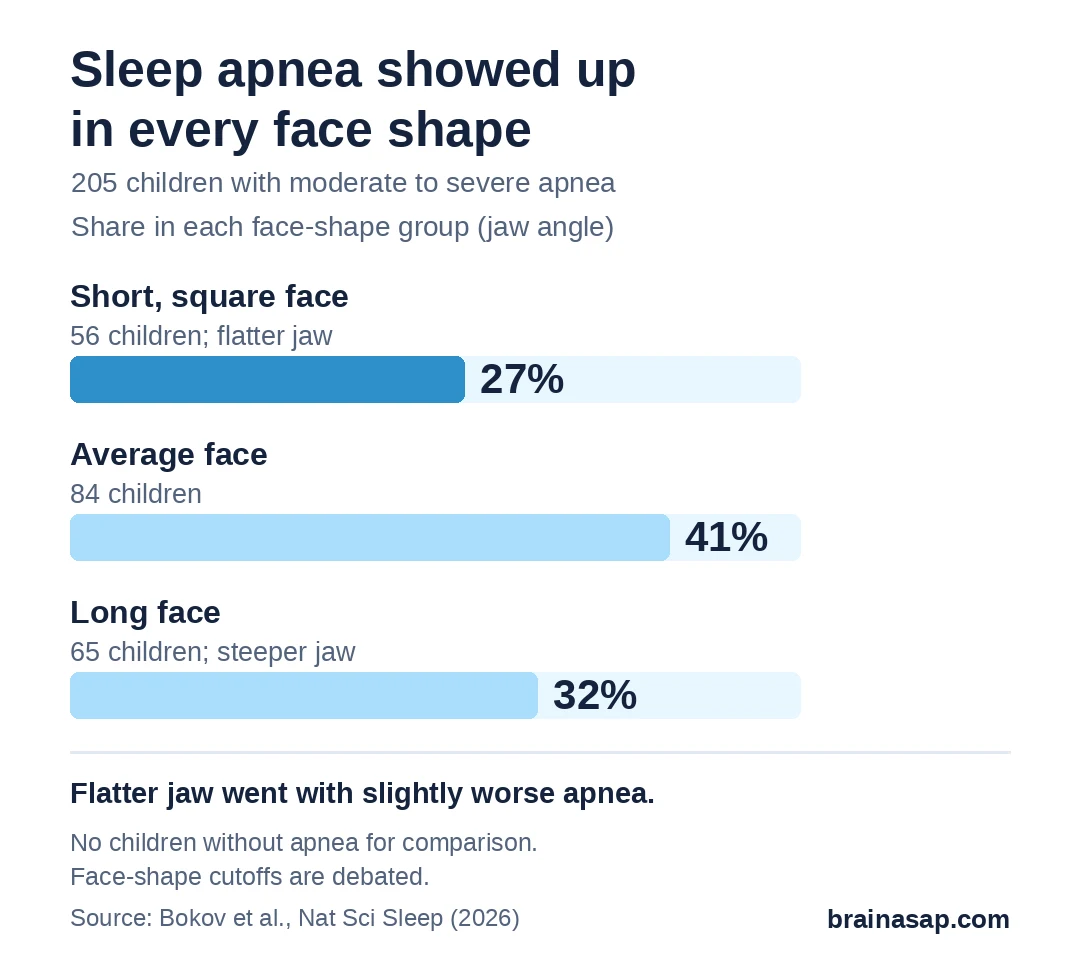
Children with long faces were younger and less overweight. Those with short, square faces had narrower throats at the back of the mouth. The authors suggest that obesity may push facial growth toward the shorter pattern, which could be one way extra weight raises apnea risk.
Throat Size Didn't Separate Moderate From Severe
The sound-wave throat test gave similar throat volumes in moderate and severe cases, about 18 cubic centimeters in both. Throat size tracked height more than anything else. The authors see the test as useful for describing a child's airway, for example spotting a floppy throat that might suit tongue exercises, rather than for grading severity.
A Snapshot Without Healthy Comparisons
- No follow-up: Whether treatments chosen from these tests worked wasn't studied.
- Only apnea patients: No children without apnea for comparison.
- Weak correlations: Most face measures had correlations around 0.2.
- Mixed group: Too few children per apnea type to analyze each separately.
- Debated cutoffs: Face-shape thresholds vary between experts.
Face X-Rays May Help Pick Treatments, Not Predict Severity
For parents, the main point is that a child's face shape says little about how severe their sleep apnea is, and apnea can show up in long and short faces alike. An overnight sleep study is still what measures severity. Face X-rays and throat tests may still help match a child to an orthodontic device or exercise therapy. Whether that matching leads to better results is the question the next study needs to answer.
Citation: DOI: 10.2147/NSS.S628495. Bokov P, Dudoignon B, Baydoun A, Dahan J, Amat P, Sghaier F, Boujemla I, Bonnet AL, Delclaux C. Utility of Cephalometry and Acoustic Pharyngometry for the Assessment of Moderate to Severe Obstructive Sleep Apnea Before Treatment in Childhood. Nat Sci Sleep. 2026;18:628495.
Study Design: Prospective observational cross-sectional study of consecutive referred children.
Sample Size: 205 children aged 3 to 18 (77 moderate, 128 severe OSA).
Key Statistic: FMA (-0.458 per degree) and hyoid distance (+0.567 per mm) independently linked to obstructive AHI; adjusted r² = 0.12.
Caveat: Cross-sectional, single center, no non-OSA comparison group; weak correlations.